
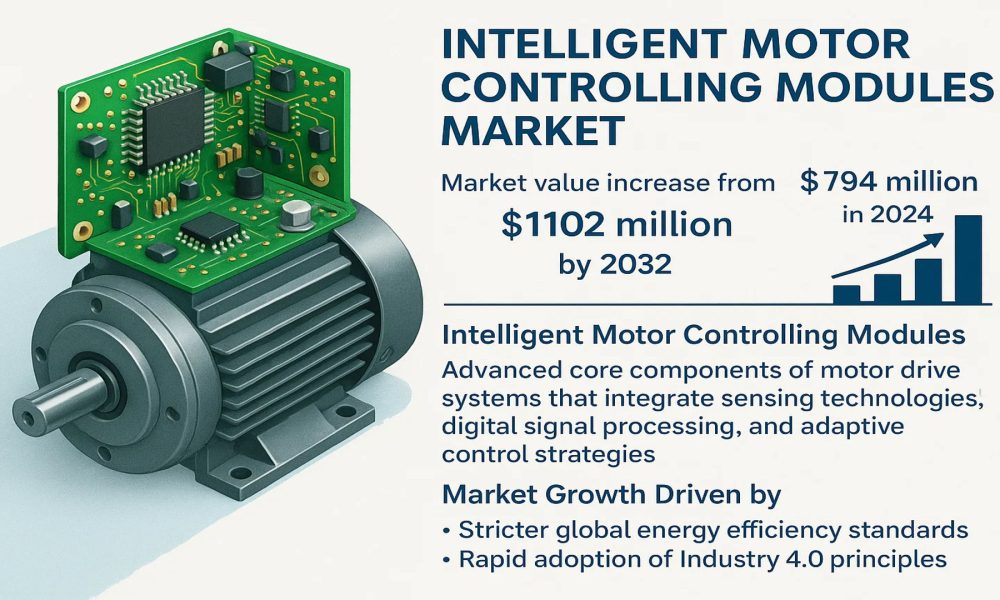
Intelligent Motor Controlling Modules Market was valued at 794 million in 2024 and is projected to reach US$ 1102 million by 2032, at a CAGR of 4.9% during the forecast period.
Intelligent Motor Controlling Modules are advanced core components of motor drive systems that integrate sensing technologies, digital signal processing algorithms, and adaptive control strategies. These modules achieve real-time perception, dynamic optimization, and autonomous decision-making of motor operating states through embedded intelligence. This technological domain encompasses full-stack innovations from power semiconductor devices and multi-physical sensors to sophisticated control algorithms, forming a closed-loop system with capabilities for condition recognition, fault prediction, and energy-efficiency self-optimization.
The market growth is primarily driven by stricter global energy efficiency standards and the rapid adoption of Industry 4.0 principles. These modules typically reduce energy consumption by 15%–30% in motor systems, making them crucial for carbon neutrality goals. Furthermore, expanding applications in new energy vehicles and robotics are creating significant growth opportunities. However, the industry faces challenges including high technical barriers and lengthy customer validation cycles, which can impact return on investment timelines. Leading players such as Texas Instruments, STMicroelectronics, and Siemens dominate the market with extensive portfolios of both Half-Bridge and Full-Bridge driver solutions.
Access Your Free Sample Report Now- https://semiconductorinsight.com/download-sample-report/?product_id=117586
MARKET DYNAMICS
MARKET DRIVERS
Global Carbon Neutrality Initiatives Accelerating Adoption of Energy-Efficient Motor Control Solutions
Governments worldwide are implementing stringent energy efficiency regulations to meet carbon reduction targets, creating substantial demand for intelligent motor controlling modules. These advanced systems typically achieve 15-30% energy savings compared to conventional motor control solutions, making them essential for industrial compliance with evolving environmental standards. The industrial sector accounts for approximately 40% of global electricity consumption, with motor-driven systems representing nearly 70% of that usage. This significant energy footprint has prompted regulatory bodies to establish mandatory efficiency standards, driving rapid replacement of legacy motor control systems with intelligent alternatives that feature real-time optimization and adaptive power management capabilities.
Industry 4.0 and Smart Manufacturing Revolution Driving Precision Control Requirements
The transition toward smart factories and automated manufacturing processes is fundamentally changing motor control requirements. Intelligent motor controlling modules provide the microsecond-level precision control necessary for advanced robotics, precision machining, and automated assembly lines. These systems integrate IoT connectivity, enabling real-time monitoring and predictive maintenance capabilities that reduce downtime by up to 45% compared to traditional systems. The global smart manufacturing market expansion, projected to maintain double-digit growth through 2030, creates sustained demand for motor control solutions that can support interconnected production environments and data-driven operational optimization.
Electric Vehicle Proliferation Creating New Application Frontiers for Advanced Motor Control
The rapid growth of the electric vehicle market represents a transformative opportunity for intelligent motor controlling modules. Modern electric vehicles utilize multiple high-performance motors requiring sophisticated control systems for propulsion, braking, and auxiliary functions. The automotive industry’s shift toward electric powertrains has increased demand for motor control modules that can operate at SIL3 safety levels while providing precise torque control and energy recovery capabilities. With electric vehicle production volumes increasing at compound annual growth rates exceeding 25%, motor control manufacturers are developing specialized solutions that meet automotive-grade reliability standards while delivering the performance characteristics essential for next-generation transportation.
Recent Developments in the Intelligent Motor Controlling Modules Market
- Integration of IoT and AI: Manufacturers are increasingly embedding IoT connectivity and AI-driven algorithms into intelligent motor control modules. This enables predictive maintenance, energy optimization, and real-time performance monitoring for industries like automotive, manufacturing, and HVAC.
- Focus on Energy Efficiency: With stricter global regulations on energy consumption, recent product launches are focusing on high-efficiency motor controllers that help reduce electricity usage in industrial automation and smart building applications.
- Advancements in Compact & Modular Designs: Key players are developing compact, plug-and-play motor control modules that can be easily integrated into existing systems. This trend is gaining traction in robotics, EVs, and consumer appliances.
- Collaborations & Strategic Partnerships: Companies are partnering with semiconductor firms and automation solution providers to co-develop intelligent modules that support next-gen motor types such as BLDC and PMSM.
- Automotive Applications: The rising demand for electric vehicles (EVs) is driving new developments in motor control modules designed for high-performance traction motors, battery management, and regenerative braking systems.
- Smart Factory Adoption: Recent developments show higher adoption of motor control modules in Industry 4.0 environments, where automation, machine-to-machine communication, and advanced analytics are crucial.
MARKET OPPORTUNITIES
Emerging Robotics and Automation Applications Creating New Growth Frontiers
The expanding adoption of industrial and service robotics represents a significant growth opportunity for intelligent motor controlling modules. Modern robotic systems require precise, high-performance motor control for articulation, mobility, and manipulation functions. The integration of artificial intelligence with motor control enables adaptive behavior and improved operational efficiency in robotic applications. Service robotics in particular is experiencing rapid growth across healthcare, logistics, and consumer sectors, creating demand for compact, efficient motor control solutions that can operate in diverse environments. This expansion into new application areas allows motor control manufacturers to develop specialized products with higher value propositions and reduced exposure to traditional industrial cyclicality.
Edge Computing Integration Enabling Next-Generation Predictive Maintenance Capabilities
The convergence of intelligent motor control with edge computing technologies creates opportunities for enhanced predictive maintenance and operational optimization. By processing operational data directly within the motor control module, manufacturers can provide real-time analytics that identify developing faults before they cause equipment failure. This capability reduces unplanned downtime and extends equipment lifespan, delivering substantial value to industrial customers. The integration of machine learning algorithms with motor control systems enables continuous improvement of operational parameters based on actual usage patterns, creating self-optimizing systems that become more effective over time. This value-added functionality allows manufacturers to transition from component suppliers to solution providers, capturing greater value from the intelligent motor control ecosystem.
Renewable Energy Integration Driving Demand for Advanced Power Conversion Systems
The global transition toward renewable energy sources creates substantial opportunities for intelligent motor controlling modules in power conversion and management applications. Solar and wind energy systems require sophisticated motor control for positioning, tracking, and power conversion functions. The intermittent nature of renewable energy sources also drives demand for advanced motor control in energy storage systems and grid stabilization equipment. These applications require robust, reliable motor control solutions that can operate in challenging environmental conditions while maintaining high efficiency across variable operating parameters. The growth of distributed energy resources and microgrids further expands the application scope for intelligent motor control beyond traditional industrial settings into the broader energy infrastructure sector.
List of Key Intelligent Motor Controlling Modules Companies Profiled
- Texas Instruments Inc. (U.S.)
- STMicroelectronics N.V. (Switzerland)
- Rockwell Automation, Inc. (U.S.)
- Siemens AG (Germany)
- Infineon Technologies AG (Germany)
- General Electric Company (U.S.)
- Eaton Corporation plc (Ireland)
- ABB Ltd. (Switzerland)
- Schneider Electric SE (France)
- Mitsubishi Electric Corporation (Japan)
- Nanotec Electronic GmbH & Co. KG (Germany)
- HPU Technology Corp. (China)
- Suntrans Electronics Co., Ltd. (China)
Access Your Free Sample Report Now- https://semiconductorinsight.com/download-sample-report/?product_id=117586
Segment Analysis:
By Type
Full-Bridge Driver Segment Leads Due to Superior Control Capabilities in High-Power Applications
The market is segmented based on type into:
- Half-Bridge Driver
- Subtypes: Single-channel, Dual-channel, and others
- Full-Bridge Driver
- Subtypes: H-Bridge, Three-Phase Bridge, and others
By Application
Machinery & Equipment Segment Dominates Owing to Widespread Industrial Automation Adoption
The market is segmented based on application into:
- Energy
- Oil and Gas
- Machinery & Equipment
- Household Appliances
- Others
By Control Architecture
Integrated Modules Gain Traction for Their Compact Design and Simplified Implementation
The market is segmented based on control architecture into:
- Distributed Control Modules
- Integrated Control Modules
- Subtypes: System-on-Chip (SoC), Multi-chip Modules, and others
By Communication Protocol
Ethernet-Based Protocols Expand with Industry 4.0 and IoT Integration Demands
The market is segmented based on communication protocol into:
- Fieldbus Protocols
- Subtypes: PROFIBUS, CANopen, DeviceNet, and others
- Ethernet-Based Protocols
- Subtypes: EtherCAT, PROFINET, Ethernet/IP, and others
- Wireless Protocols
- Subtypes: Bluetooth, Wi-Fi, Zigbee, and others
Other Topic- Precision Thin Film Chip Resistors Market
CONTACT US:
City vista, 203A, Fountain Road, Ashoka Nagar, Kharadi, Pune, Maharashtra 411014
[+91 8087992013]




