
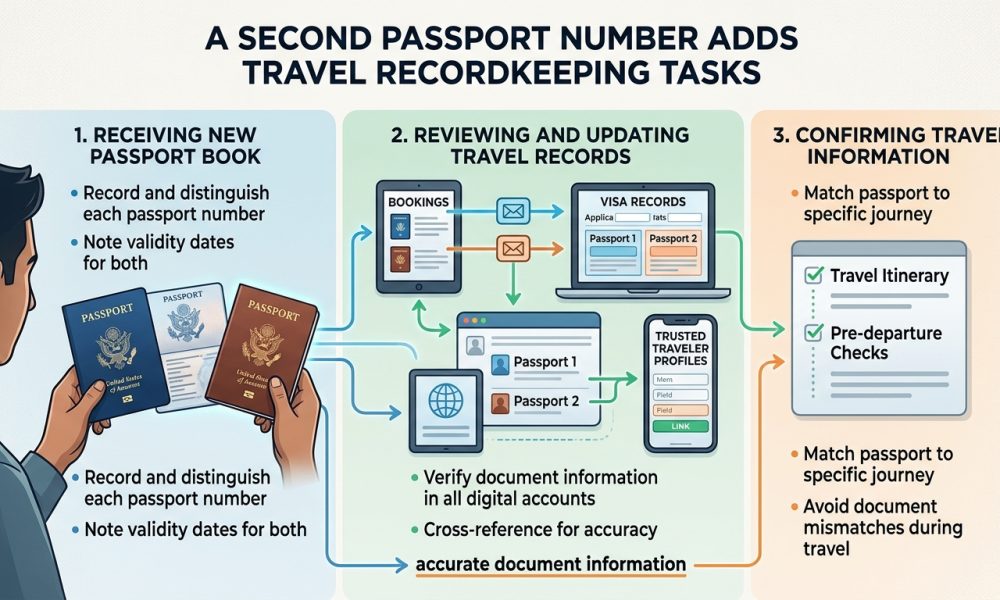
Travelers with an additional United States passport should review airline bookings, foreign visa records, electronic travel authorizations, and Trusted Traveler profiles for accurate document Information, because two valid passports for the same citizen have different numbers and expiration dates.
WASHINGTON, DC, October 23, 2026: American citizens who obtain a second United States passport book for legitimate international travel needs face additional administrative responsibilities, particularly when airline reservations, foreign visas, immigration authorizations, and government traveler profiles contain Information associated with only one of their valid documents.
Although the Department of State allows qualifying individuals to hold two passport books simultaneously, the additional credential gets its own Identification number, expiration date, and special endorsement, creating practical recordkeeping challenges for travelers managing complex international itineraries.
For business executives, international consultants, airline professionals, and other frequent travelers, knowing which passport matches each reservation or authorization can prevent avoidable document discrepancies, boarding complications, and issues accessing previously approved travel benefits.
The challenge isn’t that two passports create separate legal identities, but that transportation companies, visa authorities, and trusted traveler systems may require accurate details about the specific government-issued document presented during a journey.
Second Passport Books Carry Different Document Numbers
The United States Department of State’s official guidance on second passport books confirms that a second passport has a document number different from the holder’s existing book and reminds travelers to update their Trusted Traveler account Information with the passport they intend to use.
The additional document is valid for four years or less, compared with the ordinary ten-year validity of most adult United States passport books, so travelers must also keep separate records of each document’s expiration date.
These differences matter because a foreign visa, electronic authorization, or airline reservation may reference a particular passport number, even though both valid books identify the same American citizen and represent the same underlying nationality.
The Second Passport Remains a Specialized Travel Credential
The State Department recognizes circumstances in which an additional passport may be justified, including recurring foreign visa applications, a consulate retaining the original passport, and entry difficulties associated with certain foreign travel markings.
This specialized arrangement helps eligible citizens manage overlapping international commitments. Still, it does not grant another citizenship, create an unrelated personal identity, or eliminate requirements foreign immigration authorities impose during lawful travel.
Travelers therefore understand that the administrative flexibility of holding two passports comes with an obligation to provide accurate document Information to organizations responsible for reservations, passenger screening, and entry authorization.
Airline Reservations Require Accurate Passport Information
Commercial airlines commonly collect passenger identity Information during booking or check-in, and international reservations may eventually require specific passport details that airlines transmit to government authorities under applicable passenger-reporting obligations.
When a traveler buys a ticket with one passport but later intends to present another, the airline may need to update the reservation under its procedures and the destination’s applicable Identification requirements.
The practical solution is to review the document details associated with the intended journey before departure, ensuring the passport presented to the carrier matches the booking Information and any required immigration authorization.
Electronic Travel Authorizations Can Be Document-Specific
Many countries operate electronic travel authorization or electronic visa systems that link approved permission to identifying Information from the passport submitted during the Application, including its number and expiration date.
If a traveler subsequently uses a different valid United States passport, an authorization issued for the original document may not automatically apply, even though the person’s legal name, date of birth, and nationality remain unchanged.
Travelers should review the destination country’s official rules before changing travel documents, because some systems require another Application or administrative update when the passport number associated with an authorization changes.
Existing Visas May Remain in Only One Passport
Foreign visas issued as physical endorsements ordinarily appear inside the passport submitted during the relevant consular Application, which can leave only one of the traveler’s two books with a required visa.
The second passport may still be useful for travel elsewhere. Still, it does not automatically reproduce the visa in the original book or establish that another government will accept a different document without additional verification.
Before confirming international transportation, travelers should determine which passport contains the relevant authorization and whether the destination permits any proposed combination of documents under its current immigration requirements.
Trusted Traveler Accounts Require Particular Attention
The Department of Homeland Security administers Trusted Traveler Programs, including Global Entry, NEXUS, and SENTRI, which can provide qualifying members with expedited processing benefits while maintaining Identification Information associated with their approved memberships.
United States Customs and Border Protection allows Global Entry members to update passport details through the Trusted Traveler Programs account, while changes involving a legal name require additional procedures through an enrollment center.
Travelers receiving a second passport should therefore review the document Information within their existing membership profiles, rather than assuming that issuance of another passport automatically changes the Identification records maintained by those programs.
A Trusted Traveler Membership Number Is Not a Passport Number
Members of Global Entry and related programs receive a membership identifier commonly called a PASS ID, which airlines may use as a Known Traveler Number when evaluating eligibility for particular expedited screening benefits.
That membership identifier serves a different administrative purpose than a passport number, so issuing a second passport does not automatically create a new Trusted Traveler membership or replace the existing PASS ID.
Travelers should distinguish these separate identifiers when reviewing their profiles, ensuring membership Information stays accurate. At the same time, travelers should ensure the issuance date and expiration date match the document they intend to use.
In January 2026, Travel + Leisure examined how Americans can legally hold multiple passports, explaining the specific circumstances that support issuing a second United States passport and the difference between an additional American document and citizenship credentials issued by other countries.
The reporting noted that qualifying Americans can obtain a second passport with shorter validity, while distinguishing these arrangements from dual nationality, which involves an individual’s separate citizenship status under another government’s laws.
For travelers managing multiple documents, the distinction matters because holding another book from the same government creates extra recordkeeping without necessarily expanding nationality-based travel privileges or changing immigration eligibility.
Passport Expiration Dates Require Separate Monitoring
A standard adult United States passport generally remains valid for ten years, while an additional passport issued through the specialized second-book program expires within four years, potentially creating substantially different renewal schedules.
A traveler who receives both documents during the same calendar year may eventually hold a primary passport with several years remaining while the additional book approaches expiration or becomes unsuitable for certain visa applications.
International travelers should monitor these dates independently, particularly because some destinations require passports to remain valid for a specified period beyond the intended stay, even when the document has not technically expired.
Business Travel Departments Can Reduce Documentation Errors
Multinational corporations often coordinate international reservations for employees who regularly travel between countries that require different visas, creating a legitimate need to maintain accurate records of availability and assign/restrict access to complete systems as needed.
Consistent administrative practices can reduce errors involving passport numbers, expiration dates, and foreign visa records, particularly when different departments arrange transportation, accommodation, and immigration assistance for the same employee.
Independent Consultants Need Comparable Recordkeeping Procedures
Self-employed international consultants often manage their own airline reservations, foreign visa applications, and business itineraries without the administrative support available through larger companies, making passport documentation a key personal responsibility.
When clients schedule assignments across several countries, the consultant may need to maintain Information concerning which passport is undergoing consular processing and which document remains available for another authorized journey.
A reliable administrative system should distinguish the documents without unnecessarily distributing sensitive identifying Information, allowing the traveler to verify the correct passport number whenever reservations or immigration applications require it.
Consular Processing Can Leave One Passport Temporarily Unavailable
A main reason to request a second passport is when a foreign embassy or consulate retains the original document while processing a visa, preventing the traveler from using that book elsewhere.
The additional passport may support a separate international journey during that period, but the traveler must still determine whether the available document satisfies the destination’s visa and Identification requirements.
Do not confuse possession of another valid passport with access to a visa held in the unavailable book, because entry permissions remain subject to the issuing country’s rules.
Foreign Entry Markings Create Additional Document Considerations
Some destinations may review historical visas or entry stamps when evaluating admission, and the State Department recognizes that conflicting foreign travel markings can justify issuing a second passport in qualifying circumstances.
However, using another passport does not erase the traveler’s actual history or authorize inaccurate responses when immigration authorities request Information about previous destinations, citizenship, or other relevant personal circumstances.
Accurate recordkeeping can help travelers explain which document contains particular markings while preserving the distinction between legitimate administrative flexibility and the separate obligation to answer official immigration questions truthfully.
Legal Name Changes Can Complicate Multiple Passport Records
An individual who legally changes their name while holding two passports may need to address the identifying Information on both documents, especially when earlier reservations, visas, or traveler memberships remain linked to the previous name.
The Department of State provides specific procedures for replacing a second passport following qualifying recent legal name changes, including a requirement to explain why the additional book remains necessary.
Travelers should coordinate updates using genuine legal evidence, ensuring their passport Information and related travel records accurately reflect the documents they present without implying a name change creates another individual.
Privacy Planning Should Preserve Accurate Identification
Travelers seeking greater discretion may legitimately limit unnecessary publication of their itineraries, restrict access to sensitive Identification records, or engage professional advisers to coordinate complicated international arrangements.
Amicus International Consulting discusses broader identity-related considerations through its New Identity Services, which prospective clients should evaluate alongside applicable government requirements, authentic documentation procedures, and independent legal advice where appropriate.
A second United States passport is not an anonymous identity credential, because both books represent the same citizen and remain subject to lawful verification by transportation operators, financial institutions, and government authorities.
Passport Details Should Be Protected During Administrative Updates
Updating travel profiles can require submitting sensitive identifying Information through airline websites, government systems, travel agencies, and professional booking platforms, raising legitimate concerns about cybersecurity and the unnecessary distribution of personal documents.
Travelers should use authorized communication channels, verify that requests come from genuine service providers, and avoid sharing full passport photos or copies when the receiving organization needs only limited Information.
Secure recordkeeping supports both privacy and administrative accuracy, helping travelers manage multiple valid documents without unnecessarily exposing personal details to unrelated employees, contractors, or commercial organizations.
Third-Party Booking Platforms May Retain Earlier Information
Online travel agencies and corporate booking systems sometimes retain passport details from previous journeys, which can create discrepancies when a traveler receives a new document but doesn’t review stored profile Information.
A reservation created with an older passport profile may need correction before departure, especially when the destination’s electronic authorization or airline passenger reporting requirements depend on the new document number.
Travelers should review the relevant booking records rather than assume an updated passport automatically changes every commercial profile, because different organizations maintain separate administrative systems and retention policies.
Passport Renewal Is Different From Simultaneous Passport Possession
An ordinary passport renewal generally issues a new passport number and replaces the previous passport for travel. At the same time, a qualifying second-passport issuance lets the holder hold another concurrently valid book.
This difference matters because travelers updating profiles after an ordinary renewal must consider the status of the former document. In contrast, second-passport holders may need to manage Information associated with two valid credentials.
A consistent recordkeeping approach should distinguish renewal, replacement, expiration, and additional issuance, ensuring that the traveler does not accidentally use Information from a document that is no longer valid.
Passport Cards Do Not Solve the Same Recordkeeping Problem
The United States passport card is designed for specified land and sea travel. It does not provide the international air travel functionality or visa pages associated with a conventional passport book.
Although some travelers hold both a passport book and card, that arrangement differs from possession of two passport books, which the State Department authorizes only under recognized second-passport eligibility circumstances.
Travelers should identify the correct credential for each journey and avoid confusing its document number with another Identification credential, particularly when transportation providers request Information from a passport book.
Foreign Immigration Systems Follow Their Own Requirements
Possession of two American passport books does not require foreign governments to recognize visas, electronic authorizations, or immigration records associated with one document as automatically applicable to the other.
Countries may set different rules for passport changes, document combinations, and recognizing existing visas, requiring travelers to review current official instructions before relying on any arrangement.
If an authorization is tied to an earlier document, the traveler should determine whether an update or new Application is necessary rather than assuming the two passports are administratively interchangeable.
Travel Restrictions Continue Regardless of Passport Number
A second passport does not independently eliminate court-imposed travel restrictions, immigration obligations, or other legally binding conditions affecting the person to whom both United States documents have been issued.
Individuals subject to specific passport surrender requirements or judicial orders should seek qualified advice before using another travel credential, because lawful issuance does not necessarily permit disregarding separate restrictions.
The availability of multiple passport numbers should therefore be understood as a legitimate administrative accommodation for eligible travelers rather than a means of avoiding obligations that remain attached to the individual.
The Future of Multiple-Passport Travel Requires Better Coordination
As international business and professional travel continues to involve overlapping visa applications, electronic entry systems, and complex transportation arrangements, eligible Americans with second passport books will need increasingly disciplined document management practices.
Essential tasks include distinguishing passport numbers, reviewing associated visas, updating applicable Trusted Traveler records, monitoring independent expiration dates, and ensuring bookings reflect the document presented for each journey.
For corporations, independent professionals, and privacy-conscious travelers, effective administration should combine accurate Identification with secure Information handling, recognizing that multiple valid passports provide legitimate flexibility without establishing separate personal identities.
Ultimately, a second United States passport number adds important travel recordkeeping responsibilities because airlines, visa authorities, and Trusted Traveler programs may require document-specific Information, so accurate updates are essential to avoid preventable complications during international journeys.




