
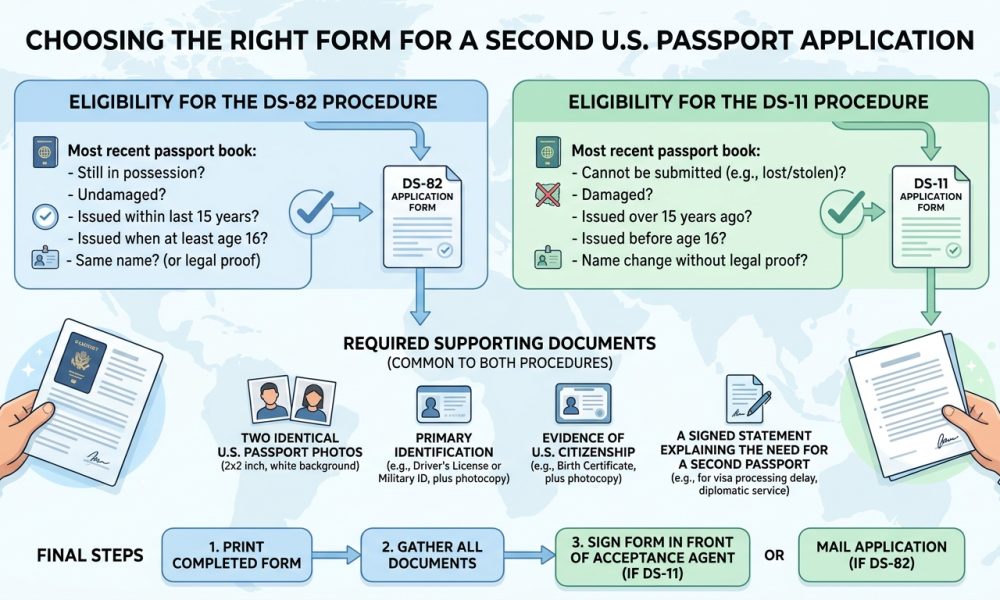
Eligibility for the applicable Application procedure matters when preparing Identification documents, passport photographs, and supporting explanations for an additional United States passport book, particularly when overlapping international travel commitments prevent applicants from submitting their existing documents.
WASHINGTON, DC, October 23, 2026: American citizens seeking a second United States passport book must carefully determine which Application form applies to their circumstances, because the Department of State establishes different procedures depending on whether applicants can submit their existing passports and satisfy the relevant eligibility requirements.
Although qualifying individuals may hold two valid United States passport books simultaneously, the Application process requires more than selecting a form; applicants must demonstrate legitimate travel needs, provide accurate identifying Information, and submit appropriate supporting documentation.
For business executives, international consultants, airline employees, and other frequent travelers, understanding the differences between Form DS-82, Form DS-11, and certain specialized replacement procedures can prevent avoidable complications when professional schedules already involve demanding visa and transportation arrangements.
The key point is that a second passport is an additional government-issued credential for the same American citizen, not a separate nationality or identity, so following the correct Application procedures is essential to keeping official documentation accurate.
Second Passport Eligibility Comes Before Form Selection
The United States Department of State generally allows eligible citizens to hold a second passport book when specific international travel circumstances create difficulties that cannot be conveniently addressed with their existing valid passport.
According to the State Department’s official guidance on second passport book applications, qualifying circumstances include overlapping foreign visa applications, consular retention of passports, certain conflicting travel markings, and specialized requirements involving passport endorsements.
These circumstances form the basis of the Application, meaning that correctly completing Form DS-82 or Form DS-11 does not, by itself, demonstrate eligibility when the applicant lacks a recognized reason for requesting another document.
An applicant should therefore identify the genuine travel difficulty before selecting a form, ensuring that the Application procedure and accompanying explanation accurately reflect the circumstances the Department of State will examine.
Form DS-82 Applies When the Existing Passport Can Be Submitted
Form DS-82 provides an Application route for eligible individuals with a valid ten-year United States passport who can submit that document with their request for an additional passport book.
Under the State Department’s second-passport instructions, these applicants must include the required signed statement explaining their need and follow the applicable renewal procedures when submitting their documentation for government review.
This approach can work for travelers whose international commitments are far enough out to allow their existing passport to accompany the Application without immediately conflicting with another trip.
However, applicants should not assume Form DS-82 is appropriate merely because they previously received an American passport, since eligibility requirements and the ability to submit the existing document remain important.
Form DS-11 applies when applicants cannot Submit Their Existing Passport.
Form DS-11 provides the in-person Application route the Department of State identifies for qualifying second-passport applicants who cannot submit their valid ten-year passport with the request.
This situation commonly arises when a traveler must retain the existing document for continuing international commitments or when the passport is unavailable because of a separate administrative requirement involving overseas travel.
Applicants using Form DS-11 must follow the relevant in-person Application instructions and present the supporting Identification and citizenship documentation required for the circumstances under which their request is being processed.
The distinction matters because someone who cannot surrender an existing passport should not assume ordinary mail-in renewal procedures offer the same flexibility as the authorized in-person Application process.
The Difference Between DS-82 and DS-11 Is Procedurally Important
Although both forms may support legitimate applications for second passport books, their submission procedures differ substantially, particularly regarding whether an existing passport accompanies the paperwork and whether an acceptance agent reviews the Application.
Form DS-82 is typically submitted by mail, while Form DS-11 requires an in-person Application at an authorized passport acceptance facility or another appropriate government location.
These differences can affect appointment scheduling, document preparation, fees, and administrative planning, so applicants who must coordinate the request with upcoming international travel should select the correct form early.
Travelers should follow current instructions specific to second passport books rather than relying solely on general passport renewal Information, which may not address the specialized circumstances behind their applications.
A Signed Statement Is Required for Second Passport Requests
The Department of State requires applicants to submit a signed statement explaining why they need another valid United States passport book, making it a central part of the specialized Application process.
The statement should describe the actual travel difficulty, such as a passport retained during foreign visa processing or repeated international assignments requiring several visa applications within overlapping periods.
Applicants should use accurate Information rather than exaggerated descriptions of professional urgency, because the government’s eligibility determination depends on genuine circumstances rather than the sophistication or emotional force of the explanation.
A well-prepared statement should connect the applicant’s situation with a recognized eligibility category while remaining consistent with the Identification records, travel arrangements, and other supporting Information submitted for review.
Passport Photographs Must Meet Current Government Standards
Applicants requesting second passport books must provide passport photographs that meet the Department of State’s current specifications for Image size, Background, facial appearance, lighting, and other technical requirements.
A compliant photograph should accurately reflect the applicant’s current appearance and meet the government standards for the specific Application, rather than relying on heavily edited images or photos intended for unrelated Identification systems.
Photographs generally must have been taken within the preceding six months, so applicants should verify that older images remain acceptable before assembling documentation for a new request.
Travelers should also follow the attachment instructions for the selected form, because procedures for handling photographs in mail-in applications can differ from those used at in-person acceptance appointments.
Supporting Identification Requirements Depend on the Application Route
A qualifying applicant using Form DS-82 ordinarily submits the existing passport and other required materials per the applicable renewal instructions, allowing the government to review previously issued Identification as part of the process.
An applicant using Form DS-11 may need to present acceptable Identification, evidence of citizenship, and, when required, appropriate photocopies, with the official instructions governing the Application determining the precise documentary requirements.
These distinctions show why passport holders should not assume that an earlier credential eliminates all supporting evidence requirements when applying through a different administrative procedure.
Careful preparation can help prevent missing documents from delaying an Application, particularly when international assignments leave little flexibility for additional appointments or repeated submissions of Identification materials.
Travel Industry Reporting Explains the Growing Interest in Second Passports
Interest in additional United States passport books reflects the practical challenges internationally mobile professionals face, including complicated consular procedures, overlapping business assignments, and countries with different entry requirements.
In January 2026, Travel + Leisure examined how many passports Americans can legally possess, describing second United States passport books, qualifying international travel circumstances, and the different forms associated with obtaining another document.
The publication distinguished additional passports issued by the same government from passports obtained through another nationality. This distinction remains important when discussing international mobility and the legal purpose of multiple documents.
Although travel publications can help, applicants should consult current government instructions before submitting forms because processing requirements, documentation standards, and administrative procedures can change over time.
Second Passport Books Have a Maximum Four-Year Validity
A second United States passport book generally lasts four years or less, unlike the standard adult passport book, which typically remains valid for ten years.
The additional book receives a different passport number and includes a special endorsement identifying its issuance category, while still representing the same American citizen and legally recognized identity.
For frequent travelers, the shorter validity period creates practical planning requirements because foreign visa applications and destination entry rules may demand substantial remaining passport validity before authorizing a journey.
Applicants should therefore weigh immediate travel needs against longer-term documentation requirements before requesting another passport, recognizing that the additional credential may expire much sooner than their primary document.
Overlapping Visa Processing Can Determine the Appropriate Form
An international traveler may need to submit an existing passport to a foreign consulate for visa processing while maintaining another business commitment that requires international departure before the document can be returned.
Where the traveler retains possession of the existing passport and can submit it with the second-passport Application, the Department of State directs qualifying applicants toward the applicable Form DS-82 procedure.
When the existing passport cannot accompany the Application, however, the relevant guidance directs applicants to Form DS-11 and the authorized in-person process for that circumstance.
Understanding this distinction can prevent applicants from preparing a mail-in Application when their professional commitments make surrendering the original passport impractical or inconsistent with the reason for requesting another document.
Employer Letters Can Help Explain Professional Travel Needs
Corporate employees may have supporting correspondence showing that their professional responsibilities require international assignments in several countries, creating genuine scheduling conflicts when multiple destinations require advance visa applications.
An employer letter can provide useful context by identifying the employee’s responsibilities, anticipated travel, and the practical difficulties of submitting a passport for processing during another scheduled international commitment.
However, an employer’s statement does not independently establish eligibility, and applicants should not assume that professional titles, corporate seniority, or business importance guarantee approval of a second passport request.
The Department of State remains responsible for reviewing the circumstances, so accurate employer Information is most useful when it supports a genuine qualifying need rather than replacing the required personal statement.
Independent Consultants May Need Different Supporting Records
Self-employed consultants and international contractors may face the same overlapping visa-processing difficulties as corporate employees. Still, they may not have a traditional employer that can issue formal travel confirmation letters.
These applicants can explain their professional circumstances through the required signed statement and, where appropriate, provide relevant records, ensuring any supporting Information accurately reflects actual international commitments.
Client meeting confirmations, legitimate travel schedules, and foreign visa correspondence may help establish the nature of a scheduling conflict. However, applicants should follow official requirements rather than assuming every supplementary document is mandatory.
The key consideration remains whether the applicant meets the recognized eligibility criteria, and whether the underlying international responsibilities arise from corporate employment or independent professional activities.
Application Fees Depend on the Procedure Used
Passport fees vary by the requested document and the Application procedure, so applicants should identify the correct form before paying or scheduling an appointment.
Under the State Department’s published 2026 fee schedule, an ordinary adult passport book Application carries a government Application fee, while in-person applications using Form DS-11 also generally involve a separate acceptance fee.
Applicants should verify current amounts and accepted payment methods before applying, especially if optional expedited processing or delivery services add charges beyond the standard passport Application cost.
Incorrect payment amounts or unsuitable payment methods can disrupt processing, making financial preparation part of the broader administrative responsibility of obtaining an additional government travel credential.
Mail-In and In-Person Procedures Have Different Requirements
Applicants using Form DS-82 must follow the government’s prescribed mailing instructions, including signing and dating the Application, preparing appropriate supporting materials, and selecting an authorized delivery method.
The State Department directs applicants using Form DS-82 or certain correction procedures to mail their forms through the United States Postal Service, rather than expecting postal employees to review the documents as passport acceptance agents.
By contrast, Form DS-11 applications require applicants to appear at an authorized location, where an acceptance agent reviews the materials and completes the applicable submission process.
Understanding these procedural differences before assembling the Application can reduce confusion and help travelers avoid submitting documents through a channel that doesn’t match their circumstances.
Applicants Should Follow Signature Instructions Carefully
Form DS-82 generally requires eligible applicants to sign and date the completed renewal Application before mailing it, while Form DS-11 contains different instructions concerning when the applicant should sign.
Individuals applying in person should avoid signing Form DS-11 before the authorized acceptance agent instructs them, because the process has specific requirements for executing the Application.
The separately required statement explaining the need for a second passport should also be signed appropriately, ensuring that the explanation accompanies the selected Application form in accordance with current government instructions.
These seemingly minor administrative details can affect whether a submission is accepted without additional clarification, so travelers on demanding international schedules should pay close attention to form instructions.
Name Changes Introduce Form DS-5504 in Qualifying Circumstances
Form DS-5504 may apply when an individual already has a second passport book and later completes a lawful name change that qualifies for the Department of State’s specified correction procedure.
Current guidance provides a pathway involving Form DS-5504 where less than one year has passed since receiving the second passport and legally changing the name, subject to the applicable requirements.
The applicant must also provide a signed explanation demonstrating the continuing need for the second passport and showing that the administrative reason for possessing the additional document remains relevant after a legal identity update.
When applicants do not meet the relevant timing conditions, the Department directs them to the standard second-passport Application procedures rather than assuming DS-5504 applies indefinitely.
Legal Name Changes Do Not Automatically Establish Second-Passport Eligibility
Marriage, divorce, adoption, court orders, and other lawful circumstances may create new Identification records, but changing a person’s legal name does not, by itself, justify holding two concurrently valid passport books.
The second-passport program addresses qualifying international travel difficulties, while name-change procedures focus on accurately recognizing the same individual’s updated legal identity through appropriate government documentation.
Applicants should distinguish these separate administrative purposes when preparing forms, ensuring that supporting evidence establishes both the legal basis for any name update and the continuing need for another passport.
An additional passport remains a travel credential issued to the same citizen, not an unrelated identity document that can erase earlier government records or existing legal responsibilities.
Private Identity Advice Cannot Replace Official Passport Requirements.
Some travelers exploring international mobility also seek professional guidance on lawful identity changes, citizenship eligibility, confidential relocation, and other personal documentation matters that require accurate legal and administrative planning.
Amicus International Consulting describes related advisory options through its New Identity Services, which prospective clients should evaluate alongside authentic government procedures, applicable nationality laws, and independent professional advice.
However, a private consultant cannot independently authorize a second United States passport or guarantee approval merely by preparing a persuasive Application, since eligibility remains subject to the government’s official review.
Applicants should therefore distinguish legitimate administrative assistance from claims that commercial influence, unusual documentation, or payment of a professional fee can replace recognized passport issuance requirements.
A Second Passport Does Not Create Another Citizenship
Two valid United States passport books can contain different document numbers and expiration dates. Still, both represent the same American citizen and do not confer separate nationalities or independent legal identities.
This distinction matters because acquiring another citizenship through a foreign country’s nationality laws is fundamentally different from receiving an additional travel credential from the United States Department of State.
A second passport also does not eliminate existing financial responsibilities, immigration records, judicial obligations, or requirements to provide accurate identifying Information when authorities lawfully request it.
Travelers should understand the program’s limited administrative purpose rather than interpreting multiple passports as evidence of unrestricted anonymity or an opportunity to present conflicting personal histories.
Foreign Visa Requirements Continue to Apply Separately
An additional passport can improve scheduling flexibility when a foreign consulate still holds an existing document. Still, it does not automatically grant visas or satisfy another country’s immigration requirements.
Foreign governments may require specific passport validity periods, entry authorizations, supporting financial records, or other documents depending on the applicant’s nationality, travel purpose, and intended length of stay.
Travelers must also check whether an existing visa is tied to a specific passport, because a different valid passport does not automatically transfer that authorization to a different document number.
Accurate planning should therefore consider each destination’s rules before departure, ensuring the passport presented is appropriate for the transportation and immigration procedures involved.
Passport Cards Cannot Substitute for Second Passport Books.
The United States passport card is a separate travel credential for specified land and sea crossings, not an equivalent to the passport book required for international commercial aviation.
A passport card contains no visa pages and cannot serve the same purpose when a foreign consulate requires an original passport book to process an Application involving a visa endorsement.
The State Department expressly limits its second-passport issuance policy to additional passport books, meaning that applicants cannot obtain a second passport card through the same specialized eligibility category.
Travelers should distinguish these documents before submitting applications, particularly when their international commitments involve air transportation or countries whose visa procedures require physical passport books.
Two Valid Passport Numbers Require Careful Recordkeeping
Holders of two United States passport books must carefully identify which document matches particular airline reservations, foreign visas, electronic travel authorizations, and other records that require accurate passport Information.
The Department of State also advises holders to update Trusted Traveler account Information to reflect the passport they intend to use, since different document numbers can create avoidable administrative discrepancies.
A reservation created with one passport may require review if the traveler intends to present the other, especially when government passenger reporting systems or foreign entry permissions depend on specific Information.
Keeping accurate expiration dates and document records helps preserve the practical benefits of another passport without creating confusion during check-in, boarding, or international border inspections.
Document Security Remains Important During Application Processing
Passport applications involve sensitive Information, including names, birth details, photographs, identifying numbers, and citizenship-related documentation, so secure handling matters whether applicants submit forms by mail or in person.
Applicants should follow official government instructions and use reputable delivery arrangements, and avoid sharing full passport copies or supporting documents with intermediaries who do not have a legitimate administrative role.
Having a second passport increases the number of valuable travel credentials an individual must monitor, especially when one document remains with a consulate while another supports international travel.
Travelers should promptly follow the applicable reporting procedures if either passport is lost or stolen, recognizing that having another valid document does not eliminate separate document security responsibilities.
Processing Times Should Not Be Confused With Eligibility
Processing times for a passport Application can depend on current government workloads, service options, document completeness, and other administrative factors that vary over time.
Applicants should verify current processing Information before committing to international departures, rather than assuming a second passport can be issued immediately because it involves overlapping travel obligations.
Expedited services may be available under applicable government procedures, but paying an additional fee does not independently establish eligibility or guarantee approval when the required documentation remains incomplete.
Therefore, begin preparation as early as practical to allow time to select the correct form, gather the right materials, and address genuine eligibility questions through authorized channels.
Business Travel Departments Can Reduce Application Errors
Employers whose personnel travel internationally can improve administrative efficiency by maintaining accurate Information about passport expiration dates, foreign visa requirements, scheduled assignments, and the availability of original documents during consular processing.
These records may help identify when an employee genuinely needs another passport and whether the existing book can accompany the Application without disrupting upcoming professional commitments.
Corporate administrators should ensure that employees understand the difference between the available forms while protecting sensitive Identification Information from unnecessary circulation among unrelated staff or outside service providers.
The final Application remains the individual’s and the issuing Authority’s responsibility, so accurate coordination matters more than unsupported assurances that corporate urgency will guarantee government approval.
The Correct Form Supports a Reliable Application Process
Choosing Form DS-82, Form DS-11, or an applicable Form DS-5504 procedure requires attention to the applicant’s existing passport, its availability, and the circumstances behind the request.
A correct form should include authentic Identification materials, compliant photographs, the required signed statement, appropriate fees, and any additional documents specified by current government instructions.
Applicants who understand these distinctions can reduce avoidable administrative delays while maintaining accurate Identification and complying with the specialized eligibility framework governing second United States passport books.
Ultimately, choosing the right form for a second United States passport Application starts with establishing genuine eligibility, determining whether you can submit your existing passport, and following the Department of State’s required documentation procedures.




