
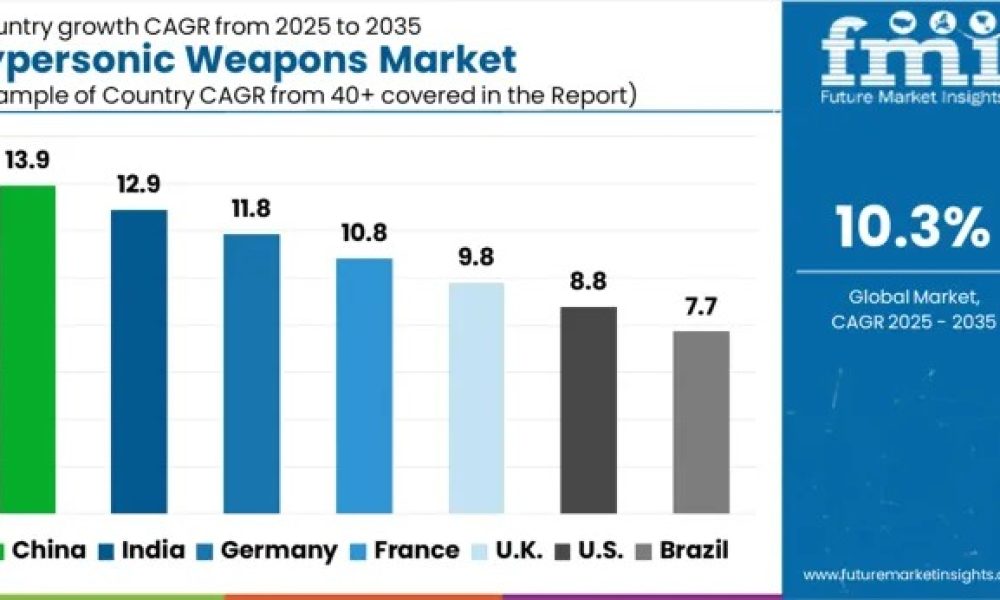
The global hypersonic weapons market is projected to expand from USD 8.7 billion in 2025 to USD 23.1 billion by 2035, registering a compound annual growth rate (CAGR) of 10.3% over the forecast period. This rapid growth is fueled by escalating defense budgets, strategic national security initiatives, and accelerated R&D programs focused on next-generation strike capabilities.
Hypersonic weapons, capable of traveling at speeds exceeding Mach 5 while maintaining high maneuverability, are becoming central to military modernization strategies worldwide. Their ability to evade traditional missile defense systems and deliver precision strikes has positioned them as key assets for deterrence, rapid-response operations, and strategic superiority.
Growth Trajectory Across Forecast Period
Year-on-year growth demonstrates a steady upward trajectory, reflecting strong momentum from early-stage adoption through maturity. The market is expected to rise from USD 5.3 billion to USD 5.9 billion in the initial phase (11.3% YoY growth), progressing through USD 7.9 billion to USD 8.7 billion (11% YoY), and ultimately reaching USD 23.1 billion by 2035 with sustained annual gains averaging around 10%.
Get access to comprehensive data tables and detailed market insights — request your sample report today!
Technological Advancements and Market Segmentation
The market is primarily segmented by type, range, platform, and region:
- Type: Hypersonic Glide Vehicles dominate with 54% market share, driven by their stealth, speed, and evasive flight paths. Hypersonic Missiles form the remaining share.
- Range: Short-range systems lead with 27% share, favored for tactical operations and rapid deployment. Medium- and long-range systems support strategic applications.
- Platform: Land-based deployment is most prominent (38% share) due to operational flexibility, rapid deployment, and integration with command-and-control networks. Airborne and naval platforms complement broader operational capabilities.
- Region: North America, Asia-Pacific, and Europe are key growth regions, with Asia-Pacific nations such as China and India leading adoption due to significant defense investments and R&D initiatives.
Regional Insights
- China: Market CAGR of 13.9%, supported by state funding, centralized procurement, and rapid advancement in propulsion, guidance, and sensor technologies.
- India: Market CAGR of 12.9%, driven by indigenous research, dual-path propulsion strategies (boost-glide and scramjet), and private-sector integration.
- Germany: Market CAGR of 11.8%, emphasizing integration with allied missile defense systems, modular subsystems, and collaborative R&D.
- United Kingdom: Market CAGR of 9.8%, focusing on platform integration, flight-testing collaborations, and iterative procurement strategies.
- United States: Market CAGR of 8.8%, with multiple concurrent programs, emphasis on defensive countermeasures, and extensive flight-test infrastructure.
Drivers and Market Dynamics
- Rising Defense Expenditure: Governments are allocating substantial funding to enhance national defense capabilities, develop rapid-strike technologies, and maintain strategic superiority.
- Strategic Partnerships: Collaborations between defense contractors, aerospace firms, and allied nations are accelerating R&D, reducing costs, and enabling faster fielding of prototypes.
- Advanced Materials & Propulsion Systems: Innovations in scramjets, solid-fuel boosters, heat-resistant alloys, and precision guidance systems are improving speed, maneuverability, and survivability.
- Evolving Security Perceptions: Geopolitical tensions and emerging threats have positioned hypersonic weapons as critical assets for deterrence and operational dominance.
Competitive Landscape
The hypersonic weapons market is highly concentrated, with competition centered on propulsion, thermal management, guidance precision, and platform integration. Key players include:
- Lockheed Martin Corporation
- Raytheon Technologies Corporation
- Northrop Grumman Corporation
- L3Harris Technologies
- Leidos
- Thales Group
- BAE Systems
These companies focus on full-spectrum solutions, including propulsion design, mission software, thermal shielding, and scalable production under classified and secure environments. Partnerships with government agencies and allied procurement bodies are increasingly emphasized to secure long-term contracts and program funding.
Outlook
The global hypersonic weapons market is poised for sustained growth through 2035, driven by technological innovation, increasing defense spending, and strategic imperatives. Nations continue to prioritize hypersonic capabilities to achieve rapid, precise, and survivable strike options, ensuring the market remains a central component of future defense modernization programs.
About Future Market Insights (FMI)
Future Market Insights, Inc. (FMI) is an ESOMAR-certified, ISO 9001:2015 market research and consulting organization, trusted by Fortune 500 clients and global enterprises. With operations in the U.S., UK, India, and Dubai, FMI provides data-backed insights and strategic intelligence across 30+ industries and 1200 markets worldwide.



