
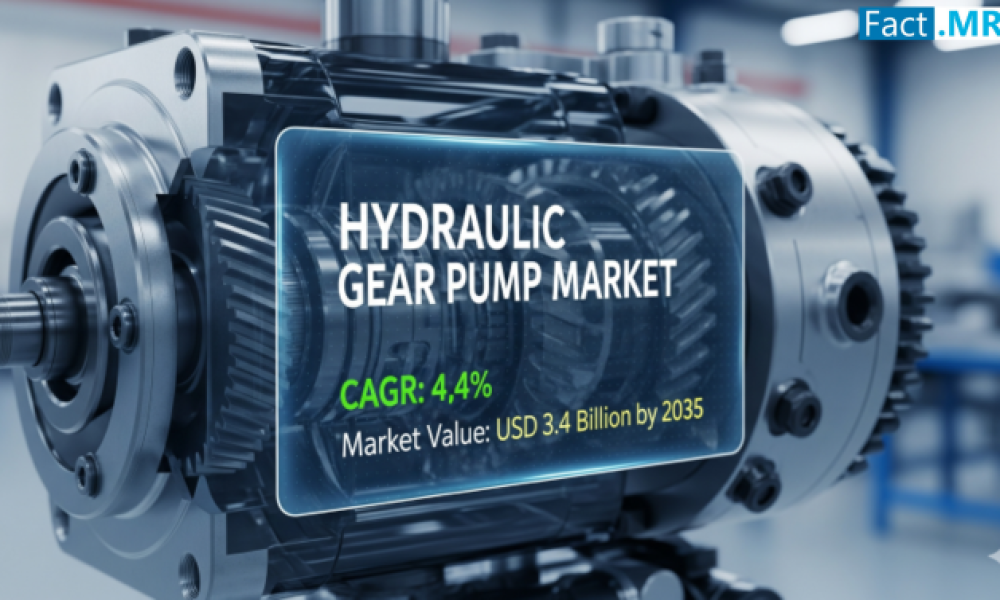
The global hydraulic gear pump market is expected to grow steadily, rising from USD 2.2 billion in 2025 to USD 3.4 billion by 2035, at a CAGR of 4.4% during the forecast period. This growth is driven by increased mechanization in construction and agriculture, the adoption of energy-efficient systems, and expanding opportunities from industrial automation.
Hydraulic gear pumps are widely used to power heavy machinery in construction, agricultural equipment, and industrial automation, enhancing equipment performance, reliability, and overall productivity.
Hydraulic Gear Pump Market Segmentation by Type
The hydraulic gear pump market is primarily divided into internal and external gear pumps:
External Gear Pumps: These pumps dominate the market due to their simple design, cost-effectiveness, and versatility, making them suitable for a wide range of applications in construction, agriculture, and industrial machinery.
Internal Gear Pumps: Although more complex, internal gear pumps are ideal for handling highly viscous fluids and are commonly used in specialized applications such as lubrication systems, food processing, and chemical industries, where precision and reliability are critical.
Segmentation by Operating Pressure
Operating pressure is a critical factor in selecting hydraulic gear pumps. The market is segmented into below 150 bar, 150–250 bar, and above 250 bar. Pumps below 150 bar are ideal for light-duty applications in agriculture and small industrial machinery. The 150–250 bar range is common in medium-duty applications requiring moderate pressure levels. Pumps above 250 bar are suited for heavy-duty industrial applications demanding high-pressure capabilities.
By End-Use Industry
Hydraulic gear pumps are integral to various industries. In construction, they power machinery like excavators and cranes. In agriculture, they are used in tractors and harvesters for efficient fluid transfer. Industrial automation applications rely on these pumps to facilitate operations in manufacturing units. Additionally, the oil and gas sector uses them for fluid movement in exploration and extraction processes, while the automotive industry employs hydraulic gear pumps in vehicle hydraulic systems.
Key Drivers of the Hydraulic Gear Pump Market
The hydraulic gear pump market is primarily propelled by rising construction activity. Equipment such as excavators, cranes, loaders, and other heavy machinery rely on hydraulic pumps for lifting, pushing, and pulling heavy loads. As global construction projects expand, demand for reliable hydraulic pumps is expected to grow. For example, in March 2022, the U.S. Census Bureau reported construction spending of $376.6 billion, marking a 12% increase from $336.3 billion in 2021.
Another major driver is the growing focus on renewable energy production. Hydraulic pumps are critical for controlling fluid flow and pressure, enhancing the efficiency, performance, and reliability of renewable energy systems. Renewable sources such as wind and solar are becoming increasingly important, ensuring long-term sustainability. In January 2023, the U.S. Energy Information Administration projected that 16% of total energy generation would come from renewable sources, up from 14% in 2022, highlighting the sector’s expanding influence on hydraulic pump demand.
Full Market Report available for delivery. For purchase or customization, please request here – https://www.factmr.com/connectus/sample?flag=S&rep_id=2991
Regional Insights
Regional demand for hydraulic gear pumps varies significantly. North America sees strong demand due to infrastructure development and industrial activities. Europe focuses on energy-efficient systems and automation, driving growth. Asia-Pacific is experiencing rapid industrialization and urbanization, boosting market expansion. The Middle East and Africa show growth due to oil and gas exploration and large-scale construction projects, while Latin America demonstrates moderate growth driven by emerging industrial activities.
Recent Developments and Key Players
The hydraulic gear pump market is witnessing notable advancements. Manufacturers are focusing on energy-efficient designs and integrating smart technologies to enhance performance and reduce operational costs. Strategic partnerships between OEMs and suppliers are strengthening market presence and expanding product offerings. Companies are also diversifying their products with varying pressure ratings and sizes to meet diverse industrial requirements.
Key players in the market include Bosch Rexroth, Parker Hannifin, Eaton Corporation, Danfoss, and Kawasaki Heavy Industries. These companies are actively innovating and forming strategic partnerships to maintain competitive advantages. Technological innovations and product diversification remain central to sustaining market leadership.
Conclusion
The hydraulic gear pump market is poised for steady growth over the next decade, driven by technological advancements, increasing industrial automation, and rising demand for energy-efficient solutions. Manufacturers focusing on innovation, partnerships, and diverse product offerings are well-positioned to cater to evolving industry needs. As industrialization and mechanization continue, hydraulic gear pumps will remain essential for powering machinery and enhancing productivity across various sectors.
Contact:
US Sales Office
11140 Rockville Pike
Suite 400
Rockville, MD 20852
United States
Tel: +1 (628) 251-1583, +353-1-4434-232
Email: [email protected]



