
The global video game industry has evolved from a niche entertainment segment into one of the most powerful forces in the global digital economy. Once driven primarily by console-based gaming and physical media, the market today is defined by mobile accessibility, cloud platforms, immersive technologies, and a rapidly expanding player base that spans all age groups and geographies.
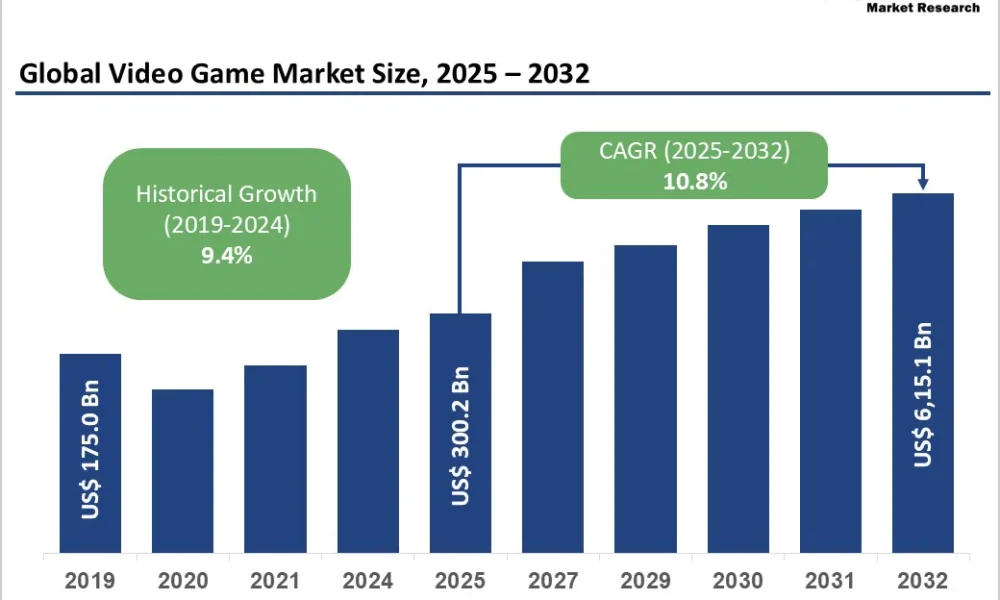
According to recent industry estimates, the global video game market is expected to reach US$300.2 billion in 2025 and surge to US$615.1 billion by 2032, growing at a robust compound annual growth rate (CAGR) of 10.8% between 2025 and 2032. This growth trajectory reflects not only technological advancements but also evolving consumer preferences, new monetization models, and deeper integration of gaming into social and cultural ecosystems.
Evolution of the Global Video Game Market
The video game market has undergone dramatic transformation over the past decade. Historically dominated by physical console games and PC titles, the industry has expanded into a multi-platform ecosystem encompassing mobile gaming, cloud-based services, esports, and live-service games.
Between 2019 and 2024, the market recorded a historical CAGR of 9.4%, signaling strong momentum even before the acceleration seen in the post-pandemic period. Advances in smartphone hardware, high-speed internet connectivity, and affordable gaming devices have lowered entry barriers for players worldwide.
At the same time, gaming has shifted from a solitary activity to a shared digital experience. Multiplayer modes, social features, streaming platforms, and in-game events have redefined how players engage with content, making gaming a core part of modern digital lifestyles.
Market Size and Growth Outlook
The global video game market’s valuation of US$300.2 billion in 2025 reflects its position as one of the largest segments within the entertainment and media industry. By 2032, the market is forecast to more than double to US$615.1 billion, driven by consistent innovation and expanding consumer engagement.
This projected 10.8% CAGR from 2025 to 2032 underscores the industry’s resilience and adaptability. Unlike traditional entertainment formats, video games continuously evolve through updates, expansions, and live-service models, enabling publishers to sustain long-term revenue streams.
As gaming becomes increasingly integrated with emerging technologies such as artificial intelligence, virtual reality (VR), augmented reality (AR), and blockchain-based economies, the market’s value proposition continues to strengthen across both casual and hardcore player segments.
Key Drivers Fueling Market Growth
Technological Advancements
Technology remains the primary catalyst behind the video game market’s expansion. High-performance mobile processors, next-generation consoles, cloud computing, and advanced graphics engines have significantly enhanced gameplay quality and realism.
Cloud gaming, in particular, has emerged as a game-changer by eliminating the need for expensive hardware. Players can now access high-quality titles on demand, expanding the potential user base and enabling cross-platform experiences.
Rise of Mobile and Cloud Gaming
Mobile gaming has revolutionized accessibility by allowing users to play anywhere and anytime. With smartphones becoming increasingly powerful, mobile titles now rival console games in terms of graphics, gameplay depth, and monetization potential.
Cloud gaming complements this trend by enabling instant access to premium content without downloads or installations. Together, mobile and cloud gaming are reshaping how content is distributed and consumed globally.
Changing Player Preferences
Modern players seek flexibility, personalization, and social interaction. This shift has driven the popularity of free-to-play models, live-service games, and hybrid online-offline experiences.
Single-player, story-driven games remain popular, but players increasingly value content that evolves over time, offering new challenges, seasonal updates, and community-driven experiences.
Regional Analysis of the Video Game Market
North America: The Market Leader
North America is expected to hold approximately 29.4% of the global video game market share in 2025, making it the leading regional market. The region benefits from a mature gaming ecosystem, strong consumer spending, and a well-established esports infrastructure.
The presence of major game publishers, console manufacturers, and streaming platforms has positioned North America as a hub for innovation and premium content development. Blockbuster intellectual properties (IPs) and competitive esports leagues continue to attract both players and investors.
Additionally, strong monetization through downloadable content (DLC), subscriptions, and in-game purchases contributes to the region’s sustained dominance.
Asia Pacific: The Fastest-Growing Region
Asia Pacific is projected to be the fastest-growing regional market, expanding at a CAGR of approximately 13.8% through 2032. Growth is fueled by widespread smartphone adoption, affordable internet access, and a rapidly expanding middle class.
Countries such as China, India, Japan, and South Korea are driving demand through localized content, mobile-first strategies, and culturally relevant game designs. The region’s strong esports culture and community-driven gaming platforms further enhance engagement.
Asia Pacific’s growth trajectory highlights the importance of emerging markets in shaping the future of the global video game industry.
Game Type Analysis: Offline vs Online Gaming
Despite the growing popularity of online and multiplayer experiences, offline games are expected to hold nearly 66.2% of the market share in 2025. This dominance reflects continued demand for uninterrupted, immersive, and narrative-driven gameplay.
Single-player titles offer players a sense of escapism and control, appealing to those who prefer deep storytelling and exploration without reliance on internet connectivity. Offline games also perform strongly in regions with inconsistent network infrastructure.
However, online gaming continues to gain traction through competitive multiplayer modes, cooperative gameplay, and live events, suggesting a balanced coexistence of both formats in the long term.
Elevate your business strategy with comprehensive market data. Request a sample report now: https://www.persistencemarketresearch.com/samples/35843
Platform Analysis: Mobile Gaming Takes the Lead
Mobile gaming is projected to account for approximately 43.7% of the global video game market share in 2025, making it the dominant platform segment. The widespread adoption of smartphones and tablets has democratized gaming, bringing millions of new players into the ecosystem.
Social integration, short session gameplay, and free-to-play mechanics have made mobile games highly appealing across diverse demographics. From casual puzzle games to competitive multiplayer titles, mobile platforms offer unmatched versatility.
Meanwhile, consoles and PCs continue to serve core gamers seeking high-end performance, advanced controls, and immersive experiences, ensuring that all platforms remain relevant within the broader market.
Business Model Trends: The Rise of Free-to-Play
The free-to-play (F2P) business model accounted for about 53.6% of the market share in 2025, reflecting a fundamental shift in how games are monetized. By removing upfront costs, F2P games lower barriers to entry and attract massive player bases.
Revenue is generated through in-game purchases, cosmetic items, battle passes, and premium upgrades. This model allows developers to continuously engage players while optimizing lifetime value.
Subscriptions, premium purchases, and hybrid monetization strategies also play a role, particularly for console and PC games, but free-to-play remains the dominant force shaping market economics.
Industry Innovation and Game Development Trends
The video game industry continues to push creative and technological boundaries. Artificial intelligence is increasingly used to enhance non-player character behavior, personalize gameplay, and optimize matchmaking systems.
Virtual and augmented reality technologies are opening new dimensions of immersion, while cross-platform play is breaking down traditional ecosystem barriers. These innovations are redefining player expectations and setting new benchmarks for interactive entertainment.
One notable upcoming development is “007 First Light,” a new James Bond video game currently in development by IO Interactive, expected to release in 2026. Such high-profile projects demonstrate continued investment in iconic franchises and narrative-driven experiences.
Competitive Landscape and Market Dynamics
The global video game market is highly competitive, with established publishers, independent developers, and emerging studios all vying for player attention. Major players leverage strong IP portfolios, advanced technology, and global distribution networks to maintain market presence.
At the same time, indie developers benefit from digital storefronts and community-driven platforms, enabling creative experimentation and niche content development. This dynamic environment fosters innovation and diversity within the gaming ecosystem.
Strategic partnerships, acquisitions, and cross-media collaborations are increasingly common as companies seek to expand reach and enhance content offerings.
Future Outlook of the Video Game Market
Looking ahead, the video game market is poised for sustained expansion as technology and consumer behavior continue to evolve. The convergence of gaming with social media, streaming, and virtual economies will further blur the lines between entertainment, communication, and commerce.
Emerging technologies such as AI-driven content creation, metaverse platforms, and blockchain-based assets may redefine ownership and engagement models. Meanwhile, growing emphasis on inclusivity, accessibility, and community building will shape game design and development strategies.
With a projected market value of US$615.1 billion by 2032, the video game industry is set to remain one of the most influential and innovative sectors in the global digital economy.
Conclusion
The global video game market stands at the intersection of technology, culture, and entertainment, driven by rapid innovation and changing player expectations. From mobile dominance and free-to-play models to regional growth in Asia Pacific and continued leadership in North America, the industry’s evolution reflects its adaptability and global appeal.
As the market grows from US$300.2 billion in 2025 to US$615.1 billion by 2032, stakeholders across the value chain—from developers and publishers to investors and platform providers—will find significant opportunities for growth and differentiation.
Ultimately, the future of gaming lies in its ability to deliver immersive, accessible, and meaningful experiences that resonate with players worldwide, ensuring the industry’s continued success well into the next decade.
Related Reports:




