
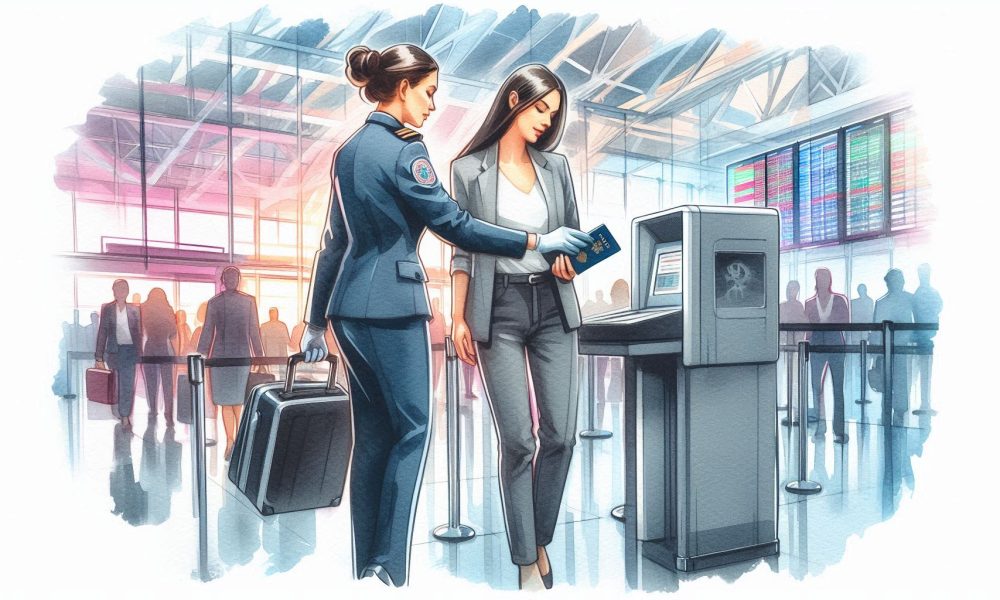
OCR systems instantly read the coded text on passports, helping officers verify traveler data without having to type it by hand.
WASHINGTON, DC, April 17, 2026.
Machine-readable passports work because the passport data page contains a specially formatted block of coded text that optical systems can scan, interpret, and transfer into border software almost instantly, allowing officers to begin verification with standardized data instead of manually retyping names, document numbers, birth dates, and expiration details at every inspection point.
That change sounds technical and almost invisible to travelers, yet it was one of the most practical breakthroughs in the history of modern border control because it solved an exhausting administrative problem that once slowed inspections, increased transcription mistakes, and created needless inconsistencies between what the passport said and what the officer entered into the system.
Before machine-readable design became standard, border processing depended far more heavily on human reading and manual keyboard entry, which meant every inspection involved more repetitive work, more opportunities for spelling errors, more variation across different officers and countries, and a much slower handoff from the physical passport to the government databases used to assess admissibility, visas, prior travel history, and possible alerts.
The machine-readable passport changed that workflow by placing the most important identity details into a standardized reading zone that scanning equipment could capture in seconds, which is why modern border inspection now begins with a small moment travelers barely notice, when the passport touches a scanner, and the officer’s screen fills with structured information almost immediately.
The machine-readable zone became the passport’s bridge between paper and software
At the bottom of a standard passport data page sits the machine-readable zone, often called the MRZ, and those lines of coded text are the part of the passport designed specifically for machines rather than for casual human reading across a counter.
The text in that area is not merely decorative or a duplicate of the visible passport page, because it reorganizes key document details into a globally standardized format that border systems can parse reliably, even when passports come from different countries, use different languages, or originate in different administrative traditions.
That standardized structure is what allows one country’s passport reader to understand another country’s travel document so quickly, because the scanner is not trying to interpret the whole visual page like a human being and is instead looking for a fixed reading zone where the characters appear in a known order, known spacing pattern, and known machine-friendly format.
Once the scanner captures those lines, the software can break the string into meaningful fields, including the document type, issuing state, holder name, passport number, nationality, date of birth, sex, expiration date, and several internal verification elements that help the receiving system decide whether the captured data is plausible and complete.
OCR technology made the passport legible to machines without making the document unreadable to people
OCR, or optical character recognition, works at the border by allowing a reader to photograph or scan the MRZ, identify each character in the coded lines, and convert that image into digital text that border-control software can use immediately without forcing an officer to type every field by hand.
That may seem routine now, although the design problem it solved was unusually difficult, because the passport had to remain readable to ordinary humans while also becoming legible to machines operating in different airports, under different lighting conditions, and across many generations of inspection hardware.
The answer was not to turn the whole passport into a computer object, but to create a carefully controlled reading zone whose font, spacing, field order, and permitted characters were stable enough that optical systems could interpret them consistently at high speed and with far fewer errors than human transcription would produce.
This is why official descriptions of a machine-readable passport from the U.S. State Department still focus on the international formatting of biographic information: the crucial feature is not just that data appears on the page, but that it appears in a standardized structure designed for machine capture.
The font and layout matter more than most travelers ever realize
Machine-readable passports do not rely on ordinary document typography, because the coded lines use a tightly controlled OCR-friendly typeface and layout system that reduces visual ambiguity and makes it easier for scanners to distinguish similar characters under operational pressure.
That discipline matters because a machine reader cannot rely on common sense the way a human inspector sometimes can, and must instead work from the physical clarity of shapes, the predictability of spacing, and the stability of line placement in order to read the passport quickly and correctly.
A traveler may see only a dense block of capital letters, numbers, and angle brackets, yet the scanner sees a carefully engineered field whose proportions, character set, and reading position were designed specifically to ensure reliable optical recognition across very large volumes of international traffic.
The success of the system depends on that quiet discipline, because the machine-readable zone works precisely because it does not behave like free-form writing but rather like a controlled border language that thousands of scanners and software systems have been taught to understand.
The coded text is designed to reduce ambiguity before deeper checks even begin
One reason machine-readable passports became so valuable is that the MRZ reduces uncertainty by presenting identity details in a compressed, highly structured form, providing border systems with a consistent starting point before any higher-level analysis begins.
Names are transliterated into a machine-friendly format, spacing is standardized, filler characters are used where needed, and the order of data elements is fixed so the reader knows which positions correspond to which parts of the traveler’s identity record.
That means the scanner is not merely reading letters and numbers, but is also reading location, sequence, and internal logic, which greatly improves the border system’s ability to populate forms correctly, compare fields intelligently, and flag values that do not fit expected patterns.
The result is a process that feels simple to the public while doing substantial, quiet administrative work behind the scenes, because the passport scan is the moment when a paper document hands over its structured identity claim to the software environment that now governs much of modern border control.
Check digits gave OCR-based passports an internal quality-control system
One of the smartest parts of machine-readable passport design is the use of check digits, because the MRZ does not simply present data and hope the scanner captured everything correctly, but includes mathematical verification markers tied to important fields such as the passport number, date of birth, and expiration date.
Those digits allow the receiving system to test whether the scanned characters form a logically valid result, enabling the software to detect many common read errors or suspicious inconsistencies almost instantly before the officer invests time in deeper inspection.
That internal checking function made OCR passports far more than a simple optical convenience, because the reader was not only saving time and reducing keystrokes but also helping the border system assess whether the captured data appeared internally coherent.
In practical terms, that gave machine-readable passports a quiet anti-tamper advantage, since an altered document now risked producing not only visual oddities on the page, but also data strings that failed internal validation once the scanner interpreted the coded lines.
The passport scan became the opening move in a much larger border process
Modern travelers often think the passport scan is the whole check, although in reality it is the opening move that loads the traveler’s core data into the system, enabling officers and automated platforms to perform the more consequential comparisons that follow.
Once the OCR reader captures the MRZ, border systems can immediately run the document against watchlists, visa records, entry and exit databases, airline submissions, prior inspection histories, and other systems that depend on clean, fast, structured identity data from the very start.
That is why OCR did not replace border judgment: the technology was never meant to decide the whole case on its own; it was designed to eliminate low-value clerical work so officers could spend more time on actual verification, questioning, and anomaly detection.
The machine-readable passport, therefore, made the entire border process more scalable, because governments could process larger passenger volumes without requiring every checkpoint to begin with the same slow ritual of manual data entry and repeated human copying from the printed page.
OCR reduced friction for legitimate travelers while also helping with fraud detection
The public benefit of OCR-based passports is obvious in the shorter queues and faster document handling that travelers experience, yet the security value is just as important because machine capture reduces the noise that used to come from inconsistent human transcription.
A passport number typed incorrectly by a tired officer, a name entered with a misplaced character, or a birth date reversed during manual entry can create confusion that wastes time for legitimate travelers and complicates enforcement for authorities, which is exactly the kind of friction machine-readable design was built to reduce.
At the same time, a passport whose machine-readable zone produces invalid combinations, missing fields, or check-digit failures may reveal that something is wrong long before a casual visual inspection fully explains the problem, giving officers a reason to slow down and look harder.
That dual effect, less friction for truthful documents and more structured scrutiny for suspicious ones, helps explain why machine-readable passports became such an enduring part of travel security rather than a temporary administrative upgrade.
The machine-readable passport laid the groundwork for the e-passport era
Electronic passports with contactless chips often receive more attention because they sound more advanced, yet the truth is that e-passports were layered onto a machine-readable foundation that had already transformed how border agencies handled document data.
Even when a passport includes a chip carrying biometric and document information, the inspection process still commonly begins with the machine-readable zone because that is the fastest and most universal way to load the traveler’s core biographic details into the system.
The MRZ is also used to help access certain chip functions, which means the older OCR-based architecture still supports newer layers of passport technology rather than sitting apart from them as a relic from an earlier era.
This continuity is important because it shows that border modernization rarely happens by throwing away the last useful system; instead, it proceeds by adding stronger verification layers to tools that already solved a foundational operational problem.
Modern border programs still rely on the scan-first logic that OCR made possible
Recent border modernization efforts continue to show how central passport scanning remains, because even newer digital entry systems typically begin by reading the travel document before collecting biometric evidence or running more advanced automated comparisons.
That basic sequence was visible in Reuters reporting on Europe’s border system rollout, which described travelers scanning passports before providing fingerprints and facial images, a reminder that OCR-friendly passport design still functions as the entry point into the larger inspection chain.
The practical reason is straightforward: biometrics works better when the system already knows whose document it is processing, which means the scan first supplies the data context that later biometric checks are meant to confirm or challenge.
OCR, therefore, remains relevant in 2026 not because border agencies failed to modernize, but because the first thing modern systems still need is a fast, standardized way to turn the passport page into reliable digital input.
Physical document design still matters because OCR depends on a clean, trustworthy presentation
Machine-readable passports also demonstrate an older truth about document security: digital usefulness begins with physical discipline, since OCR can only work well when the reading zone is printed clearly, positioned correctly, and protected from the kinds of damage or alteration that degrade machine capture.
A scanner cannot recover order from a badly printed, poorly aligned, or visibly tampered reading zone without consequences, which is why the physical integrity of the data page remains important even in systems that later rely on databases, biometrics, and chip validation.
That broader point connects machine readability to the larger evolution of passport security, because the passport became more trusted not only when it stored more information, but when governments made the critical information easier to read consistently by both humans and machines.
This is one reason commentary such as Amicus International Consulting’s overview of secure passport features continues to treat machine readability as part of a wider security ecosystem, where page design, coded text, and later verification technologies reinforce one another rather than standing alone.
OCR changed the job of the border officer, even though it did not replace the officer
Before machine-readable zones became standard, much more of the officer’s time was consumed by repetitive clerical work that added little insight, yet still had to be performed accurately under operational pressure.
After OCR-based passports became common, that burden shifted significantly, because the officer could spend less effort copying obvious data and more effort watching behavior, reviewing results, comparing the traveler with the document, and deciding whether anything about the interaction required a second look.
That shift mattered institutionally because border systems were under pressure from growing passenger volumes, and the administrative savings from machine-readable passports enabled governments to scale up inspections without turning every crossing into a longer, more error-prone typing exercise.
The technology therefore succeeded not because it made officers unnecessary, but because it let officers focus more of their attention on judgment while the scanner handled the repetitive extraction of data from a standardized reading zone.
The same passport logic still shapes lawful mobility discussions outside the airport
Machine-readable standards are not only a government curiosity, because the broader lesson also matters in legal mobility planning, where the practical value of a passport depends on whether its data can move cleanly through institutional systems.
That is one reason Amicus International Consulting’s discussion of electronic passports and related travel-document analysis keeps returning to machine readability, since lawful international movement now depends heavily on documents that can survive not only visual scrutiny but also rapid machine capture by carriers, border authorities, and compliance systems.
A passport that looks legitimate to the naked eye but fails at structured machine reading creates problems quickly, because modern institutions increasingly assume that valid travel documents should pass through scanners, automated forms, and interoperable data systems without collapsing into confusion.
In that environment, machine-readable design is not merely a convenience layer; it is part of what makes a passport operationally credible in the first place.
Why OCR still matters in 2026
Machine-readable passports work with OCR technology at the border by turning the printed passport page into a standardized data input system, allowing scanners to capture coded identity fields in seconds, validate parts of what they read, and feed that information directly into the larger inspection environment without repeated manual typing.
That capability still matters in 2026 because newer border layers, including biometric matching, chip verification, automated gates, and digital entry systems, all work better when the passport’s core data enters the system quickly, accurately, and in a format recognized across many jurisdictions.
What travelers experience as a simple scan is therefore one of the most enduringly useful ideas in modern passport design, because OCR did not just speed up the border, and it gave the passport a common machine language that still underpins how international travel data moves today.
Long before the public began associating passport technology with facial recognition and contactless chips, the machine-readable zone had already solved a foundational problem: teaching the passport how to speak clearly to a machine before the rest of the border system began listening.




