
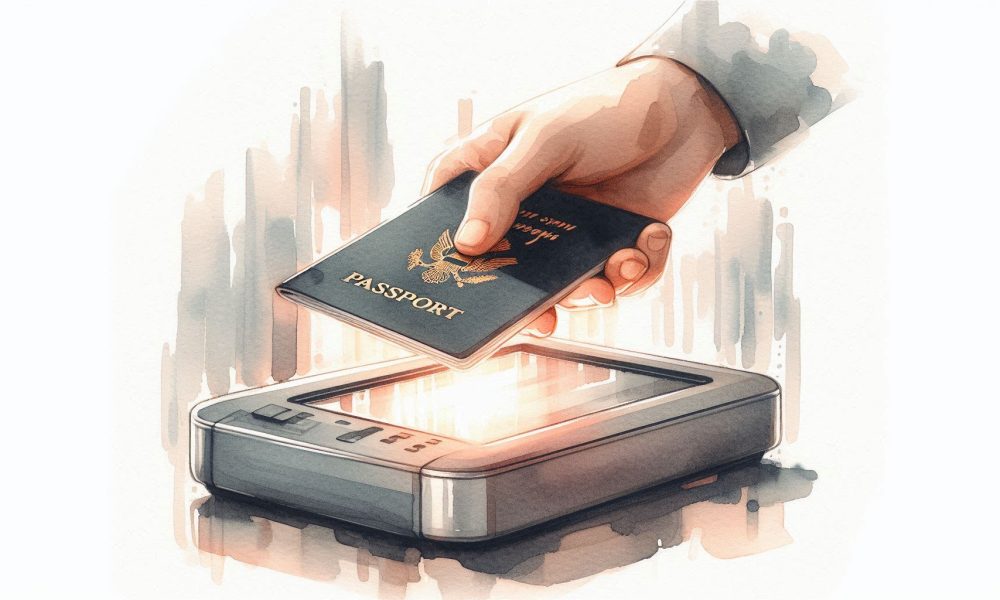
The development of OCR readers turned the passport into a faster, smarter document built for the age of mass aviation.
WASHINGTON, DC, April 17, 2026.
Passport scanning changed international travel by converting the passport from a document that officials had to read and type manually into one that could feed border systems with standardized data in seconds.
That transformation did not begin with biometric gates or embedded chips, because the first great leap came when governments and aviation authorities made passports machine-readable through optical character recognition, giving the passport a common visual language for machines.
The story matters because modern travelers often notice the scan without understanding its significance, even though that brief moment at the reader reflects decades of international work to reduce delays, cut transcription mistakes, and make mass aviation administratively possible.
Before machine-readable passports became standard, officers had to read names, numbers, dates, and issuing details from the printed page and then enter them manually, which slowed queues, increased errors, and created frustrating inconsistencies between paper documents and database records.
As international passenger volumes surged in the late twentieth century, that older method became harder to defend, because airports needed faster processing, governments wanted stronger control, and airlines could no longer treat document handling as a slow clerical ritual.
Machine-readable passports emerged when rising passenger volumes made manual keyboard entry too slow, too inconsistent, and too expensive for the age of mass international aviation.
The breakthrough came when the International Civil Aviation Organization created a standard machine-readable travel document format and embraced OCR technology as the practical answer for rapid passport reading across many countries and many types of border equipment.
ICAO’s first formal machine-readable passport specifications appeared in 1980, and the choice of OCR reflected something very practical rather than glamorous, because the technology was mature, cost-effective, and reliable enough for large-scale operational use.
Rather than designing a passport that only humans could interpret visually, ICAO standardized a reading zone that placed core identity details into a rigid coded structure, allowing compliant readers to capture the same essential information wherever the document was presented.
That decision was revolutionary in a very quiet way, because it did not make the passport flashy or futuristic to the eye, yet it made the document interoperable with software systems that could finally process traveler information at speed.
The change also reflected the realities of mass aviation, because the bottleneck at passport control was no longer only the officer’s judgment, and increasingly the repeated burden of typing information that already existed on the document.
Once scanners could extract that information directly from the passport page, the officer’s time could shift toward verification, screening, and observation rather than repetitive data entry that added little value and consumed enormous effort.
The machine-readable zone gave the passport a second language that humans could inspect visually, while scanners could translate instantly into structured border-control data reliably.
At the bottom of the passport data page sits the machine-readable zone, or MRZ, which compresses the traveler’s main identity fields into a standardized block of OCR-readable characters that border software can decode almost instantly.
In the standard passport booklet format, the machine-readable zone appears as two coded lines at the bottom of the identity page, creating a stable reading area that scanners can find and process quickly.
That coded area is not simply a duplicate decoration placed under the printed biography page, because it reorganizes the essential passport facts into a strict format that scanners can recognize without guessing about layout, fonts, field order, or language.
A human inspector still sees the ordinary visual page with the photograph, the name, the passport number, the nationality, and the expiration date, but the machine sees a disciplined text pattern built for structured capture.
That dual design was one of the smartest solutions in travel-document history because it preserved ordinary readability for people while giving inspection systems a reliable method to convert paper into digital input without constant retyping.
The passport, therefore, became more than a booklet carrying identity claims and began to function as a data source, able to speak directly to government systems, airport infrastructure, and automated inspection tools built around common international rules.
OCR technology succeeded because the reading zone was engineered for speed, clarity, and consistency across many countries, many airports, and many generations of border hardware.
OCR, or optical character recognition, works at the border by scanning the MRZ, identifying each character in the coded lines, and converting that captured image into structured text that border software can process immediately.
That sounds simple from a traveler’s point of view, but the underlying achievement was substantial, because scanners needed a stable typeface, stable spacing, stable field positions, and a limited character set that would hold up across many countries and many hardware environments.
ICAO’s use of OCR-B lettering and tightly controlled formatting rules gave the reading zone a consistency that ordinary document typography could never have provided in busy inspection settings.
The result was a passport that could be read under operational conditions far less forgiving than those in a desktop office, including airport glare, rushed presentation, worn document edges, varying scanner quality, and very high passenger volumes.
The passport scan, therefore, became as much a reliability solution as a speed solution, since it reduced clerical opportunities for misspelled names, transposed passport numbers, and birth dates entered incorrectly by tired staff.
That accuracy gain mattered deeply because the quality of a border decision often depends on the quality of the data entered first, and bad manual entry can create false mismatches, unnecessary secondary inspections, and avoidable delays for legitimate travelers.
Standardized OCR passports were developed for mass aviation because global air travel required a common documentary logic that could keep pace with modern passenger traffic.
Air travel expanded dramatically during the second half of the twentieth century, and that expansion exposed how inefficient border processing became when every officer had to read every passport as though it were a one-off piece of paper.
Machine-readable passports solved that by providing a shared document architecture, allowing readers at different airports to interpret the same core identity fields in the same order, even when national passport designs looked different visually.
This standardization was essential because international aviation is only as efficient as its slowest documentation procedure, and an airport system that cannot ingest passport data quickly will eventually fail under the strain of rising passenger throughput.
The history of passport scanning is therefore also a history of aviation modernization, since OCR readers helped move border control from a handwriting-and-keyboard environment into a higher-volume digital environment that could keep pace with modern travel demand.
In effect, OCR passport technology gave air travel a documentary infrastructure suited to scale, which is why it deserves to be treated as more than a technical footnote in the broader story of border innovation.
Machine-readable passports reduced errors by standardizing how identity data appeared before the officer ever touched a keyboard or began deeper screening.
Manual reading always leaves room for small mistakes, especially when names contain unusual spellings, document numbers blend letters with numbers, or officers must type the same categories of information thousands of times in repetitive conditions.
The machine-readable zone sharply reduced that friction by feeding the system a prearranged string whose structure helped the software consistently separate the document type, issuing country, holder name, passport number, nationality, birth date, sex, and expiration date.
That structured capture was especially valuable because it meant border databases received cleaner inputs from the very start, which improved later watchlist checks, entry records, visa lookups, and overstay calculations, all of which depend on correct identity data.
The machine-readable format also introduced internal validation features, including check digits on key fields, which gave software a way to identify certain reading errors or suspicious inconsistencies before the officer had to sort them out manually.
That combination of speed and error reduction explains why machine-readable passports spread so effectively: they did not merely help governments move faster, but also helped them do so with fewer preventable mistakes.
OCR readers did not replace officers, but they changed the job by shifting attention away from clerical transcription and toward judgment, anomalies, and actual identity verification.
Before passport scanning became routine, much of the inspection desk’s time disappeared into low-value clerical repetition, because officers had to act as typists before they could act as evaluators.
After OCR passport technology became standard, the scanner handled the first data-transfer step, which meant officers could focus more on face comparison, suspicious travel patterns, document condition, behavioral cues, and the results displayed on the inspection screen.
That shift mattered institutionally because border security is strongest when trained personnel focus on judgment and anomalies rather than mechanical copying, especially in environments where queues are long and the stakes are high.
The passport scanner did not make human expertise obsolete; instead, it made it more usable by clearing away repetitive work that used to dilute attention from the parts of inspection that actually require experience.
This is one reason passport scanning deserves to be understood as an operational breakthrough rather than merely a convenience feature: it reorganized the labor of border control in a more intelligent way.
The rise of OCR passport technology laid the foundation that chip-based and biometric systems still rely on when a passport first enters a modern inspection workflow.
Modern travelers often think of the e-passport chip or the facial-recognition gate as the beginning of smart travel documents, yet the older machine-readable zone still performs the first structured handoff from paper to software in many inspection environments.
Even when a passport contains a contactless chip, the inspection process commonly begins with the machine-readable zone, because that is the fastest way to load the document’s core biographic data and initiate the larger verification sequence.
That means OCR technology was not replaced by newer systems; instead, it became part of a layered architecture in which the scanner loads data, the chip may provide electronic confirmation, and biometrics help verify that the document belongs to the person presenting it.
The continued importance of the scan-first model is evident in modern border rollouts, where passport scanning still serves as the entry point before fingerprinting, facial imaging, or database checks deepen the inspection process.
Recent Reuters reporting on Europe’s digital border rollout described travelers scanning passports before giving fingerprints and photographs, which shows how OCR-era logic still anchors much of the modern border experience.
The official meaning of a machine-readable passport remains surprisingly simple, which helps explain why the technology spread so widely despite its enormous historical and operational impact.
The U.S. State Department’s glossary entry for a machine-readable passport defines it in practical terms as a passport with biographic information entered on the data page in accordance with international specifications, which concisely summarizes why the system matters so much.
That definition sounds modest, yet it captures the real point, because the power of the machine-readable passport comes from standardization rather than spectacle, allowing one country’s document to be processed efficiently in another country’s system.
The genius of OCR passport technology was never that it made the passport look radically different, but rather that it made the passport behave differently in institutional workflows built around software, queue management, and automated identity checks.
Once the data page could be read in a common way, border processing became more scalable, more interoperable, and less dependent on repeated human transcription, which is exactly what the global aviation system needed.
That quieter administrative success is why machine-readable passports became universal so thoroughly that many travelers now take the scan for granted without noticing the historical problem it solved.
Passport scanning also strengthened anti-forgery efforts because the coded reading zone made careless alteration harder to hide from both human inspectors and machine capture systems.
A machine-readable passport does more than speed up the queue, because the MRZ must still align with the printed page and, in electronic documents, often with the chip and database records connected to the same identity.
That means a passport altered carelessly may create inconsistencies between the visual biography page and the machine-readable data string, which can trigger closer inspection when the scanned result no longer matches what the document appears to say.
For border authorities, that is a meaningful security advantage, since fraud becomes harder when the document must satisfy both human reading and machine capture without contradiction at the most important identity fields.
That broader anti-forgery logic is why modern passport commentary, including Amicus International Consulting’s overview of secure passport features, continues to treat the machine-readable zone as a practical bridge between document design and contemporary verification technology.
The same broader point appears in Amicus International Consulting’s electronic passport overview, which explains that machine-readable technology remains part of the modern passport’s speed, accuracy, and security advantages even after chips entered the picture.
The rise of OCR passport technology still matters in 2026 because border systems cannot make smart decisions until passport data enters the workflow quickly and accurately.
Every modern border layer, from biometric matching to automated entry records to overstay detection, depends first on quickly and accurately getting the traveler’s core data into the system, which is exactly the job OCR passport technology was designed to perform.
A scanner cannot decide the whole case, but it can ensure that the passport’s key identity fields enter the workflow in a standardized way, which greatly improves everything that follows for both legitimate travelers and enforcement authorities.
That remains essential in 2026 because borders have become more digitized, more data-dependent, and more interconnected, yet none of those improvements eliminates the need for a strong first capture of passport information at the point of presentation.
The passport scanning history behind OCR readers is, therefore, not a story about obsolete pre-biometric technology, but rather a story about the first great modernization that taught the passport how to communicate with machines.
Long before facial recognition kiosks and encrypted chips came to symbolize travel technology, OCR readers had already turned the passport into a faster, smarter document built for the age of mass aviation, and that achievement still sits quietly beneath the modern border experience.




