
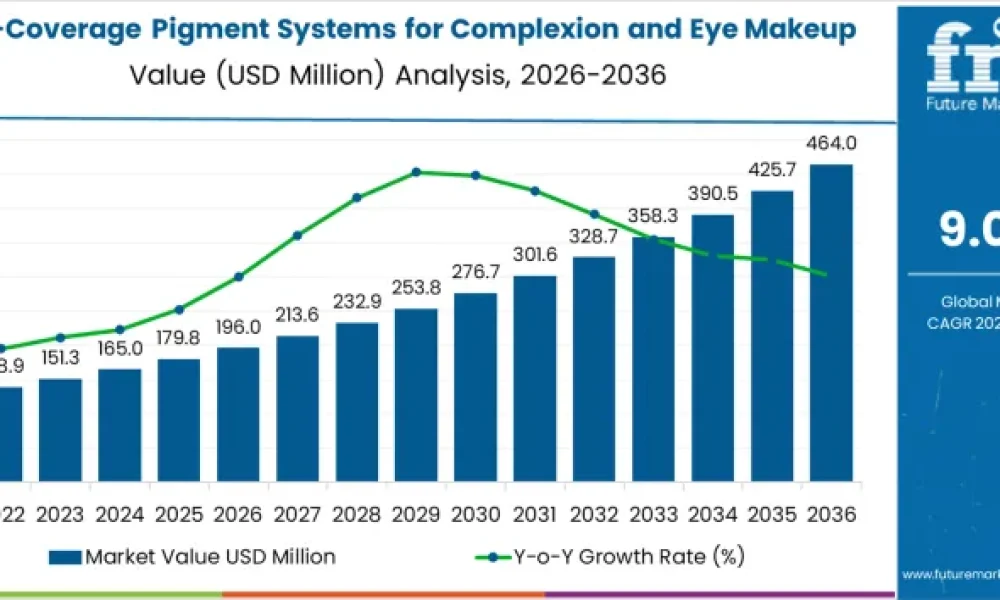
The High-Coverage Pigment Systems for Complexion and Eye Makeup Market is entering a strong growth phase as cosmetic brands, ingredient manufacturers, and formulation laboratories prioritize performance-driven makeup solutions. Valued at USD 196 million in 2026, the market is forecast to reach USD 464.0 million by 2036, expanding at a CAGR of 9.0%. This growth reflects rising demand for pigment systems that deliver superior opacity, shade uniformity, long wear, and formulation stability across diverse skin tones and product formats.
Explore comprehensive market trends, regional outlooks, and competitive intelligence – Get a Sample Copy Now
Market Outlook: Performance Over Volume
Demand for high-coverage pigment systems is shaped less by pigment volume and more by predictable color strength, dispersion stability, and sensory performance. Cosmetic manufacturers increasingly favor pigment systems that perform reliably across liquids, creams, powders, and hybrid formulations. Once approved, these systems remain embedded in long-term product portfolios due to high reformulation costs and regulatory validation requirements. As a result, suppliers offering low variability and consistent batch quality maintain strong pricing stability and long-term partnerships.
Between 2026 and 2031, the market is expected to grow from USD 196 million to USD 274 million, supported by improved milling technologies, advanced surface treatments, and wider adoption of high-pigment-load formulations in foundations, concealers, and eye products. From 2031 to 2036, growth accelerates further, with the market expanding to nearly USD 464.0 million, driven by broader SKU expansion, inclusive shade ranges, and rising global demand for long-wear, high-performance makeup.
What Is Driving Market Demand?
The shift toward high-coverage pigment systems stems from limitations in conventional pigments, which often require multiple layers to achieve opacity, resulting in heavier textures and inconsistent finishes. Consumers and professional makeup artists increasingly demand true-to-shade coverage, blendability, and durability without compromising comfort. Advances in engineered particle size distribution, encapsulated colorants, and dispersion technologies now enable higher coverage with lower pigment loadings, supporting cleaner formulations and improved skin compatibility.
Future demand will also be influenced by regulatory compliance, ingredient transparency, and inclusivity standards, embedding high-coverage pigment systems as a baseline requirement rather than a premium add-on.
Key Segments of the Market Report
By Product Type
- Iron Oxides: Account for ~42% of demand due to strong opacity, color consistency, and versatility across skin tones
- Titanium Dioxide: Supports brightness and opacity, mainly as a complementary pigment
- Ultramarines: Used for vivid hues with limited standalone coverage
- Chromium Oxides: Serve niche correction and undertone applications
By Application Area
- Face Makeup: ~55% share, driven by foundations, powders, and palettes requiring uniform coverage
- Eye Shadows: Focus on color payoff with lower volume usage
- Concealers & Correctors: High coverage needs but smaller material consumption
By End User
- Cosmetic brand owners
- Contract cosmetic manufacturers
- Formulation laboratories
- Professional and mass-market makeup producers
By Region
- Asia Pacific
- North America
- Europe
- Latin America
- Middle East & Africa
Regional Growth Highlights
- India (CAGR 12.0%): Fastest-growing market, supported by rising beauty awareness, urbanization, and large-scale cosmetic manufacturing
- China (CAGR 11.0%): Strong demand from industrial cosmetic hubs and high-volume production
- Brazil (CAGR 9.5%): Growth driven by vibrant makeup trends and expanding urban retail
- USA (CAGR 8.0%): Steady adoption in premium and mass segments, emphasizing regulatory compliance
- UK (CAGR 7.5%): Mature market focused on premium products and innovation
Competitive Landscape: Innovation Meets Reliability
The competitive environment is shaped by how effectively suppliers balance coverage, skin feel, and formulation stability. Established players such as BASF SE, Clariant AG, Merck KGaA, DIC Corporation (including Sun Chemical), and Sensient Technologies Corporation continue to lead through advanced surface treatments, dispersion platforms, and regulatory-ready solutions.
At the same time, emerging manufacturers and technology-focused entrants are finding opportunities by offering application-specific pigment systems, improved sensory profiles, and cost-efficient solutions for expanding cosmetic brands. New players aiming to scale their businesses are investing in particle engineering, consistency control, and formulation support services to compete with incumbents and integrate into long-term product development cycles.
Expanding Opportunities Through Technology
As cosmetic brands accelerate product launches and global shade standardization, high-coverage pigment systems are becoming core formulation inputs rather than optional enhancements. Suppliers that combine technical reliability, innovation in pigment treatment, and collaborative development support are best positioned to capture both established demand and emerging opportunities.
With strong growth fundamentals, expanding applications, and rising investment in pigment technologies, the High-Coverage Pigment Systems for Complexion and Eye Makeup Market is set to remain a critical pillar of the global color cosmetics industry through 2036.
Have a specific Requirements and Need Assistant on Report Pricing or Limited Budget please contact us – [email protected]
About Future Market Insights (FMI)
Future Market Insights, Inc. (FMI) is an ESOMAR-certified, ISO 9001:2015 market research and consulting organization, trusted by Fortune 500 clients and global enterprises. With operations in the U.S., UK, India, and Dubai, FMI provides data-backed insights and strategic intelligence across 30+ industries and 1200 markets worldwide.



