
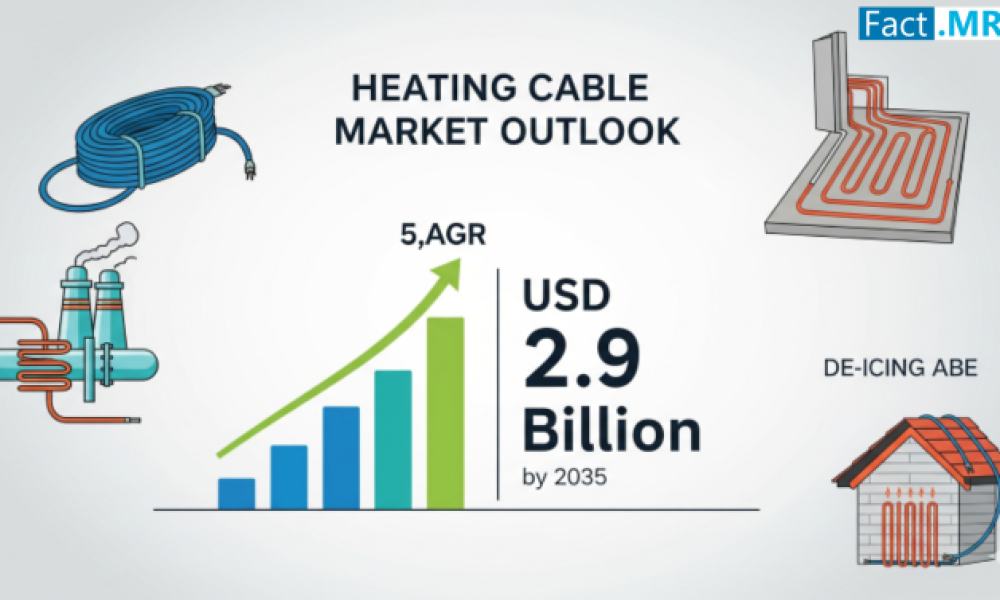
The global heating cable market is expected to expand significantly, growing from USD 1.7 billion in 2025 to USD 2.9 billion by 2035, at a CAGR of 5.4% over the forecast period. This growth is largely driven by the increasing focus on frost protection, pipe freeze prevention, and underfloor heating systems, particularly in colder regions.
Factors such as rapid urbanization, ongoing infrastructure development, and the integration of smart technologies are further boosting demand for self-regulating and constant wattage heating cables, which provide reliable thermal management and enhanced energy efficiency.
Market Segmentation by Product Type
Heating cables are primarily segmented into self-regulating heating cables, constant wattage heating cables, and constant electric power heating cables:
Self-Regulating Heating Cables: These cables automatically adjust their heat output in response to ambient temperature, improving energy efficiency and preventing overheating. They are ideal for applications requiring consistent temperature maintenance, such as freeze protection and floor heating systems.
Constant Wattage Heating Cables: Delivering a fixed heat output per unit length, these cables are suitable for applications where uniform heat distribution is essential, including pipelines, roofs, and industrial processes.
Constant Electric Power Heating Cables: Designed for specific power requirements, these cables ensure consistent performance in demanding industrial environments, making them suitable for specialized applications requiring precise thermal control.
Segmentation by Maximum Temperature and Wattage
Heating cables are designed to operate within various temperature ranges. Cables rated below 100°F are suitable for mild climates and small-scale applications, while those in the 100°F–150°F range are commonly used in residential and commercial freeze protection. Cables designed for 150°F–200°F and above 200°F are intended for industrial applications requiring high-temperature maintenance. Wattage capacity also determines efficiency, with low-wattage cables (below 50W) suitable for small-scale uses, 50W–100W for residential and light commercial applications, 100W–150W for industrial purposes, and above 150W for heavy-duty industrial operations.
Packaging Format and Conductor Material
Heating cables are available in bulk B2B packaging for industrial clients and B2C packaging tailored for retail markets. The choice of conductor material significantly influences performance and durability. Copper, known for its excellent conductivity, is preferred for high-performance applications, while aluminum offers a lightweight and cost-effective solution for situations where cost and weight are critical considerations.
Full Market Report available for delivery. For purchase or customization, please request here – https://www.factmr.com/connectus/sample?flag=S&rep_id=730
Applications and End-Use Industries
Heating cables serve multiple applications including freeze protection, temperature maintenance, anti-condensation, pond freeze prevention, and soil warming. These applications span across several industries. In oil and gas, heating cables maintain pipeline integrity and equipment functionality in harsh environments. The chemical industry relies on them to ensure optimal temperatures for processes, while the power and energy sector uses them for thermal management. Additionally, food and beverage processing and pharmaceutical industries use heating cables to maintain consistent temperatures essential for product quality and safety.
Regional Insights of Heating Cable Market
Regional dynamics influence heating cable demand significantly. In North America and Europe, harsh winters drive demand across residential, commercial, and industrial sectors. Asia-Pacific is witnessing rapid growth due to urbanization and industrialization in countries like China, Japan, and South Korea. The Middle East and Africa, despite generally warm climates, are adopting heating cables for oil and gas pipelines and cold storage applications. Latin America shows moderate growth, fueled by infrastructure development and industrial applications in nations such as Brazil and Argentina.
Competitive Landscape and Recent Developments
The heating cable market features several prominent players, including nVent Electric plc, Thermon Group Holdings, Inc., Emerson Electric Co., AnBang Electric Corp, and BARTEC Top Holding GmbH. These companies are actively innovating, expanding product portfolios, and forming strategic partnerships to maintain competitive advantages. Recent developments include the introduction of energy-efficient self-regulating cables and advancements in smart heating systems for residential and industrial applications, positioning these companies as market leaders.
Conclusion
The heating cable market is poised for steady growth over the coming decade, driven by energy efficiency, industrial demand, and technological innovation. With applications spanning multiple industries and regions, heating cables are becoming essential components in both residential and industrial thermal management solutions. Continuous advancements and strategic developments by key market players are expected to strengthen the market further, meeting the growing global demand for reliable heating systems.
Contact:
US Sales Office
11140 Rockville Pike
Suite 400
Rockville, MD 20852
United States
Tel: +1 (628) 251-1583, +353-1-4434-232
Email: [email protected]



