
Overview
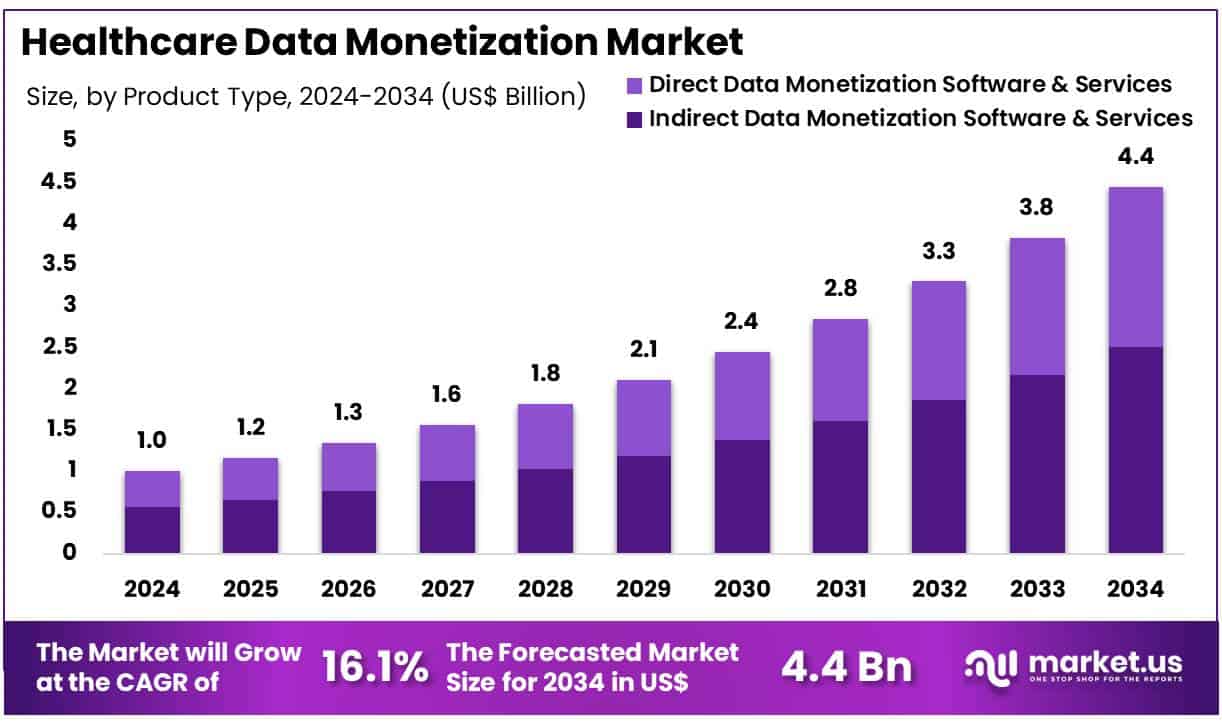
Global Healthcare Data Monetization Market size is expected to be worth around US$ 4.4 Billion by 2034 from US$ 1.0 Billion in 2024, growing at a CAGR of 16.1% during the forecast period 2025 to 2034. In 2024, North America led the market, achieving over 41.6% share with a revenue of US$ 0.4 Billion.
The global healthcare data monetization market is witnessing accelerated growth as healthcare providers, payers, and technology vendors increasingly recognize the value of structured clinical and operational data. Data monetization in healthcare refers to the process of converting health data into economic value through direct or indirect mechanisms, including data licensing, analytics services, and value-based outcomes measurement.
With the rapid digitalization of healthcare infrastructure, organizations are now leveraging electronic health records (EHRs), claims data, wearable device data, and genomic datasets to generate actionable insights. These insights are increasingly being used for pharmaceutical research, population health analytics, clinical trial optimization, and personalized care delivery.
Regulatory initiatives, such as the U.S. 21st Century Cures Act and the European General Data Protection Regulation (GDPR), have created frameworks for secure, compliant data exchange and secondary use. At the same time, rising investment in artificial intelligence (AI) and machine learning (ML) is enhancing the scalability of monetization platforms.
North America leads the market due to a robust healthcare IT ecosystem and early adoption of data-driven reimbursement models, while Asia-Pacific is poised for rapid growth due to expanding digital health initiatives. As the healthcare industry continues its shift toward outcome-based care, data monetization is emerging as a critical strategy for unlocking new revenue streams and driving innovation.
Click here to get a Sample report copy @ https://market.us/report/healthcare-data-monetization-market/free-sample/
Key Takeaways
- In 2024, the global healthcare data monetization market was valued at approximately US$ 1.0 billion and is projected to reach US$ 4.4 billion by 2033, expanding at a compound annual growth rate (CAGR) of 16.1% over the forecast period.
- By product type, the market is categorized into direct data monetization software & services and indirect data monetization software & services. Among these, indirect data monetization emerged as the dominant segment in 2023, accounting for 56.4% of the global market share.
- Based on deployment mode, the market is bifurcated into on-premises and cloud-based solutions. The cloud segment held a substantial share of 61.3%, reflecting the ongoing shift toward scalable and flexible data infrastructure in healthcare.
- In terms of facility size, the market is segmented into large facilities and small & medium-sized facilities. Large healthcare facilities dominated the segment with a revenue contribution of 59.8%, driven by higher volumes of data generation and analytics adoption.
- The end-use segmentation includes healthcare payers, healthcare providers, and life sciences companies. Among these, healthcare payers led the market, holding a 44.9% share, due to increased utilization of data for risk assessment and cost optimization.
- Regionally, North America maintained leadership with a 41.6% market share in 2023, supported by advanced health IT infrastructure and favorable regulatory frameworks.
Segmentation Analysis
- Product Type Analysis: The indirect data monetization software & services segment accounted for 56.4% of the market, driven by the demand for non-transactional data value generation. These solutions support benchmarking, reporting, and analytics that enhance clinical and financial outcomes. Integration with AI and machine learning is improving predictive insights, while cloud expansion and regulatory compliance needs are fueling adoption. Healthcare stakeholders are turning to indirect monetization for scalable, secure platforms that deliver strategic intelligence and operational efficiency.
- Mode of Deployment Analysis: Cloud deployment captured a 61.3% market share due to its flexibility, scalability, and cost-efficiency. Healthcare providers and payers prefer cloud platforms for real-time data access, remote collaboration, and compliance with regulations like HIPAA. The surge in telehealth and digital health initiatives has accelerated cloud adoption. Enhanced security, seamless software updates, and partnerships with cloud vendors are boosting confidence in these platforms. Cloud solutions reduce capital costs and support continuous innovation in healthcare data monetization.
- Facility Size Analysis: Large healthcare facilities dominated the market with a 59.8% revenue share, attributed to their vast data generation capacity and ability to invest in advanced analytics. These organizations are leveraging data monetization to improve workflows, financial performance, and patient outcomes. Regulatory mandates and the push for value-based care are also encouraging adoption. The scale of operations allows for efficient deployment of data technologies, while partnerships with vendors and research institutions support broader data utilization strategies.
- End-Use Analysis: Healthcare payers led the end-use segment with a 44.9% market share, as insurers increasingly use data monetization to enhance risk assessment, fraud detection, and care coordination. Growing regulatory complexities and reimbursement challenges are pushing payers toward advanced analytics solutions. Collaboration with providers and life sciences companies supports value-based care delivery. With AI and digital tools, payers are gaining deeper insights into patient behavior and outcomes, positioning them as key stakeholders in the evolving data monetization ecosystem.
Market Segments
By Product Type
- Direct Data Monetization Software & Services
- Indirect Data Monetization Software & Services
By Mode of Deployment
- On-Premises
- Cloud
By Facility Size
- Large Facilities
- Small & Medium Facilities
By End-use
- Healthcare Payers
- Healthcare Providers
- Life Science Companies
To Purchase this Premium Report @ https://market.us/purchase-report/?report_id=149291
Regional Analysis
North America held the largest share of the healthcare data monetization market, accounting for 41.6% of global revenue. This dominance is primarily driven by the increasing utilization of aggregated and anonymized patient data for research, innovation, and personalized medicine. The U.S. Department of Health & Human Services (HHS) actively supports initiatives that promote secure data exchange while maintaining patient privacy under HIPAA guidelines.
Furthermore, institutions such as the National Institutes of Health (NIH) are encouraging open data-sharing practices to accelerate medical research and drug development. Pharmaceutical companies and academic research centers are increasingly seeking access to real-world clinical data, further propelling market expansion in the region.
In contrast, the Asia Pacific region is projected to register the highest compound annual growth rate (CAGR) during the forecast period. This growth is attributed to increasing healthcare digitization, rising adoption of electronic health records (EHRs), and expanding investments in health data infrastructure.
Government-led programs in countries such as India and Australia are developing national digital health platforms that enable large-scale data generation and sharing. The region is also witnessing a surge in healthcare startups and collaborations between providers and tech firms, supporting the monetization of health data while complying with emerging data privacy frameworks.
Key Players Analysis
Key players in the healthcare data monetization market are accelerating growth by developing sophisticated analytics platforms, forging strategic partnerships, and expanding their presence across emerging regions. These companies leverage diverse data sources including electronic health records (EHRs), clinical trial outcomes, and real-world evidence to generate high-value insights for pharmaceutical firms, research institutions, and healthcare providers.
Significant investments are being directed toward artificial intelligence (AI) and machine learning technologies to enhance data interpretation, support predictive analytics, and enable more informed decision-making. Emphasis on data security, regulatory compliance, and ethical data use remains a critical focus area, particularly in adherence to global privacy standards such as HIPAA and GDPR.
Monetization strategies vary across the industry and include data licensing, subscription-based services, and the establishment of secure data exchange platforms. These models aim to diversify revenue and expand the utility of healthcare datasets.
A notable example is Innovaccer Inc., headquartered in San Francisco and founded in 2012. The company offers a unified healthcare data platform that enables providers to deliver value-based care through integrated, actionable insights. In January 2025, Innovaccer secured US$ 275 million in Series F funding, led by Kaiser Permanente and Microsoft’s venture arm, M12. The platform supports improved clinical outcomes, operational efficiency, and cost reduction through advanced analytics and real-time data sharing.
Market Key Players
- Siemens AG
- SAP SE
- Oracle Corporation
- Microsoft Corporation
- McKesson Corporation
- Gulp Data
- Datma
Market Dynamics
- Market Driver: The primary driver for the healthcare data monetization market is the increasing adoption of electronic health records (EHRs) and digitized clinical data. Healthcare providers, payers, and pharmaceutical companies are utilizing structured patient data to improve outcomes, streamline operations, and support research. The growing demand for real-world evidence, combined with regulatory support for data exchange under laws such as HIPAA and the 21st Century Cures Act, continues to fuel market expansion and drive data monetization efforts.
- Market Trend: A prominent trend in the healthcare data monetization market is the integration of artificial intelligence (AI) and machine learning (ML) into analytics platforms. These technologies enhance the ability to extract actionable insights from vast and complex datasets. Predictive modeling, patient risk stratification, and personalized treatment recommendations are being powered by AI-driven solutions. This trend is further supported by cloud-based deployments, which allow real-time data access, interoperability, and scalability, significantly transforming how healthcare organizations utilize and monetize data.
- Market Opportunity: A major opportunity lies in the untapped potential of healthcare data in emerging economies. Rapid digitization of health systems in regions such as Asia-Pacific, the Middle East, and Latin America is generating large volumes of patient data. Governments and private entities are investing in health IT infrastructure and public health analytics platforms. These developments present a favorable environment for implementing monetization models such as data exchanges and licensing agreements while addressing healthcare gaps through data-driven decision-making and innovation.
Conclusion
The healthcare data monetization market is poised for substantial growth, driven by the increasing digitization of healthcare systems and the rising demand for real-world data insights. With strong regulatory frameworks, technological advancements in AI and cloud computing, and expanding use cases across providers, payers, and life sciences, data is becoming a critical asset for strategic decision-making.
North America currently leads the market, while Asia-Pacific shows the highest growth potential. As stakeholders continue to prioritize value-based care and data-driven innovation, healthcare data monetization is expected to play a central role in transforming global healthcare delivery.
View More Reports:
Digital Genome Market To Reach USD 108.2 Billion By 2034
Cancer Therapeutics and Biotherapeutics Market to Surpass USD 417.2 Billion by 2034
Cancer Therapeutics and Biotherapeutics Market to Surpass USD 417.2 Billion by 2034
Smart Fitness Apps Market Technology Shows USD 8 Billion By 2033
Smart Fitness Apps Market Technology Shows USD 8 Billion By 2033



