
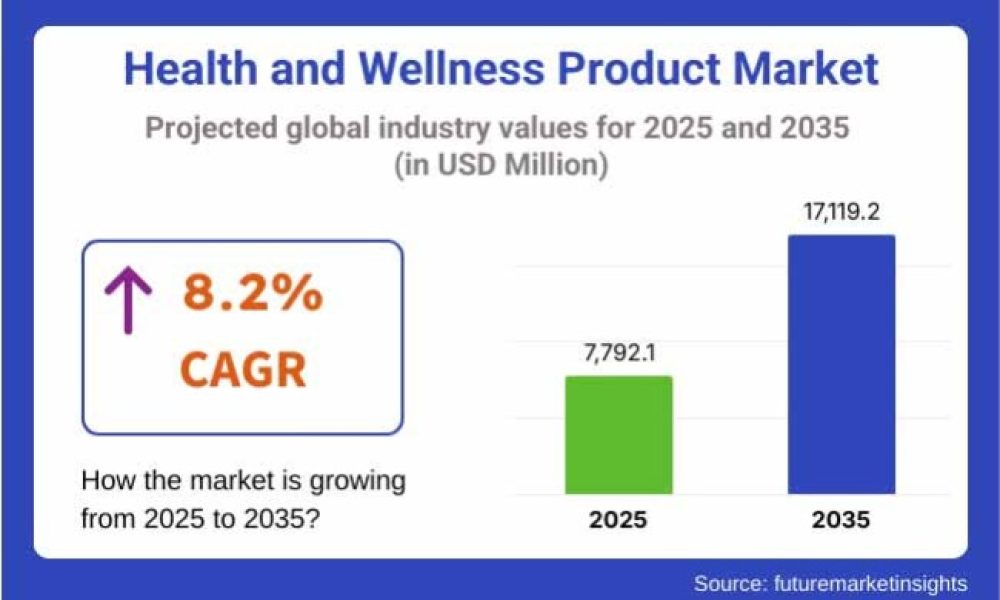
The global Health and Wellness Products Market is entering a strong growth cycle as consumers shift from illness-based treatment to everyday proactive well-being. According to the latest industry assessment, the market reached USD 7,235.0 million in 2024, and rising demand has already pushed the value to USD 7,792.1 million in 2025. Between 2025 and 2035, the market is projected to grow at a compound annual growth rate (CAGR) of 8.2%, reaching USD 17,119.2 million by the end of the forecast period.
The shift is driven by global interest in preventive healthcare, nutrition-based immunity support, and lifestyle disease management. Consumers are increasingly choosing functional foods, dietary supplements, natural personal care, and wellness-driven beverages, prioritizing mental well-being, immunity, gut health, and stress relief.
To Explore Detailed Market Data, Segment-Wise Forecasts, and Competitive Insights, Request Sample Report. https://www.futuremarketinsights.com/reports/sample/rep-gb-2506
Why Demand Is Accelerating
Consumers are no longer treating wellness as an occasional priority—health is now integrated into everyday routines.
Key drivers include:
- Awareness of lifestyle diseases, especially among working populations
- Demand for clean, organic, and non-GMO ingredients
- Growth of digital health tools that personalize nutrition and wellness
Wearables, fitness apps, customized vitamin packs, and at-home diagnostics are empowering consumers to track and modify their wellness in real time.
Brands that integrate personalization and sustainability are capturing the strongest market share—especially with millennials and Gen Z.
Market Growth Acceleration Over Time
The market’s momentum is visible in its CAGR progression:
- From 2024 to 2034, growth strengthened from 7.4% to 7.7%
- From 2025 to 2035, the rate climbed further from 8.0% to 8.2%
This reflects consistent revenue realization through retail channels and strong demand from digital commerce.
Competitive Landscape — Multi-Level Market Structure
The market consists of three competitive layers:
Tier 1: Global power brands
Companies like Nestlé Health Science, Unilever, Procter & Gamble, and Amway dominate with multi-category portfolios, massive R&D investments, and omnichannel presence. Nestlé is expanding aggressively into medical nutrition and functional beverages, while Unilever’s new Vitality & Wellbeing unit is focused on plant-based nutrition, vitamins, and natural personal care.
Tier 2: Emerging category leaders
Brands such as Garden of Life, The Honest Company, and NOW build loyalty through ingredient transparency, sustainability, and community-focused marketing.
Tier 3: Challenger startups
Young brands—like Ritual (subscription-based supplements) and Moon Juice (adaptogenic formulas)—win on agility, personalization, and clean-label positioning.
Key Demand Shifts and Business Strategies
- Functional Beverages and Healthy Snacks Surge
Consumers want nutrition on-the-go. Functional waters, probiotic drinks, adaptogenic beverages, and protein snacks are seeing strong traction.- PepsiCo’s Gatorade Fit line helped drive a 10% sales increase in its fitness beverage segment.
- Danone’s Activia probiotic drink range expanded European sales by 14%.
- Beauty-from-Within Is Becoming Mainstream
Collagen supplements, ingestible skincare, and nutricosmetics are rapidly replacing single-function products.- Vital Proteins grew 20% in Q3 2024
- Shiseido’s ingestible beauty range increased sales in Asia-Pacific by 15%
- Sustainable Products Are Driving Purchasing Decisions
Consumers are actively choosing companies that reduce plastic use, offer ethical sourcing, and use recyclable packaging.- Gaia Herbs’ compostable packaging initiative drove 12% higher annual revenue
- Pukka Herbs saw a 9% rise in European sales after introducing zero-waste packaging
- Localization Unlocks Global Growth
One-size-fits-all no longer works in wellness.- Herbalife Nutrition recorded 17% growth after launching turmeric supplements in India and spirulina drinks in Brazil.
- Amway Nutrilite’s tailored vitamin blends for Southeast Asia increased sales by 13% in Vietnam and Indonesia.
Country-Level Growth Highlights
- The United States is expanding rapidly due to digital wellness, telemedicine, wearable health tech, and personalized nutrition—achieving 7.0% CAGR through 2035.
- Germany emphasizes preventive nutrition and organic personal care, growing at 6.5% CAGR.
- China is growing at 8.5% CAGR, driven by urbanization, rising disposable incomes, and e-commerce.
- Japan, with an aging population, prioritizes wellness tech and mobility supplements, growing at 5.8% CAGR.
- India posts the fastest surge with 9.2% CAGR, fueled by rising health awareness and adoption of natural supplements.
Empower Your Business Decisions With Verified Industry Forecasts And Competitor Intelligence. Buy Full Report. https://www.futuremarketinsights.com/checkout/2506
Leading Companies
Pfizer Inc. • Nestlé S.A. • The Coca-Cola Company • Unilever • Procter & Gamble • GSK • Kraft Heinz • Walgreens • General Nutrition Centers Inc. • Arbonne International • Others
About Future Market Insights (FMI)
Future Market Insights, Inc. (ESOMAR certified, recipient of the Stevie Award, and a member of the Greater New York Chamber of Commerce) offers profound insights into the driving factors that are boosting demand in the market. FMI stands as the leading global provider of market intelligence, advisory services, consulting, and events for the Packaging, Food and Beverage, Consumer Technology, Healthcare, Industrial, and Chemicals markets. With a vast team of over 400 analysts worldwide, FMI provides global, regional, and local expertise on diverse domains and industry trends across more than 110 countries.



