
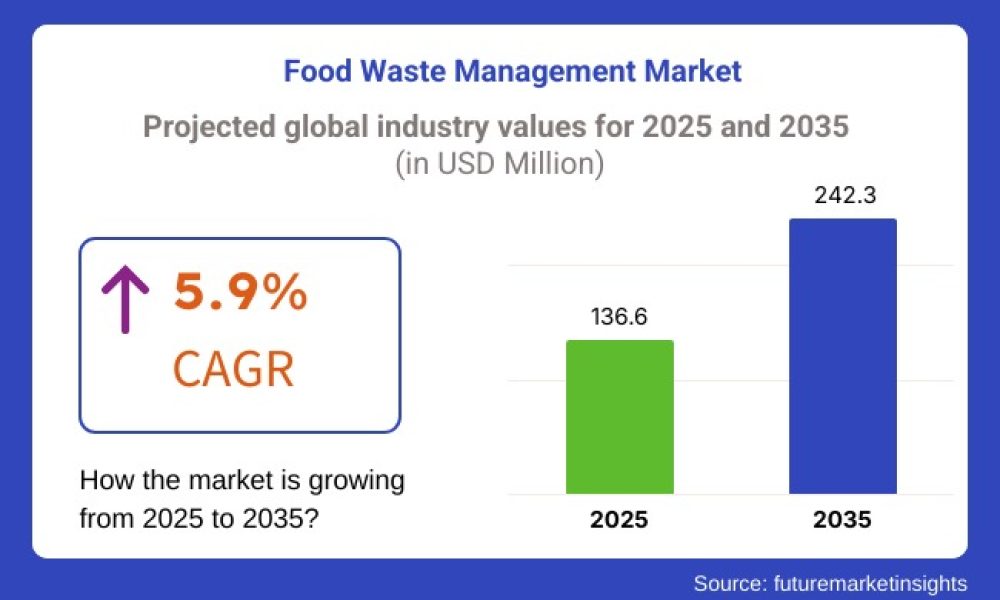
The global food waste management market is forecast to grow from USD 136.6 million in 2025 to USD 242.3 million by 2035, marking a 5.9% CAGR, according to a recent industry assessment. The market is transitioning from waste disposal toward resource monetization, driven by regulatory pressure, carbon-reduction targets, and technological advancements that convert waste into energy, fertilizer, and bio-products.
Get Exclusive Access To Data Tables, Market Sizing Dashboards, And Analyst Insights. Request Sample Report. https://www.futuremarketinsights.com/reports/sample/rep-gb-2749
Regulation Tightens — “Waste” Becomes a Recoverable Resource
Governments are accelerating landfill bans and mandatory organic waste diversion. The EU’s Farm-to-Fork strategy, multiple U.S. states, and South Korea now enforce segregation or organic waste disposal bans on businesses, prompting food retailers and food-service chains to contract specialized waste processors. Organics are now the fastest-growing waste stream globally, expanding faster than plastics and paper.
A 2024 Journal of Cleaner Production study highlights that reducing food loss delivers better Scope-3 emissions reductions than switching to recyclable or compostable packaging, pushing CPG brands to adopt surplus recovery and redistribution programs.
Technology Breakthroughs Improve ROI in Organics Recycling
Circular economy technologies have evolved from costly experiments to profitable operations. According to ReFED’s USA Food-Waste Forecast 2025, aerobic digesters and anaerobic co-digestion systems achieve breakeven in under five years, fueled by demand for renewable natural gas (RNG) and carbon-credit incentives.
AI and automation are rewriting the economics of waste diversion:
- Winnow, Leanpath, and Orbisk deploy AI-driven vision systems that reduce food waste by up to 50% in hospitality.
- Optical sorting machines today deliver 96% material purity on mixed bakery waste streams.
- Enzyme enhancers accelerate in-vessel composting by 40%.
- Blockchain certification now verifies source-segregated organic loads, improving market value of finished compost.
According to WM (Waste Management Inc.) CEO Jim Fish, announcing a USD 3 billion renewable-energy expansion,
“Food waste becomes low-carbon fuel — proof that waste is a resource when managed correctly.”
Market Dynamics Strengthen in Second Half of Forecast Period
Industry modeling reflects a stronger growth slope between 2025 and 2035 compared to 2020–2024. The current decade shows acceleration as countries move beyond voluntary waste reduction into enforcement-based zero-waste compliance. Growth rates increase in the second half of the forecast period, highlighting maturing infrastructure and broader corporate participation.
Segment Insights
Recycling leads the market with a 35% share in 2025.
Its dominance is fueled by landfill taxes, carbon fees, and incentives for composting and waste-to-energy. Multinational food companies increasingly extract value from waste streams through anaerobic digestion, fermentation, composting, and biofuel generation.
Food processing waste represents 28% of total volume.
Bakery, dairy, seafood, and meat processors drive the largest waste volumes. Companies including Cargill, Danone, Nestlé, ADM, and Bühler are commercializing feed-grade proteins, antioxidants, enzymes, and fiber concentrates from discarded by-products, demonstrating profitability through upcycling.
Regional Outlook: USA, Europe, and APAC Lead Adoption
The United States remains the largest value market, driven by:
- 63 million tons of annual food waste,
- Anaerobic digestion infrastructure growth, and
- State-mandated composting programs and landfill methane fees.
Corporations are adopting AI-based waste tracking and donation of surplus food to reduce disposal costs.
China and India drive the steepest growth rates in APAC.
China mandates waste segregation and deploys smart waste bins and AI sorting stations across 36 megacities. India invests in decentralized composting and blockchain traceability for supply chains to reduce food waste at retail and distribution points.
Europe accelerates adoption through landfill taxes, extended producer responsibility (EPR), and mandatory food waste reporting.
Japan, constrained by dense urban populations, deploys compact fermentation plants and IoT-connected waste logistics to improve recycling efficiency.
Competitive Landscape
The market is led by global waste management and recycling operators, including:
- Veolia Environnement
- Waste Management Inc.
- SUEZ Group
- Republic Services Inc.
- Clean Harbors Inc.
These companies invest in:
- Circular economy platforms,
- Waste-to-energy systems,
- AI-enabled analytics, and
- Bioconversion.
Simultaneously, startups deploying AI, smart bins, and decentralized micro-digestion units are reshaping competitive dynamics. Data-driven platforms allow real-time waste measurement, enabling customers to reduce waste at the source rather than merely process it.
For Customized Insights And Licensing Options, Get The Full Report. Purchase Full Report. https://www.futuremarketinsights.com/checkout/2749
Industry Outlook
The decade ahead marks a permanent shift — from sending food to landfill to turning food waste into fuel, fertilizer, and revenue. As regulations tighten, carbon economics strengthen, and waste valorization technology matures, the food waste management market is positioned for steady, innovation-led expansion through 2035.
About Future Market Insights (FMI)
Future Market Insights, Inc. (ESOMAR certified, recipient of the Stevie Award, and a member of the Greater New York Chamber of Commerce) offers profound insights into the driving factors that are boosting demand in the market. FMI stands as the leading global provider of market intelligence, advisory services, consulting, and events for the Packaging, Food and Beverage, Consumer Technology, Healthcare, Industrial, and Chemicals markets. With a vast team of over 400 analysts worldwide, FMI provides global, regional, and local expertise on diverse domains and industry trends across more than 110 countries.



