
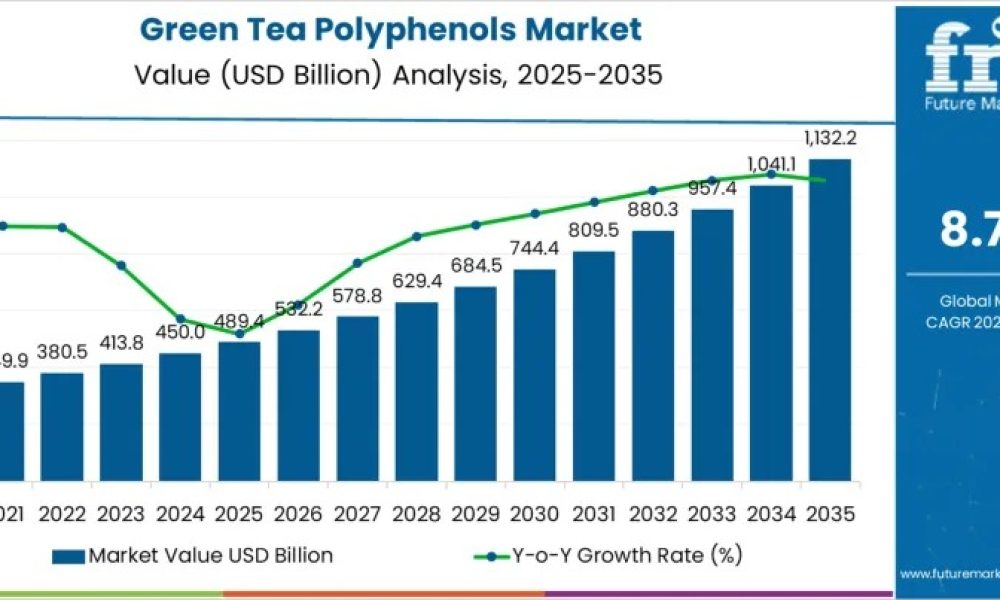
The global green tea polyphenols market is gaining strong commercial traction, with demand valued at USD 0.5 billion in 2025 and forecast to reach USD 1.1 billion by 2035, expanding at a CAGR of 8.7%. Growth is closely linked to the rising use of catechin-rich extracts across skin care, nutraceutical, and functional beverage applications, where antioxidant and anti-inflammatory performance remains central to formulation strategies.
Manufacturers increasingly prioritize natural, research-backed actives, and green tea–derived polyphenols meet these criteria with high consumer familiarity and established safety validation. The ingredient’s alignment with clean-label expectations and botanical sourcing trends supports steady integration into premium product portfolios worldwide.
Explore trends before investing – request a sample report today!
Skin care remains the leading application segment, with polyphenols widely used in serums, masks, lotions, sunscreens, and dermocosmetic solutions. These actives support photoprotection, collagen stability, environmental defense, and redness reduction. Encapsulation and delivery technologies are improving ingredient bioavailability while maintaining formulation clarity and stability.
Quick Market Snapshot
- 2025 Market Value: USD 0.5 billion
- 2035 Forecast Value: USD 1.1 billion
- Forecast CAGR (2025–2035): 8.7%
- Leading Application: Skin Care
- Key Regions: Asia Pacific, Europe, North America
Market Growth Outlook Through 2035
Asia Pacific, Europe, and North America represent the highest consumption zones due to strong personal-care manufacturing bases and expanding demand for plant-based functional actives. Premium dermocosmetic and clinically referenced skincare lines drive higher-value usage, while nutraceutical and beverage brands leverage standardized EGCG extracts for metabolic, immune, and cognitive wellness positioning.
Major ingredient suppliers including BASF SE, Croda International, Evonik Industries, Symrise, and Dow continue focusing on high-purity catechin extraction, clinical substantiation, and compatibility with multi-functional systems. Process optimization and traceable sourcing remain key differentiators.
While dietary supplements show signs of maturity in developed markets, personal care offers greater headroom as brands reformulate toward natural antioxidants. Pharmaceutical and medical nutrition research areas remain less saturated and may unlock future therapeutic positioning with stronger clinical evidence.
Demand Drivers and Industry Trends
Rising consumer awareness of oxidative stress, healthy aging, and preventive wellness is expanding the adoption of polyphenol-rich products globally. Functional beverage manufacturers include extracts in ready-to-drink teas, wellness shots, and powders, while cosmetics companies highlight anti-aging and barrier-support benefits.
Key trends shaping the industry include:
- Standardized high-purity extracts for consistent potency
- Expansion into non-beverage formats such as snacks and skincare
- Growing demand for vegan, non-GMO, and clean-label antioxidants
- Stability-focused innovations for heat- and light-sensitive formulations
Constraints include raw material variability, regulatory limits on health claims, and formulation challenges related to bitterness masking and ingredient stability.
Application and Product Form Insights
By End Use Application, skin care leads global consumption, accounting for a notable share of demand. Claims center on anti-aging, UV defense, and sensitivity repair. Hair care, sun care, and dermocosmetic categories also show steady integration.
By Product Form, powders dominate due to higher stability, concentration, and ease of handling across global supply chains. Liquid extracts support high-absorption serums and functional dosing, while gels, dispersions, and emulsions improve sensorial performance.
Regional Performance Highlights
India leads growth with 11.8% CAGR, supported by expanding nutraceutical manufacturing and herbal wellness positioning. China follows at 10.9%, benefiting from large-scale extraction capacity and export readiness. Japan grows at 10.1%, driven by clinical validation and healthy-aging demand. The UK (9.2%), Germany (8.3%), and the U.S. (7.4%) show steady expansion tied to preventive nutrition and functional beverage innovation.
Get the full scoop—view the complete report!
Competitive Landscape
The global competitive structure emphasizes ingredient purity, traceability, and oxidative stability. BASF SE holds an estimated leading share, supplying validated extracts for dermocosmetic and nutrition applications. Croda International, Evonik Industries, and Symrise maintain strong presence in personal-care channels through advanced delivery systems. Dow supports beverage and wellness applications with scalable documentation and compatibility support.
Additional contributors such as Ashland, Clariant, Seppic, Lubrizol, Lonza, and Inolex drive innovation across capsules, gummies, and topical formulations. Competitive strength increasingly depends on EGCG standardization, sustainability credentials, and formulation stability under diverse conditions.
As natural antioxidant demand strengthens across health, beauty, and functional food sectors, green tea polyphenols remain positioned as a versatile and scientifically supported botanical active for long-term market growth.
Key Players in the Green Tea Polyphenols Market
- BASF SE
- Croda International
- Evonik Industries
- Symrise (incl. IFF/Givaudan actives)
- Dow / Dow Inc.
- Ashland
- Clariant
- Others (Seppic, Lubrizol, Lonza, Inolex etc.)
About Future Market Insights (FMI)
Future Market Insights, Inc. (FMI) is an ESOMAR-certified, ISO 9001:2015 market research and consulting organization, trusted by Fortune 500 clients and global enterprises. With operations in the U.S., UK, India, and Dubai, FMI provides data-backed insights and strategic intelligence across 30+ industries and 1200 markets worldwide.



