
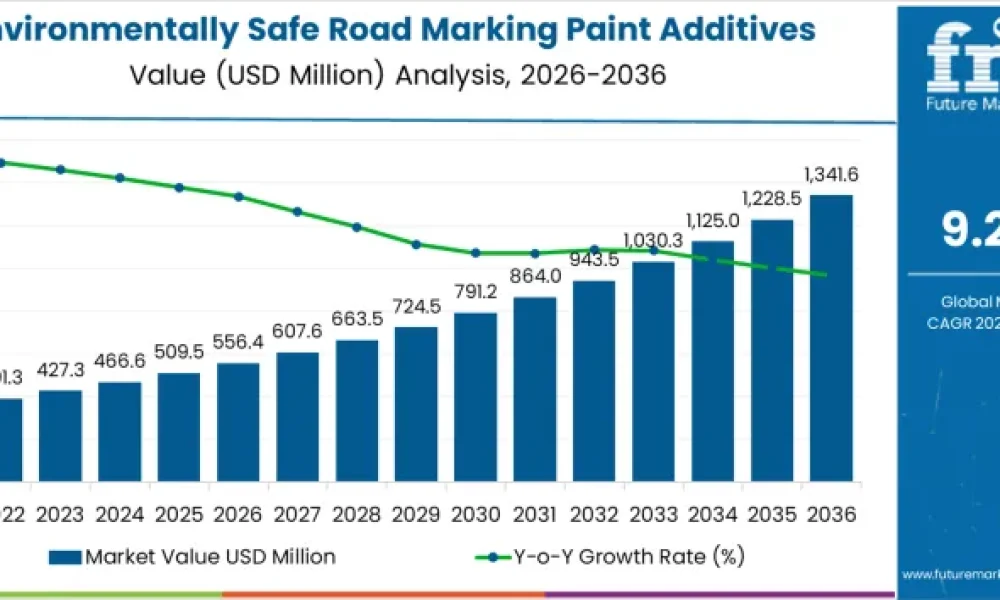
The global Environmentally Safe Road Marking Paint Additives Market is projected to grow from USD 556.4 million in 2026 to USD 1,341.6 million by 2036, representing a strong compound annual growth rate (CAGR) of 9.2% as demand for eco-friendly infrastructure solutions accelerates across public and private sectors. This growth is driven by tightening environmental regulations, increasing sustainability mandates in construction and transport projects, and the rising adoption of additives that enhance performance while reducing volatile organic compound (VOC) emissions and hazardous chemical content in traditional road marking systems.
With governments and transportation agencies worldwide prioritizing long-term environmental and safety outcomes, the market for safe road marking additives has moved beyond niche demand to become a mainstream requirement in planning and executing infrastructure development strategies.
Key Market Insights at a Glance
The market’s robust growth trajectory highlights several strategic insights. The road marking type segment of waterborne road marking paints commands the largest share at 34%, illustrating a clear shift toward low-VOC, sustainable formulations that deliver both environmental benefits and high visible performance. Highways and expressways represent the largest application area with a 32% share, underscoring how critical road safety and durability considerations are influencing public works procurement. Innovation within additive classes such as bio-based binders, UV-resistant agents, low-VOC plasticizers, and adhesion promoters continues to expand product differentiation, offering better longevity, retroreflectivity, and reduced maintenance costs over lifecycle cycles.
Segment Overview
Market segmentation by product and application reflects industry prioritization of eco-performance without compromising technical specifications. Among additive types, bio-based binders and resins are increasingly favored, acting as sustainable alternatives to traditional petroleum-derived components that also support compliance with global eco-standards. Waterborne additive systems, leading the road marking type category, are integral for delivering environmental compliance alongside weather resistance and durability. On the application side, highways and expressways dominate demand, as these corridors require high-performance markings that withstand heavy traffic loads and variable climatic conditions, while urban streets, airport runways, industrial zones, and cycling pathways present growing niche opportunities for safer additives.
Regional Overview
Regionally, the market’s growth is broadly distributed, yet certain territories demonstrate pronounced momentum. High-growth markets such as India and China show projected CAGRs above 9%, catalyzed by expanding road networks, major investments in smart city infrastructure, and heightened environmental benchmarks shaping procurement policies. Developed economies, including the United States and Germany, are contributing to steady demand as regulatory pressure and public awareness elevate sustainable solutions in road maintenance and construction. Latin American markets, particularly Brazil, are also advancing eco-safe additive adoption through infrastructure modernization initiatives. Collectively, these regional drivers paint a vivid picture of a global sector both responsive to regulatory evolution and reflective of broader sustainability priorities.
To access the complete data tables and in-depth insights — Request Your Sample Report Now
Competitive Landscape
The competitive landscape is marked by both established industry leaders and innovative challengers focusing on sustainability and performance enhancement. Key players such as 3M, Dow Inc., Sherwin-Williams, BASF SE, and PPG Industries have invested significantly in research and development to expand their portfolios of environment-friendly additives. These companies compete on the basis of product innovation, regulatory alignment, and performance reliability, with many leveraging proprietary technologies to offer enhanced adhesion, color retention, UV stability, and VOC reduction. Strategic collaborations between additive specialists and paint manufacturers are increasingly common, aimed at validating field performance and accelerating specification adoption among transportation authorities and private contractors.
Market Outlook: Powering the Next Decade
As global infrastructure spending continues to grow, market outlook forecasts point to accelerating adoption of environmentally safe road marking additives over the next decade. The industry’s shift toward low impact chemistries coincides with broader construction and transport sustainability trends, particularly as ESG (Environmental, Social, and Governance) criteria become embedded in public project funding decisions and corporate procurement standards. Demand is expected to scale as agencies seek additives that not only improve visibility and longevity but also contribute to reduced total cost of ownership through lower maintenance frequency and minimized environmental hazards.
Emerging application niches like smart road systems and reflective microbead technologies further extend the role of safe additives, offering compatibility with next-generation asphalt coatings and photoluminescent marking systems. These advancements present significant opportunities for market players to differentiate offerings, optimize performance features, and support infrastructure stakeholders in fulfilling both safety and sustainability mandates.
Recent Strategic Developments
Recent developments in the sector underscore a dynamic innovation pipeline. Product launches focusing on enhanced performance with minimal environmental footprints are becoming more frequent. Partnerships between additive suppliers, paint producers, and infrastructure agencies are enabling field trials and specification updates. Additionally, expansion into emerging markets and investments in local manufacturing capacities highlight the industry’s commitment to broadening geographic reach and responsiveness to regional needs.
Have a specific Requirements and Need Assistant on Report Pricing or Limited Budget please contact us – [email protected]
About Future Market Insights (FMI)
Future Market Insights, Inc. (FMI) is an ESOMAR-certified, ISO 9001:2015 market research and consulting organization, trusted by Fortune 500 clients and global enterprises. With operations in the U.S., UK, India, and Dubai, FMI provides data-backed insights and strategic intelligence across 30+ industries and 1200 markets worldwide.
Why Choose FMI: https://www.futuremarketinsights.com/why-fmi



