
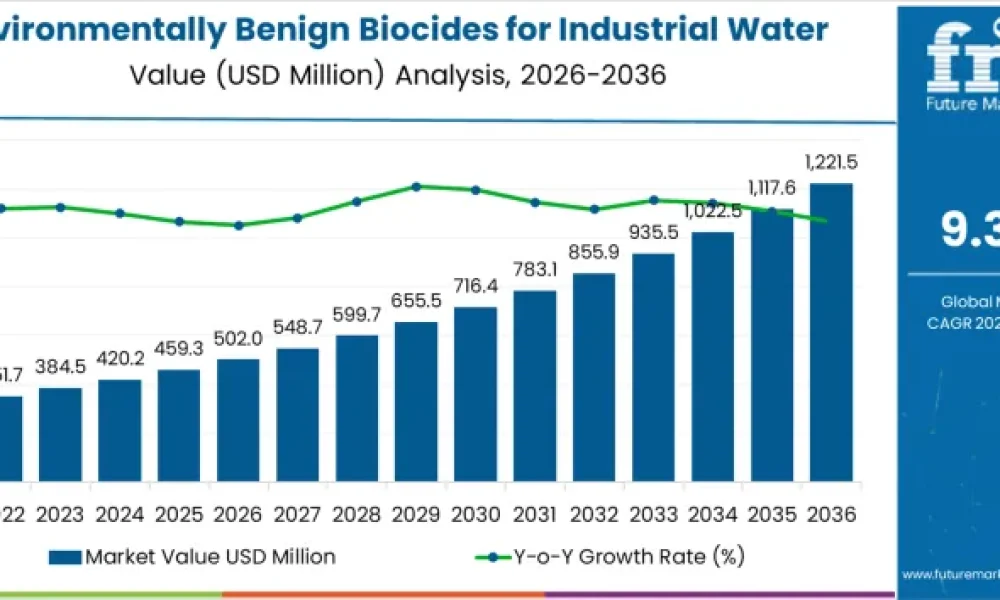
The global Environmentally Benign Biocides for Industrial Water Market, valued at USD 502 million in 2026, is projected to expand rapidly to reach approximately USD 1,221.5 million by 2036, exhibiting a robust compound annual growth rate (CAGR) of 9.3% over the forecast period as industries intensify adoption of sustainable water treatment solutions to meet stringent ecological and regulatory mandates. This strategic growth reflects an accelerated shift from traditional chemical treatments toward eco-compliant microbial control technologies in cooling towers, process water systems, and wastewater applications worldwide.
Key Market Insights at a Glance show that market expansion is primarily driven by industrial water managers’ increasing prioritization of regulatory compliance, reduction of toxic discharge, and alignment with corporate environmental, social, and governance (ESG) goals. Enzymatic and bio-based biocides are leading adoption due to their biodegradability and reduced environmental impact, while liquid dosing systems remain a preferred delivery format supporting automated control. Cooling towers and industrial water systems account for a significant share of early market adoption due to continuous operational pressures and strict effluent norms.
In the Segment Overview, environmentally benign biocides are categorized by product type, application area, and delivery method. The product type segment is dominated by enzymatic and bio-based biocides, which together capture roughly 30% of total market demand in 2026 as operators seek effective microbial control that aligns with sustainability objectives. Oxidizing green biocides and non-oxidizing eco-friendly alternatives complement this leadership, particularly in scenarios requiring rapid microbial kill or extended residual control without persistent toxic byproducts. Application segmentation highlights cooling towers and industrial water systems as commanding the largest share (about 36%) of global usage, with secondary opportunities expanding through wastewater treatment, oil and gas water injection, pulp and paper processing, and food-grade water management. Delivery methods such as liquid dosing, tablets, and powders tailor treatments to specific facility needs, balancing precision with ease of system integration.
From a Regional Overview, North America, Europe, and the Asia Pacific are pivotal growth hotspots. In North America, the U.S. market is forecast to grow at a CAGR of approximately 8.3% through 2036, supported by well-established industrial infrastructure and environmental compliance frameworks. Europe’s mature industrial base and stringent regulatory regimes underpin steady expansion, while India and China are among the fastest-growing regional markets, with projected CAGRs of about 10.2% and 9.9%, respectively, reflecting rapid industrialization paired with strengthened environmental policies. Additional traction is emerging in Latin America and Southeast Asia as sustainability priorities and water reuse initiatives gain momentum.
To access the complete data tables and in-depth insights — Request Your Sample Report Now
Within the Competitive Landscape, leading companies are advancing environmentally benign biocide portfolios through innovation, strategic collaborations, and expanded operational footprints. Notable industry players include global water treatment and chemical providers who are intensifying focus on eco-compliant solutions that deliver microbial control without compromising industrial throughput. These competitors are leveraging R&D efforts to enhance product performance, broaden application scopes, and address diverse water chemistries encountered in complex industrial environments.
As part of the Market Outlook: Powering the Next Decade, long-term prospects for environmentally benign biocides remain compelling. Intensifying environmental regulations that limit the use of persistent biocides and promote discharge safety thresholds will continue to shift capital and operational expenditures toward greener alternatives. Adoption is expected to scale from pilot deployments toward full integration in automated water treatment programs, driven by life-cycle cost assessments that increasingly favor sustainable chemistries. Enterprises are integrating advanced monitoring and dosing technologies to optimize performance, reduce overall chemical loading, and enhance operational reliability. Moreover, emphasis on water reuse, zero liquid discharge (ZLD) systems, and corporate sustainability pledges will propel demand across multiple industrial sectors.
The Key Players of the Sustainable Label Industry are effectively shaping the market’s trajectory. Through strategic partnerships, global distribution networks, and continuous product innovation, these companies are positioned to meet growing demand for environment-friendly biocidal technologies. Their expanding portfolios reflect a balance of efficacy, regulatory alignment, and ecological stewardship, enabling industrial water managers to meet performance expectations while reducing environmental footprint.
Recent years have witnessed Strategic Developments that support market maturation and broaden application reach. Innovations in enzyme-assisted treatments, targeted biofilm disruptors, and environmentally tolerant formulations are enhancing efficacy in even the most challenging water chemistries. Partnerships between chemical providers and industrial integrators are enabling seamless deployment of condition-based dosing systems, while investments in regional manufacturing capacity are ensuring faster delivery and localized support for customers.
Have a specific Requirements and Need Assistant on Report Pricing or Limited Budget please contact us – [email protected]
About Future Market Insights (FMI)
Future Market Insights, Inc. (FMI) is an ESOMAR-certified, ISO 9001:2015 market research and consulting organization, trusted by Fortune 500 clients and global enterprises. With operations in the U.S., UK, India, and Dubai, FMI provides data-backed insights and strategic intelligence across 30+ industries and 1200 markets worldwide.
Why Choose FMI: https://www.futuremarketinsights.com/why-fmi



