
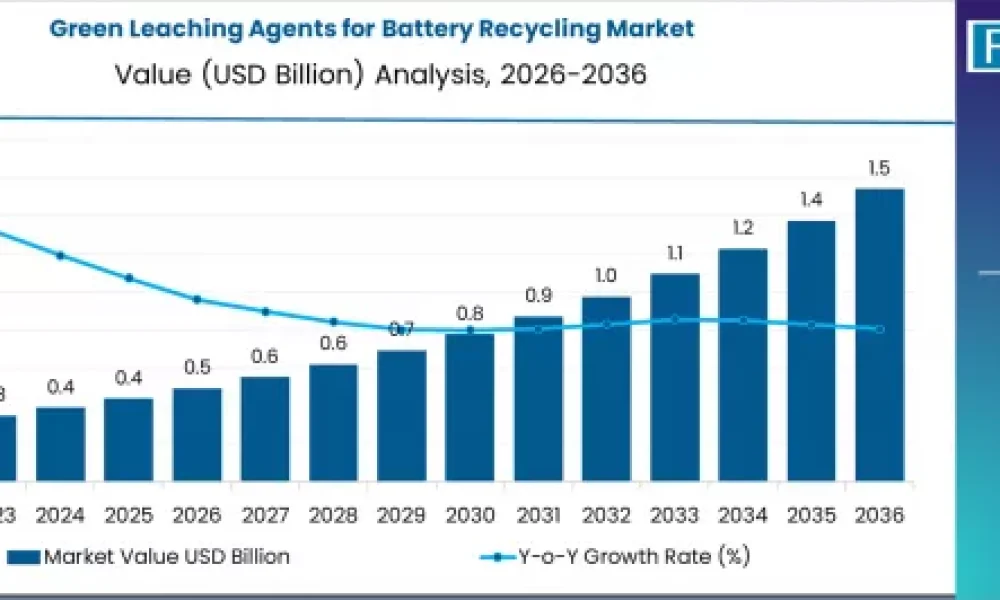
The global green leaching agents for battery recycling market is witnessing strong momentum as sustainability imperatives, circular economy goals, and critical mineral recovery become central to battery lifecycle management. With the rapid growth of electric vehicles (EVs), energy storage systems, and consumer electronics, the volume of end-of-life lithium-ion batteries is increasing significantly, creating urgent demand for environmentally responsible recycling solutions.
In 2026, the green leaching agents for battery recycling market is estimated to be valued at USD 0.49 billion. By 2036, the market is projected to reach approximately USD 1.54 billion, registering an absolute increase of USD 1.05 billion over the forecast period. This expansion reflects a compound annual growth rate (CAGR) of around 12.1% between 2026 and 2036, indicating strong adoption of low-impact chemical extraction technologies across battery recycling operations.
Market Overview
Green leaching agents are environmentally benign chemical systems designed to extract valuable metals such as lithium, cobalt, nickel, manganese, copper, and aluminum from spent batteries. Unlike conventional recycling methods that rely on strong inorganic acids or energy-intensive thermal processes, green leaching agents operate under milder conditions and significantly reduce hazardous waste generation.
These agents include deep eutectic solvents, organic acid-based systems, ionic liquids, and bioleaching solutions, all of which are engineered to improve selectivity, reduce energy consumption, and lower environmental impact. Their adoption is becoming increasingly critical as recycling efficiency, carbon footprint reduction, and regulatory compliance gain importance in the global battery value chain.
Key Takeaways from the Green Leaching Agents for Battery Recycling Market
- Market Value for 2026: USD 0.49 Billion
- Market Value for 2036: USD 1.54 Billion
- Forecast CAGR (2026-2036): 12.1%
- Leading Leaching Chemistry Share (2026): Deep Eutectic Solvents (DES) & ChCl-based systems (26%)
- Leading Recovery Focus Share (2026): Lithium recovery-oriented leachants (28%)
- Leading Process Type Share (2026): Hydrometallurgy with green solvents (45.00%)
- Leading End-User Share (2026): Dedicated EV battery recyclers (42.0%)
- Key Players in the Market: Solvomet, BASF, Umicore
To Access the Complete Data Tables & in-depth Insights, Request a Discount on this report: https://www.factmr.com/connectus/sample?flag=S&rep_id=12938
Key Market Drivers
One of the primary growth drivers for the green leaching agents market is the accelerated adoption of electric vehicles worldwide. EV batteries contain high concentrations of valuable and critical metals, making efficient and sustainable recovery essential for supply chain security and cost control. Green leaching agents enable recyclers to recover these materials while aligning with environmental regulations.
Another major driver is stringent environmental and recycling regulations. Governments and regulatory bodies are enforcing stricter recovery targets and sustainability benchmarks for battery recycling processes. These policies are pushing recyclers away from highly corrosive and polluting chemicals toward greener alternatives that offer compliance with minimal ecological impact.
The growing emphasis on ESG (Environmental, Social, and Governance) commitments among battery manufacturers, automakers, and recycling companies is further accelerating market adoption. Green leaching agents help organizations demonstrate responsible sourcing, reduced emissions, and improved lifecycle sustainability, which are increasingly important for investor confidence and brand positioning.
Market Segmentation Insights
By leaching chemistry, deep eutectic solvents and choline chloride–based systems represent the leading segment due to their biodegradability, tunable properties, and high metal selectivity. Organic acid-based leaching agents are also gaining traction, particularly in applications where mild operating conditions are required.
By recovery focus, lithium recovery remains the dominant segment, reflecting lithium’s strategic importance in EV and energy storage applications. Recovery systems targeting cobalt and nickel also hold a significant share due to their high economic value and extensive use in battery cathode materials.
By process type, hydrometallurgical recycling integrated with green solvents accounts for the largest market share. These processes offer a balance between high recovery efficiency and reduced environmental footprint. Bioleaching and hybrid process routes are emerging as promising alternatives, particularly for next-generation recycling facilities.
Regional Demand Outlook
Asia Pacific is expected to dominate the green leaching agents for battery recycling market throughout the forecast period. The region benefits from strong EV production, extensive battery manufacturing capacity, and rapidly expanding recycling infrastructure. China plays a pivotal role due to its large-scale battery recycling initiatives and policy-driven focus on circular resource utilization.
Europe represents a key growth region, supported by strict environmental regulations, advanced recycling technologies, and strong policy backing for sustainable battery management. The region’s emphasis on closed-loop battery supply chains is driving adoption of advanced green leaching solutions.
North America is witnessing steady growth as investments in domestic battery recycling facilities increase and manufacturers seek environmentally responsible recovery technologies to reduce dependence on imported raw materials.
Competitive Landscape
The green leaching agents market is innovation-driven and moderately fragmented. Market participants are focusing on developing proprietary solvent systems, improving metal recovery efficiency, and scaling laboratory-proven technologies for commercial deployment. Strategic collaborations between chemical developers, recycling firms, and battery manufacturers are becoming increasingly common.
Key competitive priorities include enhancing selectivity for target metals, improving solvent recyclability, and integrating leaching agents into existing recycling workflows without significant capital expenditure.
Future Outlook
The green leaching agents for battery recycling market is expected to maintain strong growth momentum through 2036, supported by rising EV adoption, tightening environmental regulations, and increasing focus on sustainable resource recovery. Continuous advancements in solvent chemistry, process optimization, and bio-based alternatives are expected to further improve efficiency and commercial viability.
As global battery demand continues to rise, green leaching agents will play a critical role in enabling environmentally responsible recycling, securing critical raw materials, and supporting the transition toward a sustainable and circular battery economy.
Have specific requirements or need assistance on report pricing or have a limited budget? Please contact [email protected]
About Fact.MR:
Fact.MR is a global market research and consulting firm, trusted by Fortune 500 companies and emerging businesses for reliable insights and strategic intelligence. With a presence across the U.S., UK, India, and Dubai, we deliver data-driven research and tailored consulting solutions across 30+ industries and 1,000+ markets. Backed by deep expertise and advanced analytics, Fact.MR helps organizations uncover opportunities, reduce risks, and make informed decisions for sustainable growth



