
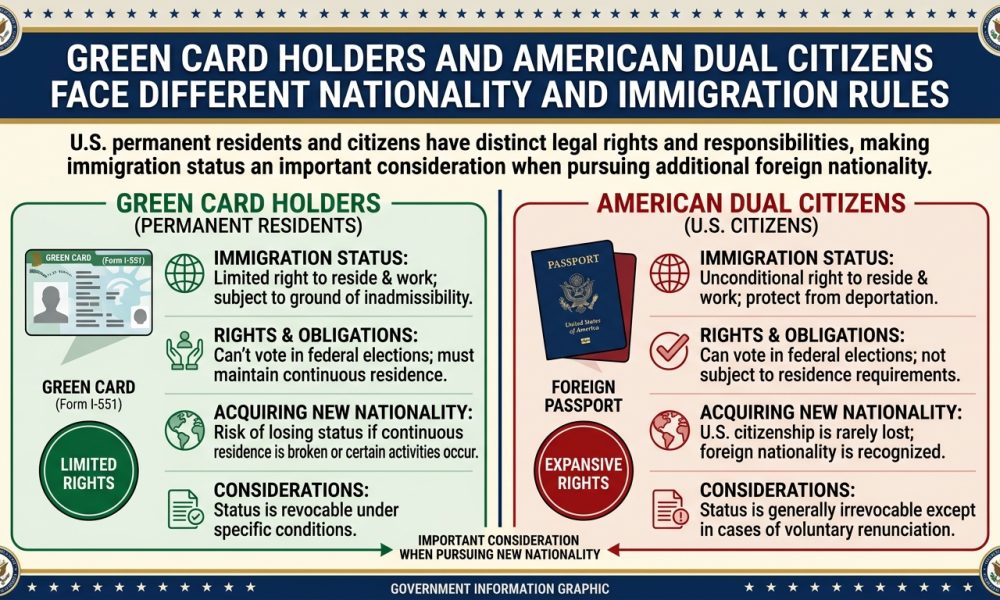
U.S. permanent residents and citizens have distinct legal rights and responsibilities, making immigration status an important consideration when pursuing additional foreign nationality, planning overseas relocation, or evaluating the consequences of extended international travel.
WASHINGTON, DC, November 18, 2026 — Foreign nationals holding United States green cards and Americans possessing citizenship in another country occupy fundamentally different legal positions, making the distinction between permanent residence and citizenship essential when planning international travel, overseas relocation, and second-nationality applications.
Although both groups may maintain substantial personal, financial, and family connections outside the United States, lawful permanent residents remain foreign nationals whose immigration status carries continuing residence requirements. At the same time, American dual citizens possess constitutional and statutory rights associated with United States nationality.
This distinction matters for individuals considering citizenship through ancestry, naturalization, marriage, or investment because obtaining an additional foreign passport does not automatically change their American immigration classification or eliminate existing legal responsibilities.
International mobility planning must therefore begin with an accurate assessment of each individual’s current status, intended residence, travel history, and citizenship eligibility before evaluating whether another passport offers meaningful additional rights or creates unexpected compliance obligations.
Permanent Residence and American Citizenship Are Different Legal Statuses
A lawful permanent resident, commonly called a green card holder, is a foreign national authorized to live and work permanently in the United States, provided the individual continues to satisfy applicable immigration requirements and maintains that status.
An American citizen, by contrast, holds United States nationality through birth, qualifying parental transmission, or naturalization, creating a legal relationship with the country that does not depend on maintaining permanent residence within American territory.
These distinctions affect international travel, voting eligibility, eligibility for certain government positions, immigration enforcement, family sponsorship, and the ability to remain abroad without risking the loss of an existing American immigration status.
Although permanent residence can provide a pathway to naturalization, holding a green card does not itself establish American citizenship, and the rights associated with citizenship generally arise only after the individual lawfully acquires that nationality.
Green Card Holders Remain Citizens of Their Original Countries
Most green card holders retain citizenship in their countries of origin, meaning they ordinarily continue traveling internationally using their foreign passports together with the documentation required to demonstrate lawful permanent residence in the United States.
A Canadian citizen holding an American green card, for example, remains Canadian unless another legally recognized nationality event changes that status. In contrast, U.S. residence authorization does not automatically convert the individual into a U.S. citizen.
Similarly, Mexican, British, Philippine, or European nationals residing permanently in America may retain their original citizenship rights, including eligibility for domestic passports, consular assistance, and residence privileges within their countries of nationality.
The key distinction is that these individuals hold foreign nationality and U.S. immigration permission. In contrast, American dual citizens hold two legally recognized citizenships, including United States nationality, regardless of where they establish their homes.
Foreign Citizenship Does Not Automatically Cancel a Green Card
A lawful permanent resident who acquires citizenship in another foreign country does not ordinarily lose American permanent residence solely because of that naturalization. However, the consequences depend upon continued compliance with American immigration requirements.
For example, a Mexican national holding a United States green card who subsequently becomes a citizen of another country may retain American permanent residence while acquiring additional nationality rights recognized under the new country’s legislation.
However, permanent resident status can become vulnerable when the individual establishes a permanent home abroad, spends extended periods outside the United States, or otherwise demonstrates an intention inconsistent with maintaining American residence.
Consequently, you should evaluate acquiring another citizenship separately from the immigration consequences of relocation, because a foreign passport cannot preserve a green card when the underlying circumstances establish abandonment of United States permanent residence.
Extended Overseas Residence Can Endanger Permanent Resident Status
A major international mobility concern for many green card holders is maintaining the United States as their permanent home, especially when employment, retirement, family obligations, or new foreign citizenship opportunities require substantial time overseas.
According to U.S. Customs and Border Protection guidance on international travel by lawful permanent residents, eligible residents may use reentry permits during qualifying overseas travel. However, the documentation does not eliminate the need to preserve their underlying immigration status.
An absence lasting less than one year does not automatically guarantee that permanent residence has been maintained, because immigration authorities may consider employment, property, family connections, tax treatment, and other evidence demonstrating the individual’s actual residential intentions.
Likewise, an extended absence does not necessarily establish abandonment in every situation, making the particular circumstances, applicable statutory provisions, and available documentation central to determining whether lawful permanent residence continues.
Reentry Permits Provide Important but Limited Protection
Green card holders anticipating lengthy international travel may apply for a reentry permit through the appropriate federal immigration procedures, generally using Form I-131 before departing the United States and completing applicable biometrics requirements.
A valid reentry permit can facilitate a permanent resident’s return following an extended temporary absence without requiring a returning resident immigrant visa, subject to its validity and other applicable admission requirements.
However, possessing a reentry permit does not conclusively establish that permanent residence has never been abandoned, particularly when the individual’s overall conduct demonstrates that another country has become their permanent home.
Individuals considering retirement abroad should therefore avoid interpreting a reentry permit as authorization to relocate indefinitely while preserving American immigration status, because continued permanent residence ultimately depends upon more than possession of a travel document.
American Dual Citizens Can Live Abroad Without Abandoning Citizenship
American dual citizens generally enjoy substantially greater freedom to establish permanent residence outside the United States because their American nationality does not depend upon maintaining an American home or returning within a prescribed immigration residence period.
For example, an American citizen who acquires Italian citizenship and relocates permanently to Italy ordinarily retains United States nationality despite living overseas for many years and establishing significant residential and economic connections in Europe.
The same principle generally applies to American citizens who obtain Mexican, Canadian, Irish, or other qualifying nationalities. However, their rights and obligations within the second country depend upon that government’s citizenship legislation.
This distinction is one of the most significant differences between citizenship and permanent residence because a green card provides conditional, continuing immigration status. In contrast, American citizenship ordinarily continues regardless of overseas residence.
Returning to the United States Involves Different Legal Protections
American citizens possess the right to enter their country of nationality, subject to lawful identity verification and applicable procedures, whereas returning permanent residents remain subject to immigration legislation governing admissibility and the preservation of their resident status.
A returning green card holder is generally not treated as seeking admission unless specific statutory circumstances apply, including certain extended absences, abandonment concerns, or qualifying criminal and immigration-related conditions recognized under federal law.
An American dual citizen returning from the country of second nationality ordinarily must present a valid United States passport, subject to authorized exceptions, rather than attempting admission as a foreign visitor using another passport.
These different procedures explain why green card holders and American dual nationals cannot be treated as interchangeable categories when evaluating airport inspections, potential immigration proceedings, overseas residence plans, or required international travel documentation.
Recent Immigration Enforcement Highlights the Distinction
Recent immigration enforcement developments have increased attention to the legal differences between permanent residents and American citizens, particularly as reports describe heightened scrutiny of individuals returning from international travel after many years of residence.
On November 17, 2026, The Washington Post reported on green card holders detained over historical legal issues, describing cases involving longstanding permanent residents whose past criminal records or disputed disclosures became subjects of renewed immigration enforcement.
The reporting included accounts of individuals and attorneys contesting the circumstances of detention. At the same time, authorities maintained that immigration screening and enforcement remained important components of their responsibility to administer federal immigration legislation.
These cases underscore that permanent residence provides substantial legal protections but does not create the same nationality-based security of residence enjoyed by American citizens, particularly when allegations involve statutory grounds of removability or inadmissibility.
Criminal Proceedings Can Affect Permanent Residents Differently
Certain criminal convictions, immigration violations, or findings of fraud can have consequences for lawful permanent residents that differ significantly from those experienced by American citizens facing otherwise comparable legal circumstances.
Depending on the offense, conviction record, statutory definitions, and procedural history, a permanent resident may face proceedings or restrictions on returning from international travel even after living in America for decades.
American citizens remain subject to criminal law and may face prosecution, imprisonment, or other lawful penalties. Still, they generally cannot be removed from the United States through ordinary immigration deportation proceedings while their citizenship remains valid.
These distinctions make qualified legal advice essential when a green card holder with prior criminal proceedings considers international travel, because assumptions based solely on past successful border crossings may not reflect current legal exposure.
Naturalization Changes the Relationship With the United States
For eligible permanent residents, naturalization generally replaces their foreign-national immigration classification with United States nationality, providing additional legal rights and eliminating the need to maintain green card status.
Naturalization ordinarily requires applicants to meet applicable residence, physical presence, good moral character, language, civics, and other statutory conditions, although exceptions or special eligibility provisions may apply to particular applicants.
Many applicants qualify under the general five-year permanent residence framework. In contrast, certain spouses of American citizens may qualify under a three-year framework when they satisfy the additional legal requirements.
After successful naturalization, the individual may retain their former citizenship if that country’s laws permit, creating dual nationality rather than automatically eliminating every citizenship relationship established before becoming American.
Continuous Residence and Physical Presence Are Separate Requirements
Green card holders planning to naturalize must distinguish between maintaining lawful permanent residence for immigration purposes and satisfying the continuous residence and physical presence requirements governing eligibility for United States citizenship.
Under the usual five-year naturalization pathway, qualifying applicants generally must demonstrate at least 30 months of physical presence in the United States during the relevant statutory period, in addition to the separate continuous residence requirement.
Absences exceeding six months but lasting less than one year can create a rebuttable presumption that continuous residence has been interrupted. In contrast, absences of one year or longer generally disrupt continuous residence unless an applicable exception applies.
Importantly, a reentry permit that facilitates travel as a permanent resident does not automatically preserve continuous residence for naturalization, meaning different immigration objectives may require different documentation and planning.
Foreign Citizenship Applications May Affect U.S. Residence Plans
Applicants pursuing citizenship in another country through a residence-based naturalization pathway may need to spend substantial periods overseas, potentially conflicting with the U.S. residence requirements for existing green card holders.
For example, a permanent resident pursuing another country’s citizenship through several years of local residence may struggle to maintain the United States as a permanent home while meeting American naturalization-related physical presence requirements.
Citizenship by descent can sometimes avoid this conflict because qualifying individuals may be eligible for recognition of foreign nationality without establishing extended residence abroad, depending upon the relevant country’s legislation and documentary requirements.
Before committing to another nationality program, green card holders should therefore examine whether the foreign pathway requires physical residence, how those obligations interact with American immigration status, and whether alternative legal routes are available.
American Dual Citizenship Does Not Require U.S. Residence
American citizens generally do not need to remain physically present in the United States to preserve citizenship, allowing dual nationals to maintain permanent homes abroad while retaining their underlying American nationality and associated international travel rights.
For example, an American who obtains citizenship through qualifying Irish ancestry may establish residence in Ireland without forfeiting American citizenship simply because the individual no longer lives or works in the United States.
Nevertheless, citizens living abroad remain subject to applicable American legal responsibilities, including federal tax rules, passport requirements, and other obligations that may continue despite permanent overseas relocation.
This difference matters for retirees and international entrepreneurs who need flexibility, because maintaining permanent residence and maintaining citizenship involve fundamentally different legal conditions and long-term consequences.
Tax Responsibilities Do Not Disappear With a Foreign Passport
United States citizens generally remain subject to federal income tax rules concerning worldwide income regardless of overseas residence. At the same time, lawful permanent residents can also remain classified as United States tax residents under applicable federal provisions.
A green card holder who relocates abroad without formally resolving immigration and tax status may therefore encounter continuing American tax obligations even when another country recognizes the individual as a resident or citizen.
Tax treaties, foreign tax credits, foreign earned income exclusions, and other statutory provisions can affect actual tax liabilities. Still, none should be interpreted as automatically eliminating the reporting responsibilities associated with American citizenship or qualifying permanent resident status.
Furthermore, the immigration consequences of claiming foreign residence or certain tax treaty positions require careful evaluation, particularly when such claims could conflict with representations that an individual continues to maintain permanent residence in America.
Green Card Abandonment and Citizenship Renunciation Are Different Processes
A permanent resident who voluntarily decides to relinquish American immigration status may use established immigration procedures, including Form I-407 where applicable, to formally record abandonment of lawful permanent residence.
An American citizen seeking to relinquish United States nationality faces a distinct legal process involving applicable nationality legislation, potential consular procedures, and consequences that should be evaluated independently of immigration status considerations.
Neither event should be confused with purchasing another passport, obtaining foreign citizenship, changing residential addresses, or spending time outside the United States, because the applicable legal requirements differ substantially.
Individuals considering either course should also evaluate potential expatriation-related taxation, foreign immigration eligibility, family consequences, and future travel requirements before making decisions that may fundamentally change their legal relationship with America.
Family Sponsorship Rights Depend Upon Immigration Classification
American citizens and lawful permanent residents can both sponsor certain family members for immigration benefits, but eligible relationships, preference categories, and immigrant-visa availability differ under federal law.
American citizens may petition for qualifying immediate relatives under provisions that generally avoid the numerical preference limits that apply to certain other family immigration categories. At the same time, permanent residents face narrower relationship classifications.
A green card holder generally cannot sponsor parents or siblings through the same immigration categories available to qualifying adult American citizens, creating potentially significant differences for families planning long-term reunification.
For families considering second citizenship alongside international relocation, these distinctions can influence decisions about whether to pursue American naturalization before departing, particularly when relatives may later seek residence in the United States.
Voting and Civic Participation Follow Citizenship Rules
Lawful permanent residents generally cannot vote in federal elections, while qualifying American citizens have federal voting rights subject to applicable registration and eligibility requirements, including for citizens residing overseas who meet the relevant rules.
An American dual citizen may also possess political participation rights in another country of citizenship, depending upon foreign election laws, registration procedures, and any residency requirements affecting citizens living abroad.
However, a foreign national holding an American green card must not assume that permission to work, pay taxes, or maintain permanent residence makes them eligible to vote in federal elections.
Accurate recognition of these distinctions is essential because improper registration, false citizenship claims, or certain election-related violations can create serious immigration consequences for noncitizens, including individuals who have maintained permanent residence for many years.
Foreign Consular Protection Depends Upon Nationality
Green card holders ordinarily retain nationality in their foreign countries. They may seek assistance from their national embassies or consulates when traveling internationally, subject to the laws governing the particular circumstances.
American dual citizens may seek United States consular assistance abroad. Still, access can be restricted when they travel to another country that also recognizes them as citizens and treats them exclusively as domestic nationals.
This distinction means that holding an American green card does not automatically entitle you to consular services reserved for United States citizens, even though permanent residence provides substantial immigration rights inside America.
Travelers should therefore verify their actual nationality and available consular arrangements before departure, especially when destination countries impose restrictions involving dual nationality, detention procedures, military obligations, or international departure permissions.
Second Passports Must Be Evaluated Against Existing Immigration Status
The decision to acquire another nationality should begin with a realistic assessment of the applicant’s current immigration classification, intended residence, international travel requirements, and longer-term family and financial objectives.
For a green card holder, preserving American residence and potentially qualifying for naturalization may represent important planning considerations, particularly when obtaining foreign citizenship involves lengthy periods outside the United States.
For an existing American citizen, the analysis differs because the individual already possesses nationality-based residence rights in America and may seek additional citizenship primarily for opportunities involving international mobility, family settlement, or employment abroad.
These differences demonstrate why generalized second-passport marketing claims cannot replace individualized immigration analysis, especially when applicants have substantially different legal relationships with the United States despite sharing similar international relocation objectives.
Amicus International Consulting and International Citizenship Planning
Amicus International Consulting addresses second citizenship, residency options, and international mobility as components of broader cross-border planning. However, legal eligibility and the preservation of American immigration status ultimately depend upon government-administered procedures.
Its second-passport and international advisory services provide information for individuals exploring additional nationality opportunities, including those seeking greater residence flexibility and international options while maintaining existing legal obligations.
For permanent residents, review any proposed foreign citizenship strategy against American residence requirements before implementation, because acquiring another passport cannot independently protect an immigration status that has been abandoned.
For American dual citizens, planning can focus more directly on the benefits and responsibilities of multiple nationalities, including overseas residence, foreign legal obligations, family considerations, and ongoing American citizenship requirements.
Legal Identity and Documentation Must Remain Consistent
Foreign citizenship recognition, lawful name changes, passport issuance, and permanent resident documentation may involve different government agencies, making accurate identity records especially important for individuals holding several immigration or nationality documents.
A lawful permanent resident who changes names through marriage or another authorized legal process should keep appropriate supporting records and update relevant documentation through established procedures to avoid inconsistencies during travel or immigration applications.
An American dual citizen should similarly ensure that government-issued passports and citizenship records accurately represent the individual’s lawful identity, since differing documents may require additional verification when crossing borders or completing financial transactions.
Neither group should assume that obtaining another nationality creates a separate identity exempt from existing legal obligations, because citizenship recognition and immigration status remain connected to the individual’s authentic personal and legal history.
International Relocation Decisions Require Different Strategies
A green card holder planning permanent retirement overseas must consider whether retaining American permanent residence is realistic, particularly when the intended relocation involves establishing a principal home, healthcare arrangements, and substantial financial connections abroad.
By comparison, an American citizen considering the same relocation can generally retain U.S. nationality without maintaining a permanent residence. However, tax reporting, foreign immigration requirements, and other legal considerations remain relevant.
When the primary objective is to maintain reliable access to America, eligible permanent residents may want to evaluate naturalization before an extended overseas relocation, while recognizing that approval depends on meeting all applicable statutory requirements.
The right sequence depends on each person’s circumstances, including citizenship eligibility, family relationships, residence history, anticipated international travel, and the legal requirements of the proposed destination country.
Citizenship and Permanent Residence Provide Different Forms of Security
The key difference between green card holders and American dual citizens is not simply which passports they hold, but whether their right to live in the United States comes from immigration authorization or citizenship.
Permanent residence offers substantial stability, employment authorization, and a possible pathway toward naturalization, but it remains subject to statutory rules concerning abandonment, certain criminal conduct, admissibility, and removal proceedings.
American citizenship provides a different legal foundation, allowing individuals to establish permanent residence abroad without automatically surrendering their right to return home, while creating continuing obligations under applicable United States law.
For individuals evaluating additional foreign citizenship in 2026, understanding this distinction is central to protecting existing rights, avoiding unnecessary immigration complications, and developing a lawful international mobility strategy consistent with long-term personal objectives.
Conclusion: Immigration Status Comes Before Second-Passport Planning
Green card holders and American dual citizens should never be treated as legally interchangeable simply because both groups maintain international connections or possess foreign passports, since their respective rights depend upon different provisions of United States nationality and immigration law.
A successful second-citizenship strategy should begin by confirming current legal status, identifying applicable residence requirements, reviewing potential naturalization opportunities, and assessing how acquiring foreign citizenship may interact with existing American obligations.
Ultimately, permanent residence provides valuable permission to make the United States a long-term home. At the same time, citizenship establishes a more enduring nationality relationship, making careful legal planning essential for anyone seeking additional international freedom without jeopardizing established rights.




