
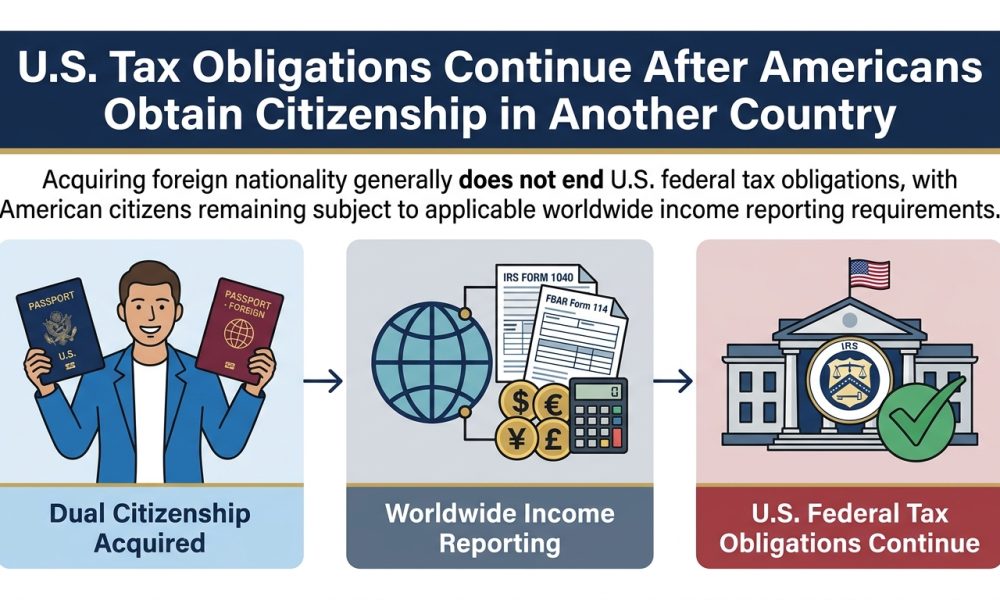
Acquiring foreign nationality generally does not end U.S. federal tax obligations, with American citizens remaining subject to applicable worldwide income reporting requirements, foreign financial account disclosures, and additional compliance responsibilities regardless of where they reside.
WASHINGTON, DC, Nov. 18, 2026 — Americans acquiring citizenship in another country through ancestry, marriage, naturalization, or investment must understand that a second passport generally does not eliminate their existing United States federal tax obligations, even when they establish permanent residence overseas.
Although additional citizenship can provide valuable international mobility, expanded residence opportunities, and greater flexibility for families managing cross-border interests, American tax legislation continues to impose worldwide income reporting requirements on qualifying United States citizens regardless of their physical location.
The distinction has become increasingly important as Americans investigate alternative citizenship arrangements, international retirement destinations, and overseas financial planning strategies that are sometimes promoted without sufficient explanation of the continuing responsibilities associated with American nationality.
For individuals considering second citizenship as part of a broader international relocation plan, understanding the differences between citizenship, tax residence, foreign income exclusions, and financial reporting obligations is essential to developing a legally sustainable strategy.
American Citizenship Remains the Foundation of Federal Tax Obligations
Unlike many countries that primarily determine individual income tax liability through residence and domestic income sources, the United States generally subjects its citizens to federal income taxation on worldwide income regardless of where they live.
The Internal Revenue Service explains in its official guidance for U.S. citizens and resident aliens abroad that Americans living overseas remain subject to federal tax laws covering income earned domestically and internationally, with applicable reporting requirements determined by their financial circumstances.
This worldwide approach means that an American who becomes a citizen of Canada, Mexico, Italy, Ireland, or another country ordinarily remains responsible for reporting taxable income to American authorities whenever federal filing requirements apply.
Income from foreign employment, overseas businesses, rental properties, investments, retirement distributions, and other international sources may therefore require inclusion in a federal income tax return, even when the individual has established substantial economic and residential connections abroad.
Importantly, reporting worldwide income does not necessarily mean paying tax twice on the same earnings, because American legislation provides exclusions, credits, deductions, and treaty-related provisions that can reduce or eliminate certain liabilities.
A Second Passport Does Not Automatically Change Tax Residency
Obtaining another country’s passport establishes or documents nationality under that government’s citizenship legislation, but it does not automatically change the individual’s classification under the United States Internal Revenue Code or terminate American tax filing responsibilities.
An American citizen who acquires Mexican nationality and relocates permanently to Mexico City, for example, may become a Mexican tax resident while simultaneously remaining subject to American federal tax rules applicable to citizens living abroad.
Similarly, Americans acquiring citizenship in European Union countries may establish foreign tax residence through actual relocation, employment, family connections, or other statutory criteria without automatically removing their existing obligations to report worldwide income to the United States.
The resulting overlap requires careful analysis because two countries may assert taxing rights over portions of the same income, making foreign tax credits, applicable treaties, and domestic exemptions important components of financial planning.
Individuals evaluating international relocation should therefore distinguish between legal nationality, immigration residence, and tax residence, since each concept operates under separate rules and can produce substantially different consequences for international finances.
Foreign Earned Income Exclusion Can Reduce U.S. Taxable Income
American citizens who live and work abroad may qualify for the foreign earned income exclusion, a federal tax provision permitting eligible taxpayers to exclude a specified amount of qualifying foreign employment or self-employment income.
For the 2026 tax year, the maximum foreign earned income exclusion is $132,900 per qualifying individual, although eligibility depends upon satisfying applicable foreign tax home requirements and either the bona fide residence test or physical presence test.
The exclusion generally applies to qualifying earned income from services performed overseas rather than passive investment earnings, meaning foreign dividends, interest, pensions, and certain other income categories require separate treatment under American tax legislation.
Taxpayers claiming this benefit ordinarily must file the appropriate federal income tax return and supporting documentation, demonstrating why living abroad and qualifying for an exclusion should not be confused with receiving an automatic exemption from filing.
Married American taxpayers may each qualify for a separate exclusion when individually eligible, although their circumstances, income sources, and filing positions must be examined carefully before determining the amount of relief available.
Foreign Tax Credits Help Address Double Taxation
The foreign tax credit provides another important mechanism for eligible Americans who pay qualifying foreign income taxes, potentially allowing those payments to offset corresponding United States federal income tax liabilities within applicable limitations.
Unlike the foreign earned income exclusion, which applies to certain qualifying earned income, foreign tax credits may address different categories of foreign-source income when the relevant taxes satisfy federal eligibility requirements.
For example, an American citizen residing in a country with comparatively high income tax rates may be able to reduce American tax liability through credits for qualifying foreign income taxes already paid.
However, foreign tax credit calculations involve complex sourcing rules, separate limitation categories, restrictions on creditable taxes, and potential carryover provisions, making professional analysis particularly important when international investments or business income are involved.
Taxpayers must also consider how the foreign earned income exclusion interacts with foreign tax credits, because American law generally prevents claiming credits for foreign taxes attributable to income already excluded under that provision.
Overseas Bank Accounts Can Trigger Separate Reporting Requirements
Americans maintaining financial accounts outside the United States may encounter additional disclosure obligations independent of whether their foreign income produces federal income tax liability, creating a significant compliance consideration for internationally mobile individuals.
The Foreign Bank Account Report, commonly known as the FBAR, generally applies when the aggregate value of reportable foreign financial accounts exceeds $10,000 at any point during the calendar year.
This threshold concerns the combined maximum value of qualifying accounts rather than the balance of each individual account, meaning several relatively modest foreign accounts can collectively trigger the reporting requirement.
Qualifying financial interests and signature authority arrangements may require examination, particularly when individuals maintain foreign checking accounts, savings accounts, brokerage relationships, or certain other financial arrangements while working or residing abroad.
An FBAR is submitted separately from the federal income tax return through the appropriate Treasury Department reporting system, and failing to recognize this distinction can create unnecessary compliance difficulties for Americans managing overseas assets.
FATCA Adds Another Layer of Financial Transparency
The Foreign Account Tax Compliance Act, commonly known as FATCA, established reporting mechanisms intended to improve transparency concerning certain offshore financial assets and accounts associated with United States taxpayers.
Under applicable FATCA provisions, specified foreign financial institutions may be required to identify and report information concerning accounts held by American persons, depending upon the institution’s obligations and relevant intergovernmental arrangements.
Certain individual taxpayers must also report specified foreign financial assets through Form 8938 when applicable filing thresholds are exceeded, although these thresholds vary according to filing status and residence circumstances.
Importantly, Form 8938 and FBAR reporting obligations are not interchangeable because their definitions, thresholds, covered assets, and submission procedures differ, potentially requiring taxpayers to complete both disclosures for overlapping financial relationships.
Americans establishing overseas banking relationships after acquiring second citizenship should accurately disclose their American tax status whenever required, rather than assuming that presenting a foreign passport changes their classification under applicable reporting legislation.
Foreign Citizenship Does Not Eliminate Investment Income Reporting
Americans who relocate abroad while retaining investments in the United States or acquiring new foreign financial assets generally remain responsible for evaluating the American tax treatment of investment income under applicable federal rules.
Dividends, capital gains, interest payments, rental income, and certain retirement distributions can remain reportable regardless of whether the financial institution holding the assets operates in the United States or another country.
For example, an American citizen holding investment accounts in Canada while residing in Thailand may face several distinct reporting and taxation questions involving investment income, account ownership, withholding arrangements, and foreign tax credits.
Foreign mutual funds and certain other non-American investment vehicles can introduce particularly complicated classifications under United States tax legislation, including potential passive foreign investment company reporting and specialized taxation requirements.
These complications demonstrate why internationally mobile Americans should assess investment structures before relocating assets overseas, rather than assuming that foreign citizenship, local banking arrangements, or overseas residence will simplify their federal tax responsibilities.
International Retirement Requires Coordinated Tax Planning
Retirement abroad has attracted interest among Americans seeking different living costs, healthcare arrangements, climate preferences, and family opportunities, but the financial consequences of permanent relocation depend upon more than the acquisition of foreign citizenship.
An American retiree receiving Social Security benefits, retirement account distributions, investment earnings, or foreign pension income must evaluate each income source under applicable federal legislation and any relevant international tax treaty.
Distributions from traditional retirement accounts may remain taxable under American rules, while foreign pension arrangements can involve additional complications depending upon contributions, investment growth, treaty provisions, and the legal classification of the particular plan.
Medicare eligibility and coverage, state taxation, estate planning, and foreign healthcare expenses can also influence relocation decisions, although these matters operate under separate frameworks from the federal income tax rules associated with citizenship.
Consequently, acquiring a second passport should be treated as one component of retirement planning rather than a comprehensive financial solution, particularly when individuals expect to maintain meaningful economic connections with the United States.
Foreign Trusts and Cross-Border Gifts Require Special Attention
Americans establishing or participating in foreign trusts may encounter specialized income tax and information reporting obligations that operate independently of ordinary citizenship documentation, potentially affecting arrangements intended for family succession or international asset management.
Depending upon the structure, ownership rules, transactions, and beneficiary relationships involved, foreign trust arrangements can create reporting requirements under Form 3520, Form 3520-A, or other applicable federal provisions.
Certain gifts or inheritances received from foreign persons may also trigger information reporting when statutory thresholds are exceeded, even when the receipt itself does not create ordinary federal income tax liability.
Trust arrangements involving foreign trustees, international beneficiaries, related-party lending, or assets transferred between jurisdictions require particular care because legal form alone does not determine the arrangement’s treatment under American tax legislation.
Families considering international trusts should obtain coordinated advice from appropriately qualified American and foreign professionals before establishing structures, transferring assets, or making distributions that could create unintended reporting or taxation consequences.
Second Citizenship Demand Includes Financial Planning Questions
Interest in alternative citizenship and residence arrangements has expanded beyond traditional high-net-worth investors to include professionals, retirees, business owners, and families seeking additional international options amid changing economic and political circumstances.
An August 2026 Business Insider report on expanding interest in second passports described how international citizenship and residence planning increasingly attracts people seeking practical lifestyle opportunities, while acknowledging that additional nationality generally does not eliminate American tax obligations.
The distinction matters because second citizenship can provide residence and mobility rights that are independently valuable even when the applicant remains responsible for federal tax filings and applicable financial disclosures.
Someone seeking European residence rights through citizenship by descent, for example, may receive substantial immigration advantages without necessarily obtaining an immediate reduction in federal income taxes or reporting obligations.
Likewise, individuals obtaining citizenship in countries offering investment-based nationality programs should evaluate program costs, nationality rights, tax residence rules, and continuing American obligations separately before concluding that an application supports their financial objectives.
Renouncing American Citizenship Is a Different Legal Process
Acquiring foreign citizenship and relinquishing American citizenship are fundamentally different legal events, with the latter requiring compliance with nationality law and potentially carrying substantial financial, immigration, and personal consequences.
American citizens who wish to relinquish their nationality generally must undertake a legally recognized expatriating act with the required intention, with formal renunciation abroad ordinarily involving proceedings before an authorized United States diplomatic or consular officer.
The act of obtaining another passport does not itself establish that American citizenship has ended, and taxpayers should not assume that a foreign naturalization certificate automatically changes their federal tax classification.
Certain individuals terminating American citizenship may face expatriation-related tax provisions, including requirements associated with Form 8854 and potential covered expatriate classification under applicable statutory tests.
Because citizenship relinquishment can affect future residence rights, family circumstances, travel arrangements, and tax obligations, the decision requires independent legal and financial evaluation rather than reliance upon promotional claims about second passports.
Expatriation Tax Rules Can Affect Certain Departing Citizens
The American expatriation tax framework addresses specific taxpayers who relinquish United States citizenship or terminate certain long-term residency statuses, with potentially significant consequences when statutory net-worth, tax-liability, or compliance-certification tests are satisfied.
Individuals meeting the definition of covered expatriates may become subject to special tax calculations involving the deemed disposition of certain assets, along with separate rules for deferred compensation, retirement arrangements, and specified interests in trusts.
Not every person relinquishing American citizenship becomes a covered expatriate, however, because the outcome depends upon detailed statutory conditions, individual financial circumstances, and available exceptions that may apply to certain individuals with dual citizenship from birth.
The possibility of expatriation-related taxation reinforces why obtaining another nationality should not be marketed as an uncomplicated mechanism for ending American tax responsibilities, particularly when substantial assets or unresolved reporting matters are involved.
Americans Living Abroad May Still Have State Tax Considerations
Although federal income tax rules apply to American citizens regardless of their geographic residence, state income tax obligations follow separate legal principles that can produce different outcomes depending upon domicile, statutory residence, and continuing personal connections.
An American moving overseas from California, New York, or another state imposing individual income taxes should investigate whether the relocation sufficiently changes domicile and whether remaining business, property, or family connections affect continued state taxation.
Conversely, individuals departing states without broad individual income taxes may encounter a different set of state-level considerations, although their federal tax obligations remain governed by applicable nationwide citizenship and residence rules.
A foreign passport does not independently establish termination of state domicile, making contemporaneous documentation of relocation circumstances and appropriate professional advice important for taxpayers seeking to understand their remaining domestic tax exposure.
Amicus International Consulting Emphasizes Planning Beyond Passport Acquisition
Second citizenship can support legitimate objectives involving international mobility, residence flexibility, succession planning, and family security, but those benefits should be assessed independently of federal taxation and foreign financial reporting requirements.
In its analysis of second passports and continuing U.S. tax reporting obligations, Amicus International Consulting addresses the important distinction between obtaining additional nationality and changing the tax responsibilities associated with American citizenship.
An effective international relocation strategy should identify the applicant’s intended country of residence, existing citizenship status, anticipated income sources, financial assets, and family circumstances before evaluating the most appropriate legal and administrative arrangements.
The objective is to preserve the legitimate advantages of international mobility while ensuring that proposed banking, investment, trust, and residence structures are reviewed against applicable laws in every jurisdiction involved.
Accurate Documentation Supports Long-Term International Compliance
Americans who obtain foreign citizenship should maintain organized records concerning nationality acquisition, overseas residence, income sources, foreign taxes paid, account ownership, and relevant financial transactions to support accurate annual reporting.
These records may become especially important when claiming foreign earned income exclusions, calculating foreign tax credits, establishing residence dates, or responding to legitimate government inquiries regarding assets held across multiple jurisdictions.
Where reporting errors or historical omissions are identified, taxpayers should investigate applicable correction procedures and obtain qualified professional advice rather than assuming that overseas residence or another country’s passport removes potential federal compliance responsibilities.
International mobility planning remains strongest when citizenship applications, immigration arrangements, tax reporting, and financial documentation are coordinated from the outset, reducing the risk that inconsistent assumptions create difficulties after relocation.
The Financial Value of Second Citizenship Extends Beyond Tax Reduction
For American citizens, a second passport can offer valuable advantages involving overseas residence, employment eligibility, education, family reunification, and international contingency planning, even when those benefits do not reduce federal income tax obligations.
The economic value of additional nationality may instead arise from greater freedom to establish residence, pursue international business opportunities, access foreign markets, or provide family members with lawful alternatives for future relocation.
These advantages deserve careful consideration because a citizenship program evaluated exclusively through potential tax savings may obscure more meaningful benefits while creating unrealistic expectations about the continuing responsibilities attached to American nationality.
Ultimately, Americans exploring second citizenship in 2026 should recognize that acquiring foreign nationality generally expands international options without terminating United States federal tax obligations, making informed compliance and coordinated cross-border planning essential to protecting the long-term value of their new citizenship.