
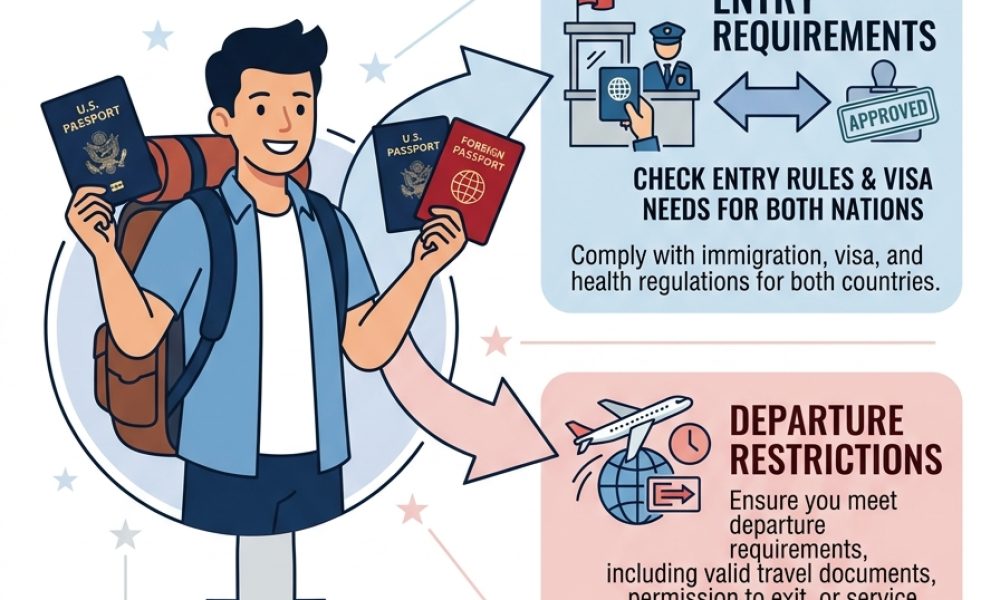
Holding multiple passports can create additional entry requirements, departure restrictions, and nationality obligations that travelers should understand before crossing international borders, particularly when governments impose different rules on citizens possessing more than one nationality.
WASHINGTON, DC, November 18, 2026 — Americans obtaining second citizenship through ancestry, naturalization, marriage, or qualifying investment programs must navigate an increasingly complex international travel environment in which possessing multiple passports can provide additional mobility while simultaneously creating overlapping legal responsibilities.
Although dual citizenship can expand opportunities for international residence, employment, education, and family relocation, travelers frequently overlook the fundamental principle that every country retains the authority to regulate the entry, departure, Identification, and legal obligations of its own citizens.
For Americans with foreign citizenship, understanding these overlapping requirements matters most when traveling between their countries of nationality, visiting destinations with different visa arrangements, or encountering governments that impose nationality-specific exit restrictions and administrative procedures.
International mobility specialists emphasize that a second passport should be treated as an additional legal privilege rather than a replacement for existing citizenship responsibilities, because the rights of one nationality do not automatically override the laws of another.
Dual Citizenship Creates Rights and Responsibilities in Two Countries
Dual nationality arises when an individual simultaneously satisfies the citizenship requirements of two countries, whether through birth, parental ancestry, marriage-related naturalization, residence-based citizenship, or another acquisition procedure recognized under the applicable nationality legislation.
Some individuals automatically acquire multiple citizenships at birth because their parents have different nationalities. In contrast, others become dual citizens later in life after completing naturalization requirements or securing formal recognition of citizenship inherited through earlier generations.
Legal consequences vary considerably because some governments broadly accept multiple citizenships, others recognize dual nationality only under specified conditions, and certain jurisdictions restrict or prohibit voluntarily acquiring another nationality without relinquishing existing citizenship.
Consequently, travelers must investigate not only whether their additional citizenship is legally recognized, but also how each country treats their nationality when processing passport applications, admitting returning citizens, permitting international departures, and providing consular assistance.
The United States generally allows its citizens to acquire another nationality without automatically losing American citizenship. However, foreign nationality laws can create separate obligations that remain enforceable in the country recognizing the individual’s additional citizenship.
American Dual Nationals Must Use Their U.S. Passports
Under federal travel legislation, American citizens generally must use valid United States passports when entering or departing the country, subject to limited statutory and regulatory exceptions for certain travel circumstances and approved alternative documents.
The U.S. Department of State explains these requirements in its official guidance on dual nationality and international travel, warning that dual citizens may encounter conflicting obligations and should investigate applicable foreign nationality laws before traveling internationally.
An American who acquires Canadian, Mexican, Italian, Irish, or another foreign citizenship cannot ordinarily substitute the newly acquired passport for the American travel document required when returning to the United States following an overseas journey.
Likewise, a United States citizen cannot properly avoid American passport requirements by attempting to enter as a foreign visitor under an electronic travel authorization, because the Visa Waiver Program applies to qualifying foreign nationals rather than American citizens.
These requirements do not eliminate the benefits of second citizenship. Still, they draw an important distinction between having additional international travel privileges and meeting the mandatory documentation rules imposed by the traveler’s country of citizenship.
Foreign Governments May Require Their Own Passports for Entry
Countries recognizing dual nationality may require citizens to enter or depart using passports issued by their own government, meaning travelers sometimes need to present different documents at opposite ends of the same international journey.
For example, an American who also possesses Mexican citizenship may need to use Mexican nationality documentation when entering Mexico while retaining a valid United States passport for the American portions of international travel.
Similarly, dual citizens traveling to countries with strict nationality-recognition systems may face additional requirements involving national identity cards, domestic population registers, civil-status documents, or locally issued travel permits before receiving permission to depart.
These requirements reflect governments’ sovereign authority to determine which documents establish citizenship at their borders, rather than allowing travelers to choose an alternative nationality whenever another passport seems more convenient.
Travelers should therefore review entry and departure rules issued by both governments before purchasing tickets, especially when their passports show different names, include different administrative details, or have substantially different expiration dates.
Airlines Introduce Another Layer of International Document Checks
Commercial airlines must verify passenger documentation before international flights, including passports, applicable visas, residence permits, and electronic travel authorizations, creating practical challenges when passengers possess multiple nationalities with different entry privileges.
A dual citizen may need to show eligibility to enter the destination with one passport while presenting a different document to establish citizenship in the country from which the individual is departing.
Airline reservation systems and automated document checks can sometimes require clarification when the nationality recorded during booking differs from the passport presented at check-in, particularly when foreign visitors ordinarily require visas or advance permission.
Travelers should carry both valid passports when appropriate and ensure that airline representatives understand their dual citizenship status, allowing the carrier to evaluate the documents required for the complete itinerary without incorrectly treating the passenger as an unauthorized foreign visitor.
Providing accurate identity information throughout the booking and boarding process helps prevent unnecessary complications. However, travelers remain responsible for complying with government requirements even when an airline initially accepts their documents without identifying a potential problem.
European Border Systems Highlight Changing Passport Procedures
European countries have introduced additional border-management technology intended to improve the recording of international travel, identity verification, and compliance with entry conditions, creating important distinctions between citizens enjoying European free-movement rights and travelers entering under foreign-national arrangements.
In May 2026, The Associated Press reported on Greece’s implementation of European biometric border checks, highlighting the practical consequences of the European Union’s Entry/Exit System for qualifying non-EU travelers and the continuing distinction between their documentation procedures and those applicable to European citizens.
An American who also holds recognized citizenship in an EU member state may benefit from European free-movement rights when entering participating European countries, provided the individual can establish the relevant EU citizenship through appropriate Identification.
However, travelers should distinguish between EU citizenship, Schengen visitor permissions, and residence authorizations because these legal categories establish different entry conditions, permitted activities, documentation requirements, and obligations when traveling throughout Europe.
Americans acquiring European citizenship through ancestry should also verify the registration and passport issuance procedures required by the relevant member state, because qualifying for nationality recognition does not necessarily mean every supporting identity document has already been issued.
Some Countries Limit Recognition of Foreign Citizenship
Not every government recognizes dual nationality the same way, and travelers may face restrictions when authorities treat them as citizens only of the country they are visiting, despite their valid American passport.
China is a particularly important example because its nationality framework generally does not recognize dual nationality for Chinese citizens, and questions about prior citizenship, citizenship transmission, and nationality status may affect administrative treatment.
Individuals who previously held Chinese nationality may need to resolve their citizenship status before traveling, particularly when local authorities require additional documents or determine that previously established nationality records remain relevant to departure procedures.
Other countries may recognize dual nationality while nevertheless treating individuals exclusively as domestic citizens within their territory, limiting the practical significance of a foreign passport when government authorities enforce local legal obligations.
These differences make individualized nationality verification essential, especially for naturalized Americans whose original countries impose citizenship-retention restrictions, require formal renunciation procedures, or maintain administrative records that may not reflect subsequent foreign naturalization.
Consular Protection May Be Limited in a Second Country of Citizenship
American citizens generally have access to United States consular services when traveling internationally. Still, dual nationals may encounter important limitations when seeking diplomatic assistance inside another country that recognizes them as its own citizens.
Local authorities may decline to recognize an individual’s American nationality for certain purposes, restrict consular access, or insist that domestic citizenship obligations take precedence over requests presented through the United States embassy.
For example, an American citizen holding nationality in a country that considers the individual exclusively a domestic national may face additional difficulties obtaining foreign consular intervention during detention, legal proceedings, or disputes involving government agencies.
Although American consular officials may attempt to provide appropriate assistance, their ability to intervene depends upon international law, diplomatic relationships, local rules, and the circumstances of the individual case rather than passport ownership alone.
Dual nationals planning extended residence in another country of citizenship should therefore understand the limits of foreign diplomatic Protection and maintain contact information for appropriate legal advisers and consular authorities before emergencies arise.
Exit Restrictions Can Prevent Departure Despite Valid Passports
A valid passport establishes an important travel credential. Still, it does not automatically guarantee permission to leave a country when local legislation authorizes departure restrictions arising from judicial proceedings, national security measures, or other legally recognized circumstances.
Some governments impose exit controls connected to unresolved criminal proceedings, court orders, family disputes, military-service requirements, or other domestic obligations, potentially affecting citizens who also hold foreign nationality and possess valid international travel documents.
An individual subject to a lawful departure restriction generally cannot resolve that restriction simply by presenting another passport, because government authorities may apply the restriction to the person regardless of which nationality document is produced.
In countries where exit permits, registration procedures, or additional government authorizations apply, dual nationals may need to satisfy those requirements before airlines or border officials permit departure on an international flight.
The practical lesson is that unrestricted foreign travel depends on compliance with applicable national law and possession of authentic Identification, and a second passport should never be treated as immunity from judicial or administrative restrictions.
Military Service and Other Citizenship Obligations Require Attention
Certain countries impose military-service obligations on qualifying citizens, creating potential complications for dual nationals who have spent much of their lives abroad and may be unfamiliar with registration requirements or applicable exemptions.
Circumstances vary by nationality, age, gender, residence history, prior military service, and specific domestic legislation, so generalized assurances about exemptions are unreliable without reviewing the rules governing the individual’s citizenship status.
An American who acquires or retains citizenship in a country maintaining compulsory service should investigate whether military registration, postponement, exemption, or other procedures apply before making extended visits or establishing permanent residence.
Separate obligations may also involve civil registration, national Identification systems, local tax filings, or other administrative duties that continue independently of whether the individual normally travels using an American or foreign passport.
Individuals considering a second nationality should review these potential obligations during the application stage, rather than discovering unexpected registration requirements after arriving in the country that recognizes the additional citizenship.
Dual Citizenship Does Not Eliminate International Tax Responsibilities
The legal consequences of maintaining more than one nationality extend beyond immigration procedures because citizenship, tax residence, financial reporting, and foreign-source income rules can interact differently across jurisdictions where individuals maintain personal or economic connections.
American citizens generally remain subject to federal income tax obligations concerning worldwide income regardless of overseas residence. However, applicable exclusions, foreign tax credits, tax treaties, and other statutory provisions may influence their actual liabilities.
A second country may separately impose taxes based on residence, income sources, business activities, assets, or other statutory connecting factors, making tax planning an important part of any proposed international relocation strategy.
Travelers should distinguish obtaining foreign citizenship from establishing foreign tax residence because citizenship documents alone do not necessarily determine where income is taxable, which accounts must be reported, or whether bilateral agreements provide relief.
Professional advice becomes especially important when dual nationals hold property, investments, corporations, retirement accounts, or family trusts across multiple jurisdictions, since inaccurate assumptions about nationality and taxation can create significant financial and compliance consequences.
Children With Dual Nationality Require Additional Planning
Children may acquire multiple nationalities automatically through their parents or birthplace. Still, families should not assume that a single passport satisfies every government’s entry and departure requirements when arranging international travel.
Parents should examine citizenship registration, passport issuance, custody documentation, and any applicable consent requirements, especially when children travel with only one parent or possess nationalities recognized differently by the countries involved.
Some jurisdictions impose special procedures when minor citizens depart the country, potentially requiring parental authorization, supporting legal documents, or additional identity verification intended to reduce the risk of international child abduction.
An American child who also holds another nationality generally remains subject to applicable United States passport requirements, even when the family ordinarily uses a foreign passport for local Identification or domestic administrative purposes.
Families considering international relocation should ensure every child’s nationality records and travel documents are current, while separately verifying the laws governing departure, parental custody, guardianship, and the international movement of minors.
Different Passport Names Can Create Travel Complications
Dual nationals who have completed lawful name changes, marriage-related surname changes, or other authorized amendments to their civil records may face additional document checks when the names on their passports do not match.
Such differences do not automatically invalidate legitimate citizenship documents. Still, immigration officials and airlines may require supporting evidence showing that both passports belong to the same person and match the identity recorded on the reservation.
Marriage certificates, official name-change orders, civil registry extracts, and replacement identity documents may help establish that connection. However, the precise evidence accepted depends upon national legislation and the administrative requirements of the authorities conducting verification.
Travelers should consider updating relevant documents before undertaking complicated international itineraries, particularly when multiple border crossings, visa applications, or residence-permit renewals could expose inconsistencies that are difficult to resolve while traveling.
Accurate documentation also supports identity security because modern border authorities increasingly use electronic passport data, biometric comparisons, and government verification systems to examine the relationship between a traveler’s identity and the citizenship credentials presented.
Second Citizenship Should Support Lawful International Mobility
The practical value of second citizenship depends on the legal rights established by the issuing country, including residence eligibility, employment opportunities, family reunification procedures, citizenship transmission, and access to appropriate government services abroad.
For individuals evaluating these opportunities, Amicus International Consulting’s second-passport and international advisory services offer a starting point for understanding how lawful citizenship documentation fits into broader international relocation and personal mobility planning.
However, prospective applicants should distinguish citizenship from residence permits, investor visas, and other immigration arrangements because each legal status carries different benefits, renewal requirements, and limitations that can affect long-term planning.
A passport obtained through lawful naturalization or another recognized citizenship pathway should be treated as evidence of an established nationality, rather than as an instrument for avoiding court orders, concealing identity information, or circumventing applicable border restrictions.
Effective planning therefore requires a realistic understanding of both countries’ laws, verification of the applicant’s citizenship eligibility, and careful coordination of international travel documents with any continuing personal, financial, or legal obligations.
Preparing for International Travel With Two Passports
Before traveling, dual nationals should verify that both passports remain valid, review the entry requirements of each destination, and determine whether any governments require citizens to present domestically issued Identification when entering or departing.
Travelers should also review transit-country rules, airline documentation policies, visa exemptions, residence-permit requirements, and potential restrictions tied to their nationality combinations, because a passport accepted at one checkpoint may not grant eligibility at another.
When an itinerary includes extended residence abroad, additional preparation may involve confirming local registration requirements, consulting qualified immigration advisers, and ensuring relevant family members have the identity and citizenship documents required for their circumstances.
Keeping accessible copies of essential documents and accurate emergency contact information can support administrative procedures after a lost passport. However, travelers must still obtain replacement travel documents through authorized government channels.
Where citizenship status is uncertain or official records conflict, travelers should seek clarification from the relevant government authorities before departure, rather than assuming another valid passport resolves the underlying legal question.
A Second Passport Expands Opportunities but Does Not Override National Laws
As international travel systems become more sophisticated, Americans with multiple citizenships must recognize that expanded mobility brings additional responsibilities, especially when governments maintain different requirements for citizenship recognition, travel documentation, residence, and departure authorization.
For dual nationals, the most reliable international travel strategy combines authentic passports, accurate identity records, advance verification of border requirements, and compliance with both countries’ laws, preserving legitimate mobility benefits without creating unnecessary legal complications.
Ultimately, two passports can offer valuable international opportunities and greater flexibility for individuals and families. Still, successful cross-border travel requires understanding that each citizenship carries independent legal consequences, regardless of which passport a traveler presents.




