
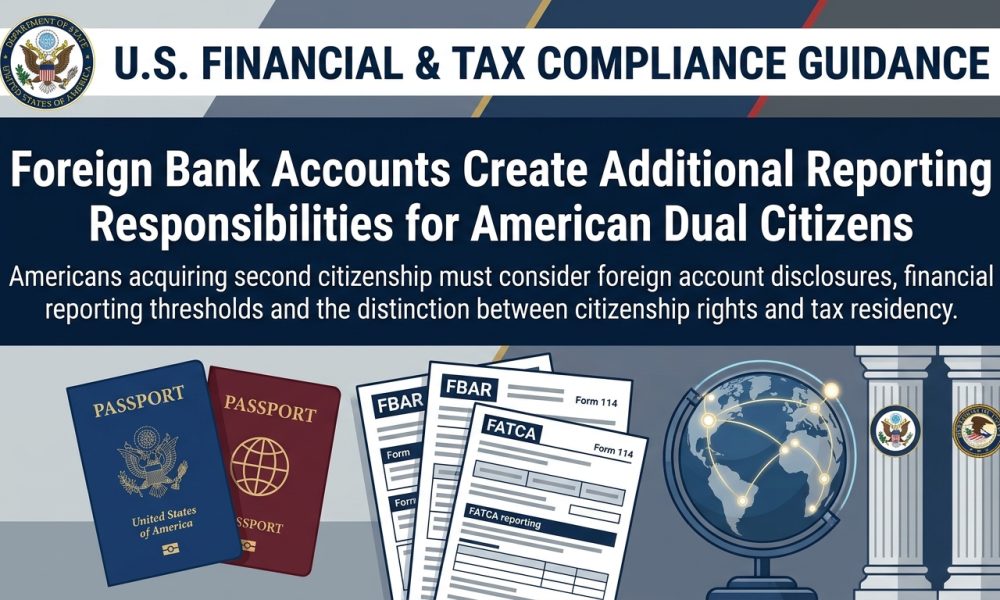
Americans acquiring second citizenship must consider foreign account disclosures, financial reporting thresholds, and the distinction between citizenship rights and tax residency, as federal regulations still apply to qualifying overseas financial relationships regardless of additional nationality.
WASHINGTON, DC, November 18, 2026 — American citizens obtaining second citizenship through ancestry, naturalization, marriage, or investment must understand that opening financial accounts in another country can create substantial United States reporting responsibilities, even when the funds originate from legitimate sources and remain entirely overseas.
Although foreign banking can support international relocation, retirement planning, property purchases, and cross-border investment activities, federal financial disclosure rules generally still apply to qualifying American account holders, regardless of additional citizenship or permanent residence abroad.
The distinction has become increasingly important as individuals pursue second passports to expand their international opportunities while considering financial relationships in countries where citizenship or long-term residence may simplify access to local banking services.
For American dual citizens, successful international financial planning requires understanding the separate obligations associated with foreign bank account reporting, overseas investment disclosures, and citizenship-based taxation before transferring assets or establishing additional banking relationships.
American Citizenship Continues to Determine Federal Reporting Obligations
United States financial reporting requirements generally apply to qualifying American citizens, regardless of whether they reside domestically, maintain permanent homes overseas, or hold valid passports and citizenship documentation issued by another sovereign government.
An American who acquires Mexican, Canadian, Italian, Irish, or Caribbean citizenship ordinarily remains a United States person for relevant federal reporting purposes, so qualifying foreign accounts cannot be excluded simply because another nationality appears on the bank’s records.
This principle reflects the distinction between legal citizenship and tax residency, since obtaining foreign nationality may provide new immigration rights without automatically terminating financial disclosure responsibilities imposed upon American citizens under existing federal legislation.
Consequently, internationally mobile Americans should assess their financial obligations before opening overseas accounts, particularly when overseas banking arrangements involve multiple institutions, different account currencies, investment holdings, or business relationships across national borders.
The FBAR Threshold Applies to Combined Foreign Account Values
The Report of Foreign Bank and Financial Accounts, commonly known as the FBAR, generally requires qualifying United States persons to disclose foreign financial accounts when their aggregate value exceeds $10,000 at any point during a calendar year.
This requirement can apply to foreign checking accounts, savings accounts, brokerage accounts, and certain other financial arrangements, depending on whether the individual possesses a reportable financial interest or qualifying signature authority.
The Internal Revenue Service explains the distinctions in its official comparison of FBAR and Form 8938 reporting requirements, emphasizing that these disclosure systems operate independently and may both apply to the same taxpayer.
Importantly, the $10,000 threshold applies to the combined value of reportable foreign accounts rather than requiring each account to exceed that amount individually, creating potential filing responsibilities for people maintaining several relatively modest balances.
For example, an American citizen maintaining three overseas accounts with maximum combined balances exceeding the statutory threshold may need to file an FBAR even when no individual account contains more than $10,000.
Foreign Accounts Do Not Need to Produce Income to Become Reportable
One frequently misunderstood feature of FBAR compliance is that an account may require disclosure even when it produces no interest, generates no investment earnings, and creates no additional United States income tax liability.
A foreign account used exclusively for household expenses, international travel, tuition payments, or retirement savings can therefore fall within reporting requirements when applicable ownership, authority, and aggregate balance conditions are satisfied.
Similarly, accounts maintained in countries where the individual possesses citizenship may remain reportable to American authorities, because the location and legal classification of the financial relationship matter more than the passport used during account opening.
This distinction is particularly relevant for retirees and internationally mobile families who maintain overseas accounts for everyday living expenses and mistakenly assume that routine personal banking arrangements cannot create federal reporting obligations.
FBAR Filing Operates Separately From Federal Income Tax Returns
The FBAR is submitted electronically through the Financial Crimes Enforcement Network’s reporting system using FinCEN Form 114, rather than being attached directly to the individual’s annual federal income tax return.
Although the Internal Revenue Service helps administer and enforce FBAR requirements, the filing originates under the Bank Secrecy Act framework. It should not be confused with income tax schedules or foreign asset disclosures.
The standard annual FBAR deadline is April 15 following the calendar year being reported, with an automatic extension to October 15 available under the applicable filing procedures without requiring a separate extension request.
Americans who qualify for income tax filing extensions while residing overseas should nevertheless verify their separate FBAR obligations, because the deadlines, forms, and administrative procedures do not necessarily correspond in every respect.
Maintaining a clear annual filing calendar can help prevent inadvertent omissions, especially when taxpayers operate foreign businesses, maintain multiple overseas residences, or coordinate tax preparation between advisers working in different countries.
FATCA Creates Additional Foreign Financial Asset Reporting
The Foreign Account Tax Compliance Act, commonly called FATCA, introduced another reporting framework addressing specified foreign financial assets, foreign financial institutions, and certain financial relationships associated with United States taxpayers.
Under applicable provisions, qualifying taxpayers must file Form 8938 when the aggregate value of specified foreign financial assets exceeds the relevant threshold. However, eligibility depends upon filing status and whether the individual satisfies specified overseas residence conditions.
For unmarried individuals living in the United States, the general Form 8938 threshold is more than $50,000 on the final day of the tax year or more than $75,000 at any time during that year.
For qualifying unmarried taxpayers living abroad, the corresponding thresholds generally increase to more than $200,000 at year-end or more than $300,000 during the year, reflecting the different circumstances applicable to overseas residents.
Married taxpayers may face different thresholds depending on whether they file jointly or separately, making individual circumstances essential when determining whether additional disclosures are required beyond ordinary federal income tax filings.
Form 8938 and FBAR Requirements Can Overlap
Although Form 8938 and the FBAR both address foreign financial interests, their reporting thresholds, covered assets, ownership definitions, and submission procedures differ enough that taxpayers must evaluate each requirement independently.
A taxpayer may therefore need to disclose the same foreign bank account on both forms without treating that overlapping reporting as an administrative error, because the two systems serve distinct statutory purposes.
Certain assets that may be reportable on Form 8938 are not necessarily covered by the FBAR, including particular interests in foreign entities or financial instruments held outside ordinary financial accounts.
Conversely, qualifying signature authority over a foreign account can trigger FBAR consideration even when the individual does not possess the beneficial ownership interest ordinarily relevant to the Form 8938 reporting analysis.
These differences make accurate asset classification particularly important for Americans holding international investment portfolios, operating foreign corporations, or participating in financial arrangements established under unfamiliar foreign legal structures.
Foreign Banks May Request American Citizenship and Tax Information
Foreign financial institutions participating in FATCA reporting arrangements may request information concerning a customer’s American citizenship, tax residency, taxpayer Identification number, and other relevant details before opening or maintaining qualifying accounts.
An individual possessing two passports should therefore expect financial institutions to investigate potentially reportable American connections rather than assume that presenting a foreign passport automatically establishes an exclusively foreign tax classification.
Some banks may also request self-certification documents, evidence of residential addresses, tax Identification numbers, and explanations of the source of funds as part of their broader customer verification and regulatory compliance procedures.
These requirements differ from standard immigration permissions because the ability to live in a country or hold its citizenship does not necessarily determine the customer’s classification for international financial reporting purposes.
Providing complete and accurate information during onboarding can reduce future administrative disputes, particularly when citizenship status, account ownership, or residential circumstances change after the original banking relationship has been established.
International Financial Information Exchange Continues to Develop
International cooperation concerning financial account transparency has expanded significantly, with governments establishing reporting agreements intended to identify relevant account holders and improve the exchange of tax-related financial information across national borders.
In June 2024, Reuters reported that Switzerland and the United States signed an agreement on reciprocal financial account information exchange, illustrating the ongoing Development of cross-border reporting arrangements between major international financial centers.
The agreement highlighted the broader shift toward structured financial information exchange, although individual arrangements differ regarding implementation dates, reporting procedures, participating institutions, and the categories of customer information exchanged.
For American dual citizens, these developments reinforce the importance of distinguishing legitimate financial privacy from the expectation that overseas bank accounts are automatically excluded from applicable governmental information-reporting systems.
International account holders should therefore evaluate the legal disclosure responsibilities affecting their financial relationships rather than relying on promotional claims that offshore banking arrangements provide complete secrecy from tax authorities.
The Common Reporting Standard Introduces Additional Considerations
The Common Reporting Standard, developed through the Organization for Economic cooperation and Development, establishes a separate framework for financial account information exchange among participating jurisdictions based primarily upon relevant tax residence classifications.
Although the United States operates its own FATCA framework rather than participating in CRS as a standard exchanging jurisdiction, American dual nationals residing abroad may nevertheless encounter CRS-related Identification and reporting procedures imposed by other countries.
For example, an American citizen who becomes a tax resident of a European country while maintaining financial accounts elsewhere may be subject to information exchanges involving the European residence jurisdiction under applicable CRS arrangements.
These overlapping systems demonstrate why citizenship and tax residence must be evaluated separately, since financial institutions may need information about multiple legal connections before determining the appropriate reporting treatment.
International information exchange arrangements do not make foreign banking unlawful or inherently suspicious, but they reinforce the importance of accurate disclosures when individuals maintain financial relationships across several jurisdictions.
Signature Authority Can Trigger Reporting Without Personal Ownership
American citizens may face FBAR obligations through their professional responsibilities even when the foreign financial accounts do not belong to them personally, and the account balances represent an employer’s assets.
Corporate officers, business managers, and other authorized individuals with qualifying control over foreign accounts may need to evaluate reporting responsibilities regardless of whether they receive income or distributions from those accounts.
Certain exceptions and modified procedures may apply to qualifying employees or officers. Still, those provisions depend upon specific regulatory conditions and should not be assumed solely because an account belongs to a business.
International entrepreneurs operating companies across multiple countries should consequently identify authorized signatories, account ownership arrangements, and applicable exemptions before determining which individuals or entities must submit foreign account reports.
Joint Accounts and Family Banking Require Individual Review
Married couples and family members who jointly own overseas bank accounts may face reporting obligations based on the full account value, even when each person’s economic interest represents only part of the balance.
Certain simplified procedures exist for qualifying spouses, but eligibility depends on specific ownership and filing conditions, so evaluate the requirements before assuming one spouse’s disclosure satisfies both individuals’ responsibilities.
Families with different combinations of American and foreign citizenship may face added complexity because one account holder may be subject to United States reporting rules while another is not.
Children possessing American citizenship can also hold reportable foreign accounts, and applicable filing responsibilities may arise regardless of age when the relevant financial interest and balance requirements are satisfied.
Parents establishing education or savings accounts overseas should therefore consider whether their children’s citizenship creates independent reporting obligations that require appropriate documentation, authorized assistance, or additional coordination with qualified tax professionals.
Foreign Retirement and Investment Accounts Require Careful Classification
International retirement planning frequently involves pensions, employment savings arrangements, brokerage accounts, and investment vehicles that may receive favorable treatment under foreign legislation while creating distinct reporting or taxation considerations for American citizens.
The classification of these arrangements depends on their legal structure and applicable American reporting rules, not merely on the terminology used by the foreign financial institution offering the product.
Some foreign pension and investment arrangements may implicate Form 8938, FBAR requirements, foreign trust reporting, or specialized investment taxation provisions, while other arrangements may qualify for particular exceptions.
Foreign mutual funds and certain other pooled investment products can also create passive foreign investment company considerations, potentially generating reporting complexity beyond the ordinary disclosure of account balances and investment income.
Americans considering foreign investment products should therefore obtain individualized advice before transferring retirement savings or purchasing unfamiliar financial instruments, especially when foreign tax advantages do not translate into equivalent treatment under American law.
Second: Citizenship Does Not Establish Automatic Financial Anonymity
Citizenship acquired through naturalization, ancestry, or another legitimate pathway may expand residence and banking eligibility. Still, it does not automatically create a separate financial identity disconnected from an individual’s existing citizenship and tax obligations.
Banks commonly employ customer Identification, beneficial ownership verification, anti-money-laundering controls, and source-of-funds procedures to evaluate financial relationships, particularly when substantial international transfers or complex ownership structures are involved.
When an individual has legally changed their name, financial institutions may require documentary evidence linking historical and current identity records. Hence, the customer’s financial information accurately reflects applicable Identification and compliance requirements.
Omitting required American citizenship information or misrepresenting beneficial ownership can create additional legal and banking risks, making transparent documentation preferable to arrangements based on avoiding established reporting responsibilities.
For internationally mobile families, preserving legitimate financial privacy is generally compatible with required disclosures, provided personal information is handled securely and submitted through the authorized procedures established by relevant institutions and governments.
Foreign Trusts and Corporate Structures May Add Reporting Obligations
Some Americans establish foreign companies, family trusts, or international holding arrangements to manage investments, succession planning, and cross-border financial relationships. Still, these structures may add reporting requirements beyond the standard FBAR and Form 8938 frameworks.
Depending on ownership, control, transactions, and the entity’s classification under American tax law, relevant reporting obligations can involve specialized corporate information returns, foreign trust disclosures, or other provisions governing international financial arrangements.
A foreign entity’s ownership of a bank account does not automatically eliminate reporting considerations for American individuals connected to that entity, especially when financial interests or signature authority satisfy applicable regulatory definitions.
Similarly, trust arrangements involving American beneficiaries, foreign trustees, or internationally transferred assets require independent analysis because the legal form selected under foreign law does not necessarily determine the structure’s United States tax treatment.
International Relocation Planning Must Address Banking Compliance
Americans relocating permanently overseas may require local accounts for property expenses, utilities, healthcare, employment compensation, and everyday financial transactions, making access to reliable foreign banking services an important practical consideration.
A second citizenship can potentially simplify residence permissions or local administrative requirements in certain jurisdictions. However, banks may still impose independent account-opening conditions, including tax Identification, address verification, and financial background documentation.
Prospective expatriates should therefore coordinate their immigration planning with realistic banking arrangements, including assessing whether existing financial institutions permit international transfers and whether destination-country banks accept applicants with their particular residence status.
For individuals planning substantial asset transfers, preparation should include documenting the lawful origin of funds, identifying applicable reporting obligations, and understanding financial institution requirements before initiating cross-border transactions.
Amicus International Consulting Examines Second Passports and Tax Exposure
The financial implications of acquiring another nationality require particular attention when individuals expect their new citizenship to simplify international banking, reduce tax exposure, or support a broader long-term relocation strategy.
In its discussion of second passports and United States tax reporting considerations, Amicus International Consulting explains why additional citizenship does not automatically end American tax responsibilities and why international financial planning requires careful evaluation of applicable legislation.
A coordinated approach should examine the applicant’s nationality status, anticipated residence, existing financial assets, foreign income sources, and intended banking arrangements before determining which foreign accounts or structures meet the individual’s legitimate objectives.
Although second citizenship can provide meaningful benefits involving residence flexibility, travel opportunities, and family mobility, those advantages should be distinguished from federal reporting obligations that continue under American law. In contrast, the relevant citizenship or tax classification remains applicable.
Incomplete Reporting Can Result in Significant Penalties
Failures to file required foreign account reports may expose taxpayers to civil penalties, and serious willful violations can create additional legal consequences. However, the applicable outcome depends upon statutory provisions and individual circumstances.
Penalty assessments can be influenced by factors including the nature of the violation, the taxpayer’s conduct, applicable legal limitations, and whether the government establishes the elements required for a particular penalty.
Taxpayers who discover historical reporting omissions should investigate available correction procedures and seek qualified professional advice before submitting amended forms, because the appropriate response depends on the underlying facts and applicable compliance programs. These enforcement provisions do not mean every reporting error reflects intentional wrongdoing. Still, theyt they show why maintaining complete records and understanding annual filing requirements is especially important for internationally mobile taxpayers.
An Annual Financial Compliance Review Can Prevent Omissions
A practical year-end review should identify all reportable foreign financial accounts, establish their maximum annual values, record ownership and signature authority, and examine whether additional foreign asset disclosures are required.
Taxpayers should retain relevant account statements, currency conversion information, ownership documentation, and supporting financial records under applicable retention rules, particularly when accounts span multiple countries and currencies.
Changes involving marriage, relocation, foreign citizenship, business ownership, or investment acquisitions should prompt a renewed evaluation because applicable reporting thresholds and asset classifications may differ from those used in earlier filing periods.
Engaging professionals familiar with international taxation can help ensure that foreign earned income exclusions, tax credits, financial disclosures, and other cross-border obligations are evaluated together rather than treated as unrelated administrative tasks.
Second Citizenship Expands Mobility Without Removing Financial Accountability
For American dual citizens, overseas banking can offer legitimate advantages in international residence, investment management, retirement planning, and family financial arrangements. Still, those benefits must be weighed against ongoing federal requirements for reporting foreign accounts and certain financial assets.
The central distinction remains that foreign citizenship may expand where an individual can live, work, or establish financial relationships. At the same time, American nationality still creates reporting responsibilities that another passport cannot ordinarily eliminate.
As international financial transparency develops, individuals who combine accurate identity records, properly documented banking relationships, and timely regulatory disclosures will be better positioned to preserve their international mobility while reducing avoidable administrative and legal complications.
Ultimately, foreign bank accounts should be viewed as practical financial instruments supporting lawful international activities, rather than mechanisms for escaping citizenship-based reporting rules, making informed compliance an essential component of every sustainable second-citizenship and cross-border financial strategy.