
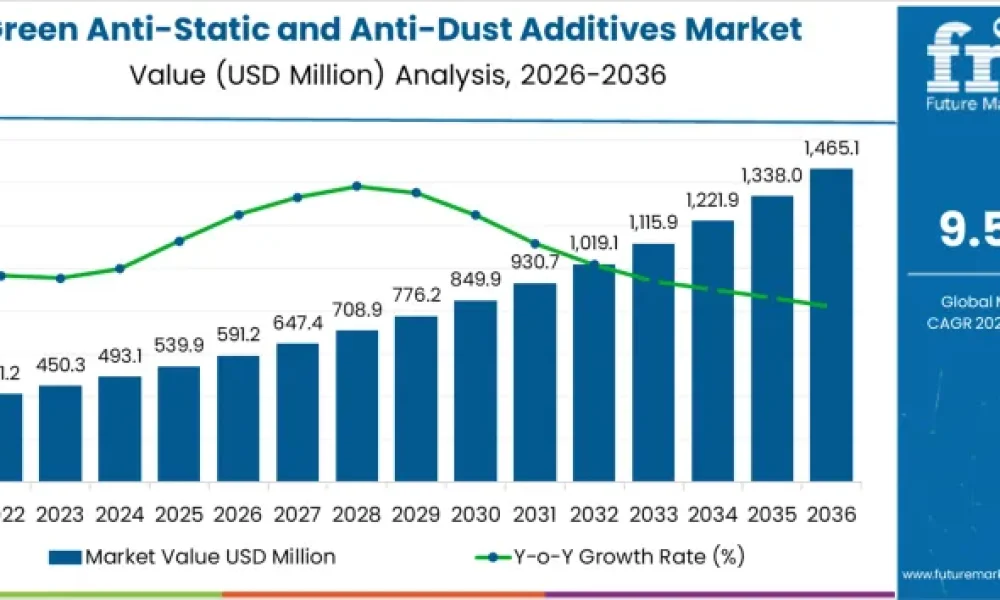
The global Green Anti-Static and Anti-Dust Additives Market is on track for robust expansion, with the total market value projected to rise from approximately USD 591.2 million in 2026 to USD 1,465.1 million by 2036, representing a strong compound annual growth rate (CAGR) of 9.5 % through the forecast period. This growth is driven by accelerating demand for sustainable, eco-friendly materials that mitigate static charge build-up and dust accumulation across high-growth industries such as electronics, automotive, packaging, and textiles.
Key Market Insights at a Glance reveal that bio-based anti-static agents command the leading share of the chemistry segment, capturing nearly 28 % of global demand due to their renewable and low-impact profiles. Polyethylene and polypropylene equally dominate the polymer type landscape, each accounting for roughly 28 % of consumption owing to their widespread use in packaging and performance-critical components.
Segment Overview
The market is analyzed across multiple vectors including chemistry types, polymer types, and end-use applications. Among the chemistry types, bio-based agents lead, followed by conductive polymer additives and mineral-based anti-dust solutions, reflecting a marked industry tilt toward products that combine efficient static control with environmental compliance. In terms of polymer categories, polyethylene and polypropylene share the forefront, driven by their prevalence in consumer and industrial applications where static and dust control significantly impact product quality and process reliability. Additionally, engineering plastics, PVC & elastomers, and bio-plastics are gaining traction as performance demands elevate across advanced manufacturing sectors.
Across application areas, the market’s versatility is evident. Additives are increasingly embedded in packaging films, automotive interiors, consumer electronics housings, industrial materials, and construction surfaces, underscoring the cross-sector emphasis on enhancing product longevity, safety, and user experience through advanced additive technologies.
To access the complete data tables and in-depth insights — Request Your Sample Report Now
Regional Overview
Growth dynamics vary across global regions. India stands out with the fastest forecast CAGR of approximately 10.2 %, supported by rapid industrialization and expanding production ecosystems in electronics, automotive, and textiles. China follows closely with a projected CAGR near 9.9 %, buoyed by its dominant manufacturing base and rising eco-compliance mandates. North America, particularly the United States, is expected to grow at a steady pace of around 8.1 %, reflecting strong consumer demand for sustainable products combined with regulatory pressures to reduce hazardous chemical use. In Europe, Germany and other industrial hubs are forecasted to register moderate growth rates in the high-single digits as precision manufacturing and sustainability standards drive additive adoption.
Competitive Landscape
The competitive environment is characterized by strategic innovation and sustainability-led differentiation. Established chemical and materials firms including BASF SE, Clariant, Croda International, Evonik Industries, and Ampacet Corporation are among the forefront players advancing green additive portfolios. These companies are focused on enhancing product performance while reducing ecological impact, leveraging formulation science to tailor solutions for diverse substrates and performance requirements. Investments in R&D, expanded manufacturing capabilities, and partnerships with OEMs underline the strategic focus on capturing emerging opportunities in this growth market.
Market Outlook: Powering the Next Decade
Looking ahead, the Green Anti-Static and Anti-Dust Additives Market is set to power a new wave of sustainability-oriented material innovations through 2036. Increasing regulatory emphasis on non-toxic, biodegradable materials, coupled with rising consumer awareness of indoor air quality and product safety, is expected to fuel broader adoption of green additives. Multifunctional additive systems that combine static mitigation with dust repellency and additional surface benefits such as UV resistance or scratch protection are also gaining industry favor, further expanding application prospects. As circular economy principles and eco-certification frameworks become mainstream, demand for additives that support recyclability and lifecycle safety will continue to grow.
Key Players of Sustainable Label Industry driving this transformation include BASF SE, Clariant, Croda International, Evonik Industries, and Ampacet Corporation — organizations that align performance excellence with environmental stewardship and industry compliance.
Recent Strategic Developments reflect a clear industry pivot toward greener, high-performance additive solutions. Leading suppliers are enhancing product portfolios to meet stringent global regulations, collaborating with manufacturers to integrate sustainable additives in emerging applications like advanced packaging and electric vehicle components, and investing in scalable technologies to deliver consistent performance while minimizing ecological footprints.
Have a specific Requirements and Need Assistant on Report Pricing or Limited Budget please contact us – [email protected]
About Future Market Insights (FMI)
Future Market Insights, Inc. (FMI) is an ESOMAR-certified, ISO 9001:2015 market research and consulting organization, trusted by Fortune 500 clients and global enterprises. With operations in the U.S., UK, India, and Dubai, FMI provides data-backed insights and strategic intelligence across 30+ industries and 1200 markets worldwide.
Why Choose FMI: https://www.futuremarketinsights.com/why-fmi



