
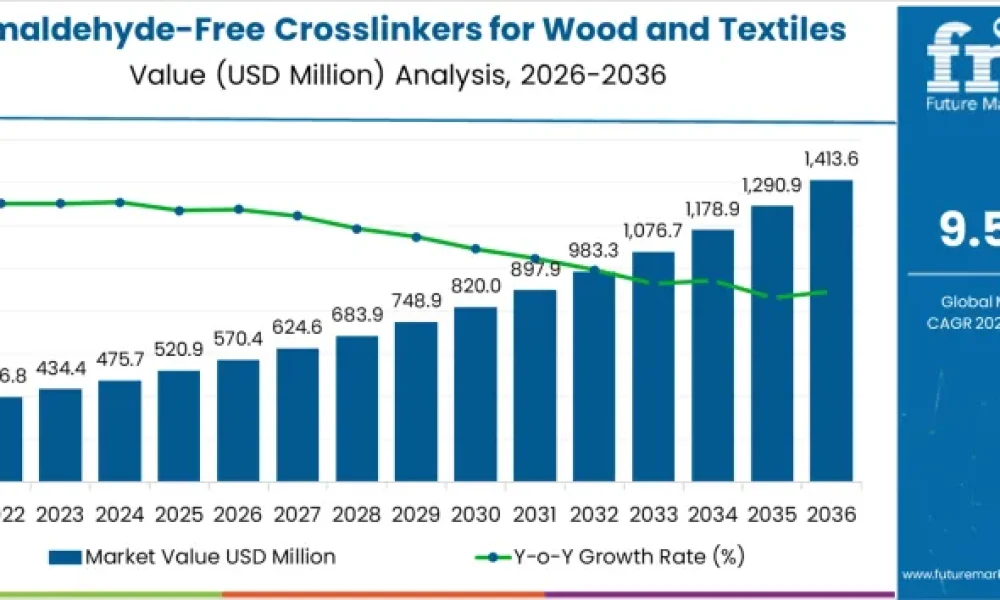
The global formaldehyde-free crosslinkers for wood and textiles market is set to expand significantly from a projected USD 570.4 million in 2026 to USD 1,413.6 million by 2036, reflecting a robust compound annual growth rate (CAGR) of approximately 9.5% over the forecast period. This dynamic growth underscores strong industry momentum as manufacturers and brands across wood processing and textile sectors accelerate the shift toward safer, greener chemistries that enhance product performance without the health and environmental risks associated with formaldehyde.
In a landscape where regulatory scrutiny and consumer expectations are intensifying, formaldehyde-free crosslinkers are rapidly becoming the preferred choice for bonding and finishing applications, enabling enhanced durability, moisture resistance and compliance with stringent emission standards. The expanding market trajectory signals critical opportunities for stakeholders across the value chain to innovate and scale sustainable solutions that align with evolving global sustainability mandates.
Key Market Insights at a Glance
Market demand is being propelled by multi-dimensional factors, including tightening regulations on volatile organic compound (VOC) emissions, the proliferation of green building standards, and heightened consumer awareness of chemical safety in everyday products. Manufacturers of engineered wood, furniture, and textiles are increasingly adopting formaldehyde-free alternatives to meet indoor air quality criteria and brand commitments to responsible materials use. The market’s growth is further supported by technological advances in crosslinking chemistries that deliver performance parity — and in some cases superiority — compared with traditional formaldehyde-based systems.
Segment Overview
In terms of product chemistry, polycarboxylic acid (PCA) crosslinkers emerge as the leading segment, commanding around 30% share of the global market due to their strong bonding capabilities and non-toxic profile. PCA formulations are widely used across both wood and textile applications, offering moisture resistance and durability critical for high-performance materials.
Application analysis reveals that wood panels and engineered wood products hold the largest segment share at approximately 34%, driven by shifts in residential and commercial construction towards low-emission and sustainably certified materials. Textiles including apparel, home textiles and technical fabrics are also driving significant uptake as brands seek non-toxic crosslinking agents that support wash durability and fabric performance without compromising safety.
To access the complete data tables and in-depth insights — Request Your Sample Report Now
Regional Overview
Geographically, Asia Pacific stands out as a high-growth region, with markets such as India and China delivering some of the highest expansion rates globally as their manufacturing industries embrace sustainable practices. Developed regions in North America and Western Europe continue to grow steadily, benefiting from strict regulatory frameworks and strong consumer demand for eco-friendly products. In markets such as the United States, Germany and South Korea, formaldehyde-free solutions are becoming integral to compliance with tighter chemical emissions and product safety standards.
Competitive Landscape
The competitive landscape is characterized by a mix of established chemical manufacturers and innovative specialty players who are prioritizing sustainable product portfolios. Leading companies are investing in research and development to enhance the performance and application scope of formaldehyde-free crosslinkers, fostering competitive differentiation through quality, regulatory compliance and environmental credentials. These strategic priorities are shaping industry competition and driving partnerships, product launches, and geographic expansion strategies.
Market Outlook: Powering the Next Decade
Looking ahead, the formaldehyde-free crosslinkers market is positioned for sustained growth through 2036 and beyond, powered by structural changes in manufacturing practices, evolving sustainability regulations, and stronger market preference for health-conscious materials. As global industry stakeholders integrate formaldehyde-free chemistry into mainstream production processes, the market is expected to deliver significant value creation across wood processing, textile finishing, and advanced material applications. Innovation pipelines focused on bio-based chemistries, performance optimization, and digital formulation tools will further accelerate adoption and expand end-use potential.
Key Players of Sustainable Label Industry
Market leadership is anchored by a cadre of companies that have made formaldehyde-free chemistry a core part of their sustainable solutions portfolio. These players are recognized for advancing safer crosslinking systems that meet industrial performance requirements while aligning with environmental and health imperatives.
Recent Strategic Developments
Recent activity in the space reflects a rise in strategic initiatives such as product innovations tailored to specific substrate challenges, collaborative research between chemical developers and end-users, and expanded capabilities aimed at high-growth regional markets. Together, these developments point to a forward-looking industry that is responsive to regulatory dynamics, sustainability goals, and market demand for high-performance, safe materials.
Have a specific Requirements and Need Assistant on Report Pricing or Limited Budget please contact us – [email protected]
About Future Market Insights (FMI)
Future Market Insights, Inc. (FMI) is an ESOMAR-certified, ISO 9001:2015 market research and consulting organization, trusted by Fortune 500 clients and global enterprises. With operations in the U.S., UK, India, and Dubai, FMI provides data-backed insights and strategic intelligence across 30+ industries and 1200 markets worldwide.
Why Choose FMI: https://www.futuremarketinsights.com/why-fmi



