
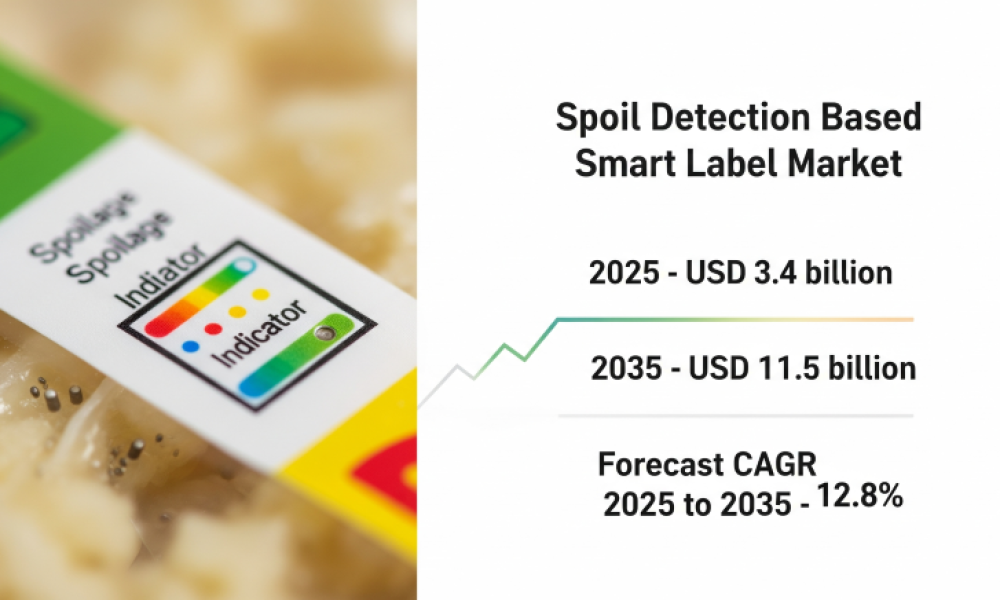
The global spoil detection-based smart label market is poised for significant growth, with a forecasted value of USD 11.5 billion by 2035, up from USD 3.4 billion in 2025. This translates to a compound annual growth rate (CAGR) of 12.8% during the forecast period, driven by rising consumer demand for food safety, supply chain efficiency, and waste reduction. With foodborne illnesses and spoilage being top concerns globally, the need for advanced real-time spoil detection solutions has never been more critical.
Unlock detailed analytics – Request your personalized report now! https://www.futuremarketinsights.com/reports/sample/rep-gb-1162
Market Growth Factors: Increasing Consumer Awareness and Technological Advancements
The rapid expansion of the spoil detection-based smart label market is fueled by several key drivers. Chief among them are heightened global concerns around food safety, regulatory pressure on food labeling, and a growing demand for transparent, traceable supply chains. As consumers become more aware of the risks associated with food spoilage, retailers and manufacturers are turning to smart label technologies to monitor freshness and minimize waste.
Technological innovations in sensors, biosensors, nanomaterials, and printed electronics are further propelling the market. These advancements enable more accurate and affordable spoil detection, enhancing the scalability of smart labels across industries. Among these, Time-Temperature Indicators (TTI) are expected to be the market leader, accounting for 39.6% of market revenue by 2025. TTIs can detect temperature variations in real-time, providing visual feedback and ensuring compliance with stringent cold chain requirements.
Segmental Insights: Key Product Types and Applications
The spoil detection-based smart label market is segmented into product types, applications, and regions. The Time-Temperature Indicator segment is projected to dominate the market, owing to its ability to provide real-time monitoring and visual indication of temperature abuse, a critical factor for maintaining food safety.
The meat application segment is also expected to lead the market in terms of revenue, accounting for 28.3% of the market share in 2025. The high perishability of meat products, which are particularly susceptible to temperature fluctuations and microbial contamination, makes spoil detection labels indispensable. With increasing demand for food transparency and higher regulatory scrutiny, the use of spoil detection-based smart labels in the meat industry is set to rise.
Other significant applications include fish, dairy products, processed foods, and vegetables. Additionally, the growing demand for spoil detection labels extends beyond food products, as industries such as pharmaceuticals, medical, and healthcare sectors adopt these technologies to ensure product safety and traceability.
Regional Outlook: North America, Europe, and Asia-Pacific Lead Market Growth
Regionally, North America, Europe, and Asia-Pacific are expected to be the primary growth drivers for the spoil detection-based smart label market. North America is anticipated to dominate the market, driven by high consumer awareness and technological advancements in packaging. Western Europe, led by Germany and France, is poised for steady growth, with robust adoption of smart packaging solutions across the food and beverage sector.
Asia-Pacific, particularly China and India, is projected to witness the highest CAGR during the forecast period. This growth is supported by increasing urbanization, rising consumer demand for packaged food, and growing awareness of food safety practices. China is expected to lead the region with a CAGR of 17.3%, followed by India at 16.0%.
Comprehensive Market Report Available. Inquire for Customization! https://www.futuremarketinsights.com/customization-available/rep-gb-1162
Competitive Landscape: Key Players and Market Strategies
The spoil detection-based smart label market is highly competitive, with several key players actively contributing to the market’s expansion. Leading companies include The Woodlands Group, Impinj, Zebra Technologies, Thin Film Electronics, Cognex Corporation, Avery Dennison Smartrac, NXP Semiconductors, Wiliot, and OmniID. These companies are investing in research and development to improve the accuracy and affordability of smart labels, as well as collaborating with food manufacturers, retailers, and logistics providers to drive adoption.
Future Outlook: Opportunities Beyond Food Safety
While the primary applications for spoil detection-based smart labels are in the food and beverage sector, the pharmaceutical and medical industries are increasingly exploring these solutions. The ability to track the spoilage of temperature-sensitive items like vaccines, medical supplies, and lab samples presents a significant growth opportunity. Furthermore, supply chain management (SCM) applications, particularly in pharmaceuticals and logistics, are expected to be key contributors to market expansion.
About Future Market Insights (FMI)
Future Market Insights, Inc. (ESOMAR certified, recipient of the Stevie Award, and a member of the Greater New York Chamber of Commerce) offers profound insights into the driving factors that are boosting demand in the market. FMI stands as the leading global provider of market intelligence, advisory services, consulting, and events for the Packaging, Food and Beverage, Consumer Technology, Healthcare, Industrial, and Chemicals markets. With a vast team of over 400 analysts worldwide, FMI provides global, regional, and local expertise on diverse domains and industry trends across more than 110 countries.



