
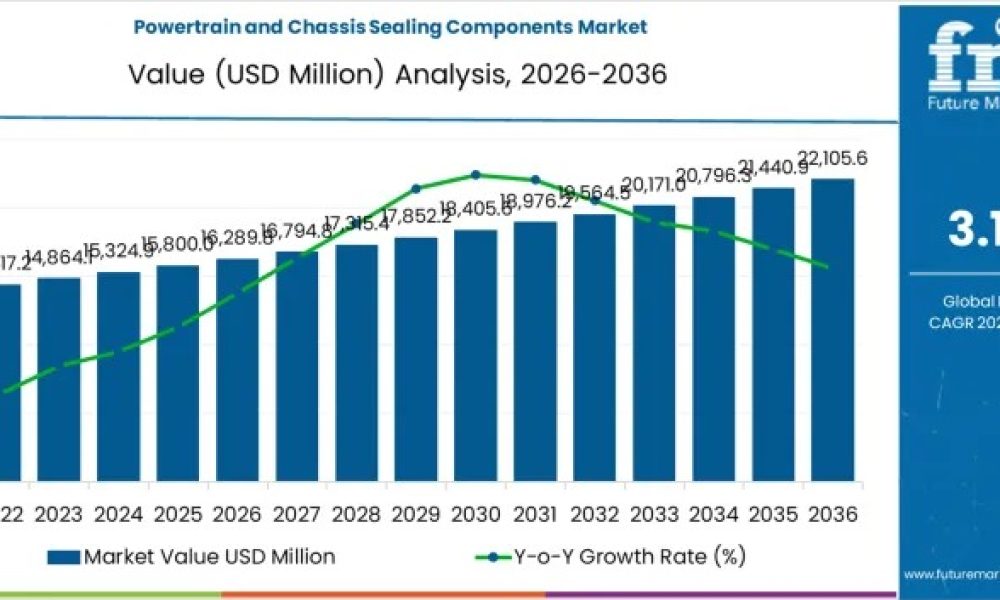
The global powertrain and chassis sealing components market is projected to grow from USD 16,289.8 million in 2026 to USD 22,105.6 million by 2036, registering a CAGR of 3.1% during the forecast period. Market expansion is driven less by vehicle production growth and more by the structural necessity of sealing systems across increasingly complex automotive architectures.
Market Growth Anchored in Structural Sealing Requirements
Value creation in the market is fundamentally linked to the high number of sealing points integrated into engines, transmissions, axles, suspension systems, and underbody assemblies. Each powertrain and chassis platform incorporates multiple interfaces that require consistent sealing performance to manage fluids, prevent contamination, and ensure durability. As design complexity increases, aggregate demand remains resilient regardless of short-term fluctuations in vehicle volumes.
Regulatory Pressure and Durability Standards Strengthen Demand
Tightening emission control norms, extended drain intervals, and higher operating temperatures are increasing reliance on chemically resistant and compression-stable seals and gaskets. OEMs prioritize sealing components with proven validation histories and low leakage rates to meet compliance requirements and minimize warranty exposure. These regulatory and durability-driven requirements continue to support long-term demand stability.
Electrification Expands Sealing Interfaces Without Disrupting Core Demand
The gradual transition toward electrified powertrains introduces additional sealing requirements around e-axles, reduction gearsets, and thermal management circuits. However, conventional sealing needs remain intact across bearings, housings, joints, and chassis interfaces. As a result, electrification contributes incremental demand rather than replacing existing sealing applications.
Get access to comprehensive data tables and detailed market insights — request your sample report today!
Replacement Demand Driven by Wear, Exposure, and Maintenance Cycles
Aftermarket and replacement demand is governed by material aging, environmental exposure, and service intervals rather than discretionary upgrades. Sealing components remain consumable parts subject to wear from temperature cycling, chemical exposure, and mechanical stress. This predictable replacement behavior supports steady aftermarket volumes across passenger and commercial vehicle fleets.
Manufacturing Economics Limit Rapid Cost Compression
Production economics in the sealing components market depend on elastomer formulation stability, tooling accuracy, and yield control. High validation requirements and customization across platforms constrain rapid standardization and aggressive cost reduction. As a result, pricing remains relatively stable, reinforcing the market’s compliance- and service-driven nature.
Seals and Gaskets Dominate Component Demand
High Interface Count Drives Volume Leadership
Seals and gaskets account for approximately 44.0% of total demand, making them the dominant component category. Their extensive use across engine joints, transmission housings, axle interfaces, and chassis connections results in consistently high consumption volumes.
Broad Functional Coverage Across Systems
Flat gaskets, profile seals, oil seals, and bonded seals address a wide range of pressure, temperature, and vibration conditions. While O-rings and specialty seals support niche applications, the broad coverage provided by seals and gaskets ensures their continued dominance across powertrain and chassis systems.
Elastomers Lead Material Adoption Due to Versatility
Flexibility and Cost Efficiency Support High-Volume Use
Elastomers represent 42.0% of material demand, driven by their flexibility, compression recovery, and compatibility with automotive fluids. Their cost efficiency and processing versatility make them suitable for high-volume OEM and aftermarket applications.
Material Tuning Enhances Performance
Elastomer formulations can be tuned for hardness, temperature resistance, and chemical compatibility. Advanced materials such as fluoroelastomers and silicone compounds support high-temperature and aggressive fluid environments, though their use remains more targeted due to higher costs.
Powertrain Applications Remain the Primary Demand Center
Fluid-Intensive Systems Require Extensive Sealing
Powertrain applications account for 46.0% of total demand, reflecting the high sealing intensity required in engines, transmissions, and driveline systems. These assemblies operate under elevated temperatures and pressure differentials, increasing the criticality of reliable sealing solutions.
Direct Impact on Efficiency and Emissions
Effective sealing directly influences lubrication efficiency, thermal management, emissions control, and component longevity, reinforcing the concentration of demand within powertrain systems compared to chassis and auxiliary applications.
Global Demand Growth Reflects Maintenance and Compliance Dynamics
Asia, Americas, and Europe Show Measured Expansion
Global demand growth remains steady across major markets, led by China (4.1%) and Brazil (4.0%), followed by the USA (3.0%), Germany (2.8%), and South Korea (2.6%). Expansion is driven primarily by vehicle utilization intensity, environmental exposure, and regulatory enforcement rather than rapid increases in vehicle populations.
Aftermarket Stability Offsets Production Cycles
High mileage accumulation, preventive maintenance practices, and fleet aging sustain strong aftermarket replacement demand. This dynamic buffers the market against short-term production volatility and supports predictable long-term growth.
Competitive Landscape Driven by Validation and Material Expertise
Global Suppliers Compete on Reliability and Scale
Leading players such as Freudenberg Sealing Technologies, Trelleborg, Parker Hannifin, Dana, SKF, NOK, and ElringKlinger maintain strong positioning through validated product portfolios, materials expertise, and global manufacturing footprints.
Differentiation Through Compliance and Platform Support
Competitive differentiation depends on sealing reliability under stress, regulatory compliance, material innovation, and the ability to support complex vehicle platforms at scale. Suppliers with broad portfolios and OEM-aligned quality systems remain preferred partners across global automotive supply chains.
Why Choose FMI: Empowering Decisions that Drive Real-World Outcomes: https://www.futuremarketinsights.com/why-fmi
About Future Market Insights (FMI)
Future Market Insights, Inc. (FMI) is an ESOMAR-certified, ISO 9001:2015 market research and consulting organization, trusted by Fortune 500 clients and global enterprises. With operations in the U.S., UK, India, and Dubai, FMI provides data-backed insights and strategic intelligence across 30+ industries and 1200 markets worldwide.



