
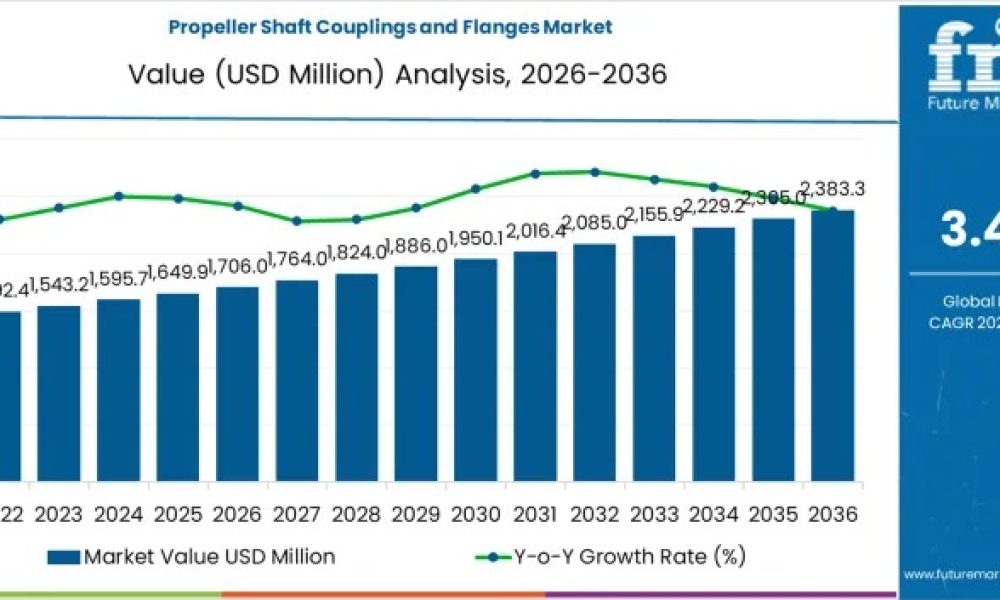
The global propeller shaft couplings and flanges market continues to demonstrate resilient, fundamentals-driven growth as vehicle manufacturers and fleet operators prioritize mechanical integrity, vibration control, and long-term driveline reliability. Valued at USD 1,706.0 million in 2026, the market is projected to reach USD 2,383.3 million by 2036, expanding at a compound annual growth rate (CAGR) of 3.4%. Unlike technology-driven component categories tied to rapid platform redesigns, value creation in this market is anchored in the essential mechanical role these components play within rotating driveline assemblies.
Propeller shaft couplings and flanges sit at the intersection of torque transfer, concentricity control, and vibration management. Their performance directly influences drivetrain efficiency, noise behavior, and durability under cyclic loading. As a result, dimensional accuracy, fatigue resistance, and material integrity remain non-negotiable requirements, sustaining consistent demand across passenger vehicles, commercial fleets, off-highway equipment, and industrial machinery.
Demand Anchored in Mechanical Reliability Rather Than Volume Expansion
Market expansion is not primarily driven by increases in global vehicle production volumes. Instead, consumption is governed by stress exposure, balance tolerances, and maintenance thresholds accumulated over operating life. OEM demand remains tied to standardized driveline architectures, while aftermarket demand reflects wear progression caused by torsional cycling, imbalance, misalignment, and environmental exposure during extended service.
Replacement events are typically triggered by spline wear, bolt hole elongation, fretting corrosion, or deviations in noise, vibration, and harshness (NVH) identified during inspections. These factors create predictable, maintenance-led demand patterns that support market stability even during periods of moderated new vehicle growth. Electrified and hybrid drivetrains further reinforce relevance, as high torque densities continue to rely on mechanical shaft interfaces despite broader powertrain transitions.
Get access to comprehensive data tables and detailed market insights — request your sample report today!
Conservative Materials and Precision Manufacturing Shape Economics
Material selection in propeller shaft couplings and flanges remains deliberately conservative due to safety-critical failure risks and certification burdens. Steel dominates with a 64.0% share, offering proven fatigue resistance, strength under fluctuating torque, and compatibility with established forging and machining processes. Manufacturing economics depend less on scale flexibility and more on forging accuracy, heat treatment consistency, and machining precision to maintain balance and concentricity at operating speeds.
Manufacturers invest heavily in process control, inspection, and validation to meet stringent OEM qualification standards. Improper tolerances or surface treatment variability can elevate failure risk and warranty exposure, reinforcing barriers to entry and favoring suppliers with deep metallurgical expertise and disciplined production systems.
Segment Insights Reflect Structural Priorities
By component type, flanges or yokes account for the largest share of demand at 38.0%. These rigid connection elements secure propeller shafts to transmissions and differentials, bearing primary structural loads while ensuring precise alignment. Their exposure to continuous rotational stress elevates specification priority, making precision machining and balance control essential.
Passenger vehicles represent the largest vehicle segment at 42.0%, driven by high production volumes and widespread use of rear-wheel and all-wheel drive configurations. Increasing comfort expectations in this segment intensify focus on NVH optimization, reinforcing demand for accurately machined and well-balanced driveline components. Commercial vehicles and off-highway equipment apply similar components under higher load intensity, contributing steady but lower unit volumes.
Global Demand Trends Remain Maintenance-Led
Geographically, demand growth reflects operating intensity, fleet utilization, and maintenance discipline rather than structural changes in drivetrain design. China leads with a CAGR of 4.4%, supported by high utilization of commercial vehicles in logistics and construction. Long operating hours increase torsional stress, accelerating wear and supporting replacement demand. Domestic truck and bus production sustains steady OEM installations, while regulatory inspections emphasize driveline integrity.
Brazil follows closely at 4.3%, where long-distance freight, variable road conditions, and agricultural logistics contribute to vibration-induced wear. Aging fleets and extended service life strategies drive aftermarket replacement, anchoring demand growth in operational realities rather than new vehicle expansion.
The United States market grows at 3.2%, supported by high mileage accumulation across heavy-duty trucks and disciplined maintenance practices. Aftermarket replacement dominates as fleets prioritize vibration reduction to protect adjacent drivetrain components. Germany’s market expands at 3.0%, shaped by mature fleet management, high engineering standards, and predictable replacement cycles under preventive maintenance regimes. South Korea shows controlled growth at 2.9%, reflecting efficient logistics, shorter transport distances, and strong maintenance discipline that limits unscheduled replacements.
Competitive Landscape Defined by Engineering Depth and Validation Capability
Competition in the propeller shaft couplings and flanges market centers on torsional stiffness, fatigue performance, dimensional precision, and compatibility with standardized driveline interfaces. Buyers evaluate suppliers on their ability to meet rigorous OEM validation protocols, deliver consistent quality at scale, and support global platforms with localized manufacturing.
Leading players such as Neapco, Dana, GKN Automotive, American Axle & Manufacturing, Schaeffler, ZF, Meritor (Cummins), JTEKT, NTN, and Bharat Forge differentiate through metallurgical expertise, advanced forging capabilities, and extensive testing frameworks. As electrified and hybrid platforms introduce higher instantaneous torque loads, the importance of robust mechanical interfaces and NVH optimization further strengthens supplier positioning rooted in precision engineering.
Outlook
With demand driven by lifecycle wear, torque management, and reliability imperatives, the propeller shaft couplings and flanges market offers steady, defensible growth through 2036. Value concentration will remain with suppliers capable of delivering high-integrity components that meet evolving torque densities and durability expectations across conventional, hybrid, and electrified drivetrains. As maintenance-led replacement continues to underpin global consumption, detailed market intelligence is essential for understanding where demand accumulates, how material and manufacturing choices influence competitiveness, and which regions and vehicle segments will define long-term opportunity.
Why Choose FMI: Empowering Decisions that Drive Real-World Outcomes: https://www.futuremarketinsights.com/why-fmi
About Future Market Insights (FMI)
Future Market Insights, Inc. (FMI) is an ESOMAR-certified, ISO 9001:2015 market research and consulting organization, trusted by Fortune 500 clients and global enterprises. With operations in the U.S., UK, India, and Dubai, FMI provides data-backed insights and strategic intelligence across 30+ industries and 1200 markets worldwide.



