
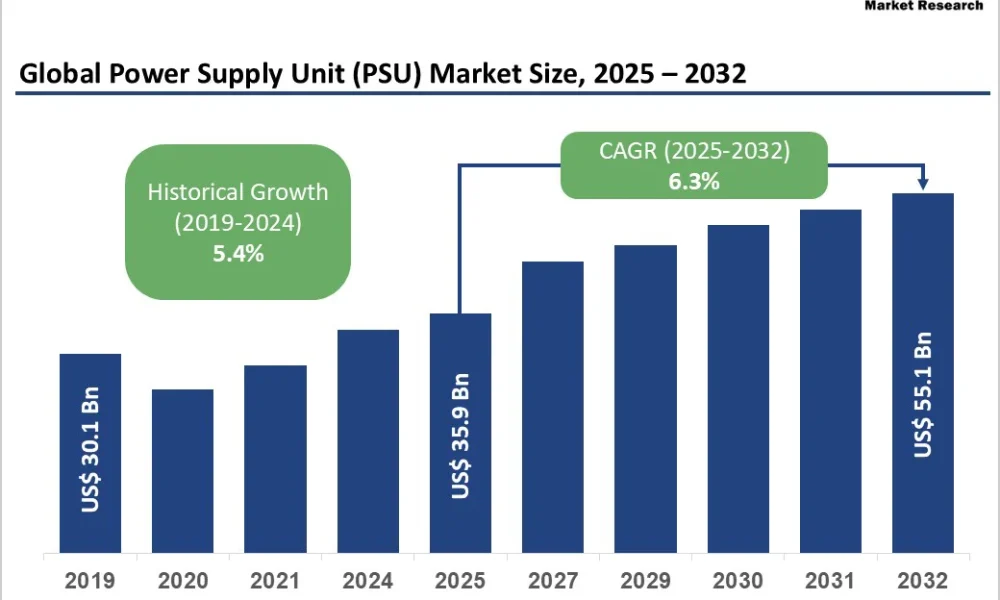
The global Power Supply Unit (PSU) market is undergoing significant expansion, driven by technological innovation, rising energy efficiency demands, and the growth of high-power applications such as data centers, renewable energy systems, and electric vehicles (EVs). According to recent forecasts, the market is expected to reach US$55.1 billion by 2032, up from US$35.9 billion in 2025, representing a compound annual growth rate (CAGR) of 6.3% during the 2025–2032 period. This growth underscores the critical role that PSUs play in modern electronics and industrial infrastructure.
Understanding the PSU Market
A power supply unit is an essential component that converts electrical power from a source into the proper voltage, current, and frequency needed by electronic devices. PSUs are utilized across a wide range of sectors, including consumer electronics, telecommunications, industrial automation, data centers, renewable energy, and electric vehicles.
Recent advances in PSU technology, such as modular designs, digital control, and AI-enabled intelligent power systems, have enhanced efficiency, reliability, and scalability. At the same time, rising energy efficiency regulations and the push toward sustainable energy solutions are fueling demand for high-performance, eco-friendly PSUs globally.
Market Growth Drivers
Rising Adoption of Energy-Efficient Power Supplies
One of the primary growth drivers in the PSU market is the global push for energy-efficient devices. Governments and regulatory bodies across North America, Europe, and Asia have implemented stringent energy efficiency standards for electrical and electronic devices. This has encouraged manufacturers to develop high-efficiency PSUs that reduce power wastage while delivering stable performance.
Consumer electronics, in particular, have benefited from energy-efficient PSU integration. Smartphones, laptops, and gaming consoles increasingly rely on compact, high-performance PSUs that minimize energy consumption without compromising performance.
Expansion of Data Centers
The explosive growth of cloud computing, artificial intelligence (AI), and high-performance computing (HPC) has driven massive investments in data center infrastructure. Data centers require high-wattage, reliable power supplies to maintain uptime and meet the growing demand for processing power.
In response, PSU manufacturers are focusing on AI-optimized power supplies and modular designs that allow data centers to scale efficiently. For instance, NVIDIA’s August 2025 announcement of a new AI power supply incorporating GaN (gallium nitride) technology highlights the trend of using advanced semiconductor materials to enhance PSU efficiency and power density for demanding workloads.
Integration of Renewable Energy and EV Expansion
The global transition toward renewable energy and electric mobility is another key factor driving PSU demand. DC-DC converters and other specialized PSUs are increasingly required for solar power systems, wind turbines, and EV charging infrastructure.
The DC-DC converter segment is projected to be the fastest-growing PSU device type through 2032, reflecting the surging adoption of electric vehicles and distributed renewable energy systems. PSUs in these applications must handle variable input power, maintain efficiency, and support high reliability under fluctuating conditions.
Market Segmentation
By Device Type
The PSU market comprises several device types, each catering to specific applications:
- High-Wattage AC-DC Power Supplies: Leading the market with a 45% revenue share in 2025, these PSUs are widely used in data centers, industrial automation, and high-performance computing.
- DC-DC Converters: Projected as the fastest-growing segment, they are crucial for EVs, solar energy systems, and other renewable energy applications.
- Low-Wattage and Modular PSUs: Increasingly adopted in consumer electronics and compact computing devices, they enable efficient energy use and system flexibility.
By Output Power Range
The PSU market is also segmented based on output power capacity:
- Up to 500W: Leading the market with 50% share, this range caters mainly to consumer electronics and low-to-mid-range computing devices.
- 500W–1,000W: Expected to witness the fastest growth due to increasing demand in industrial automation, gaming PCs, and mid-to-high-range data center deployments.
- Above 1,000W: Predominantly used in HPC systems, large-scale industrial setups, and server farms, this segment is growing steadily as digital infrastructure expands globally.
By Application
PSUs serve multiple end-use applications, including:
- Consumer Electronics: Dominating with a 41% revenue share in 2025, this segment includes computers, mobile devices, gaming consoles, and home appliances.
- Industrial Automation: Set to be the fastest-growing application, driven by smart manufacturing, robotics, and IoT-enabled industrial equipment.
- Telecommunications: Requires PSUs for reliable network operation, especially as 5G infrastructure expands globally.
- Data Centers and HPC: High-demand segments needing scalable, high-wattage, and efficient PSUs.
- Renewable Energy and EVs: Increasingly dependent on specialized DC-DC and AC-DC converters for clean energy integration.
Elevate your business strategy with comprehensive market data. Request a sample report now: https://www.persistencemarketresearch.com/samples/35864
Regional Market Analysis
Asia Pacific: Market Leader
The Asia Pacific region dominates the global PSU market, accounting for 44% of total revenue in 2025. The region benefits from:
- Rapid growth in consumer electronics manufacturing in China, India, Japan, and South Korea.
- Expansion of industrial automation and smart manufacturing initiatives in countries such as China and India.
- Significant investments in data centers and cloud infrastructure, particularly in China, India, and Southeast Asia.
North America and Europe: Technological Leaders
North America and Europe contribute substantially to global PSU innovation:
- North America is a hub for AI-optimized PSUs, modular designs, and high-performance computing applications.
- Europe emphasizes energy-efficient solutions to meet stringent regulatory standards and promote sustainable energy systems.
Emerging Markets
Other regions, including Latin America and the Middle East & Africa, are witnessing gradual adoption of PSUs in renewable energy projects, industrial automation, and telecom infrastructure. These markets are expected to grow steadily, driven by government initiatives supporting clean energy and digital transformation.
Competitive Landscape
The global PSU market is moderately consolidated, with leading players competing through:
- Technological innovation: Energy-efficient, modular, and AI-integrated PSUs.
- Strategic partnerships: Collaborations with data center operators, EV manufacturers, and renewable energy firms.
- Product differentiation: Offering high-performance PSUs optimized for specific applications such as HPC, EVs, and renewable energy.
Prominent PSU manufacturers include Delta Electronics, TDK-Lambda, Corsair, NVIDIA, and Seasonic, among others. New entrants often focus on niche segments such as GaN-based PSUs or intelligent power systems, which enhance efficiency and scalability.
Key Industry Innovation: GaN Technology
Gallium Nitride (GaN) technology is revolutionizing PSU design by offering:
- Higher efficiency: Reduced power loss compared to traditional silicon-based PSUs.
- Compact size: Smaller components allow for space-efficient designs.
- High power density: Supports demanding applications in data centers, AI workloads, and EV chargers.
NVIDIA’s AI power supply announcement in 2025 illustrates how advanced semiconductor materials are shaping the future of PSUs, enabling higher performance at lower energy consumption.
Trends Shaping the PSU Market
Shift to Intelligent Power Systems
Modern PSUs are evolving from simple power converters to intelligent power management systems. Features such as:
- Digital monitoring and control
- Adaptive load management
- AI-driven energy optimization
…are becoming standard, especially in data centers and industrial applications. These systems allow operators to maximize energy efficiency, minimize downtime, and optimize operational costs.
Modular PSU Designs
Modular PSUs allow end-users to connect only the cables they need, improving airflow, reducing clutter, and enhancing energy efficiency. This is particularly important in gaming PCs, data centers, and industrial automation setups, where space optimization and thermal management are critical.
Energy Efficiency Regulations
Government policies and environmental regulations are increasingly shaping PSU design:
- Energy Star certifications in North America and Europe
- Mandatory efficiency standards for consumer electronics and industrial equipment
- Incentives for renewable energy integration and EV adoption
These measures push manufacturers to develop PSUs that consume less power, generate less heat, and are environmentally friendly.
Future Outlook
The PSU market is poised for steady, technology-driven growth from 2025 to 2032. Key drivers for future expansion include:
- Rising demand for electric vehicles and renewable energy integration
- Increasing investments in data centers, cloud computing, and AI infrastructure
- Advances in digital control, modular designs, and GaN-based power supplies
- Growing adoption of industrial automation and smart manufacturing
Asia Pacific will continue to lead in market share, while North America and Europe drive innovation and high-efficiency solutions. The industry will likely see moderate consolidation, with technology leaders expanding their portfolios to maintain a competitive edge.
Conclusion
The Power Supply Unit market is entering a phase of accelerated growth and transformation, fueled by energy efficiency demands, digital infrastructure expansion, and clean energy adoption. With innovations like AI-enabled PSUs, modular designs, and GaN technology, manufacturers are well-positioned to meet the diverse needs of consumer electronics, industrial automation, EVs, and renewable energy systems.
By 2032, the PSU market is expected to reach US$55.1 billion, underscoring its critical role in powering the modern world efficiently and sustainably. For stakeholders, the focus will remain on technological innovation, energy efficiency, and scalable solutions, as these factors will define market leadership in the coming decade.
Related Reports:




