
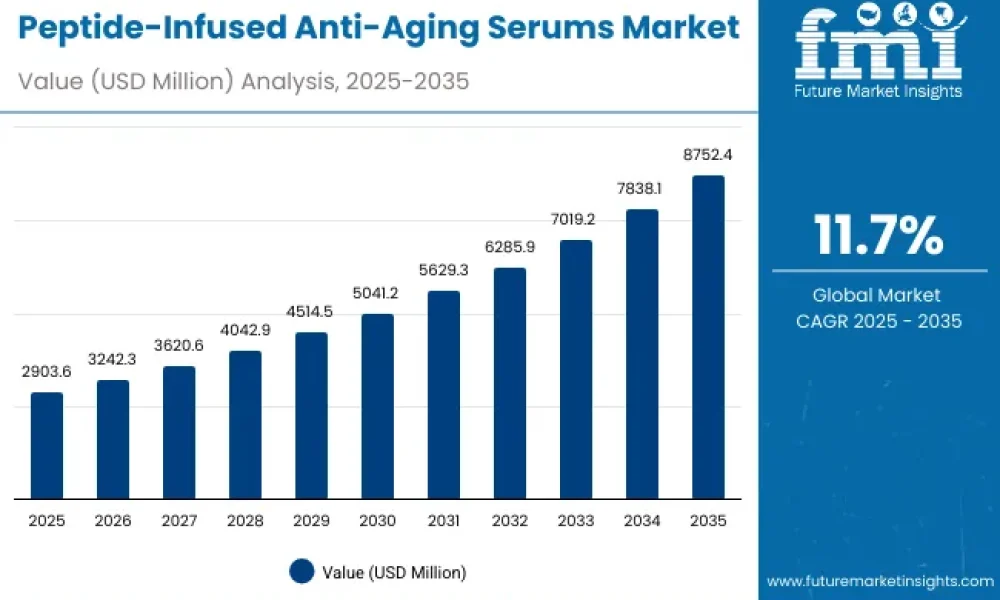
The global Peptide-Infused Anti-Aging Serums Market is entering a decisive growth phase, backed by rising consumer trust in clinically validated skincare and continuous innovation by both established beauty leaders and emerging manufacturers. Valued at USD 2,903.6 million in 2025, the market is projected to reach USD 8,752.4 million by 2035, registering a strong CAGR of 11.7% over the forecast period. This expansion represents an absolute value opportunity of nearly USD 5.85 billion, underscoring the category’s long-term commercial potential.
Market Outlook: A Decade of Accelerated Expansion
Between 2025 and 2030, the market is expected to grow from USD 2.9 billion to USD 5.04 billion, driven by increasing adoption of science-backed formulations and premium skincare routines. Growth is forecast to accelerate further during 2030–2035, supported by widening consumer bases in Asia-Pacific, luxury skincare demand, and innovation in peptide delivery technologies. Signal peptides are anticipated to retain leadership with a 47% market share in 2025, reflecting their proven efficacy in wrinkle reduction.
Why the Market Is Growing
The peptide-infused anti-aging serums market is expanding as consumers increasingly prioritize visible, measurable results over cosmetic claims. Demand is being fueled by:
- Rising awareness of preventive skin health
- Strong preference for clinically validated and dermatologist-endorsed products
- Rapid expansion of e-commerce and digital-first beauty platforms
- Growing appeal of clean-label, vegan, and fragrance-free claims, especially among millennials and Gen Z
Emerging economies such as India and China are witnessing accelerated adoption due to urbanization, rising disposable incomes, and social commerce-driven beauty education.
Innovation Creating Opportunities for New and Established Players
Competitive intensity remains high, with global brands such as Estée Lauder, Olay, Clinique, SkinCeuticals, and La Roche-Posay strengthening their positions through R&D investments and diversified brand portfolios. At the same time, newer and indie brands are gaining traction by introducing affordable peptide innovations, hybrid serum formats, and digital-native engagement strategies.
Recent launches, including Good Molecules’ Super Peptide Serum and Babaria’s Botox-Effect Serum, demonstrate how emerging manufacturers are successfully challenging premium incumbents by combining peptide technology with accessible pricing and viral social media marketing.
Key Segments of the Peptide-Infused Anti-Aging Serums Market (Pointwise)
By Peptide Type
- Signal peptides (Matrixyl, Argireline) – Market leader due to wrinkle-reduction efficacy
- Carrier peptides (copper peptides)
- Enzyme inhibitor peptides
- Neurotransmitter-affecting peptides
By Function
- Wrinkle reduction – Dominant segment with 52% share in 2025
- Firming & elasticity
- Brightening
- Repair & barrier strengthening
By Format
- Water-based serums – 46% share, driven by lightweight texture and broad skin compatibility
- Gel serums
- Ampoules
- Cream-serum hybrids
By Distribution Channel
- E-commerce – Fastest-growing channel
- Specialty beauty retail
- Pharmacies
- Dermatology clinics
By Claim
- Clinically validated
- Vegan
- Fragrance-free
- Clean-label
By Region
- North America
- Europe
- East Asia
- South Asia & Pacific
- Latin America
- Middle East & Africa
Regional Highlights
- India is the fastest-growing market with a projected 18.5% CAGR, supported by a rapidly expanding middle class and digital-first adoption.
- China follows closely at 16.4% CAGR, driven by advanced beauty retail ecosystems and strong social commerce penetration.
- Japan benefits from its reputation for cosmetic science, while Europe sees steady growth led by the UK and Germany, supported by regulatory trust and sustainability focus.
- The United States, though mature, continues to grow through premiumization, personalization, and multifunctional peptide formulations.
Competitive Landscape
The market remains moderately fragmented, with Estée Lauder holding the largest identifiable share at 8.4% in 2025, while the remaining share is distributed across global, regional, and indie brands. Over the next decade, competitive advantage is expected to favor players that combine scientific validation, sustainable sourcing, hybrid delivery systems, and strong digital engagement.
Looking Ahead
The peptide-infused anti-aging serums market is poised for sustained growth through 2035, shaped by scientific rigor, regional expansion, and premium positioning. As both established manufacturers and new entrants invest in peptide technologies and consumer-centric innovation, the category is set to redefine the future of evidence-based anti-aging skincare worldwide.
Have a specific Requirements and Need Assistant on Report Pricing or Limited Budget please contact us – [email protected]
About Future Market Insights (FMI)
Future Market Insights, Inc. (FMI) is an ESOMAR-certified, ISO 9001:2015 market research and consulting organization, trusted by Fortune 500 clients and global enterprises. With operations in the U.S., UK, India, and Dubai, FMI provides data-backed insights and strategic intelligence across 30+ industries and 1200 markets worldwide.



