
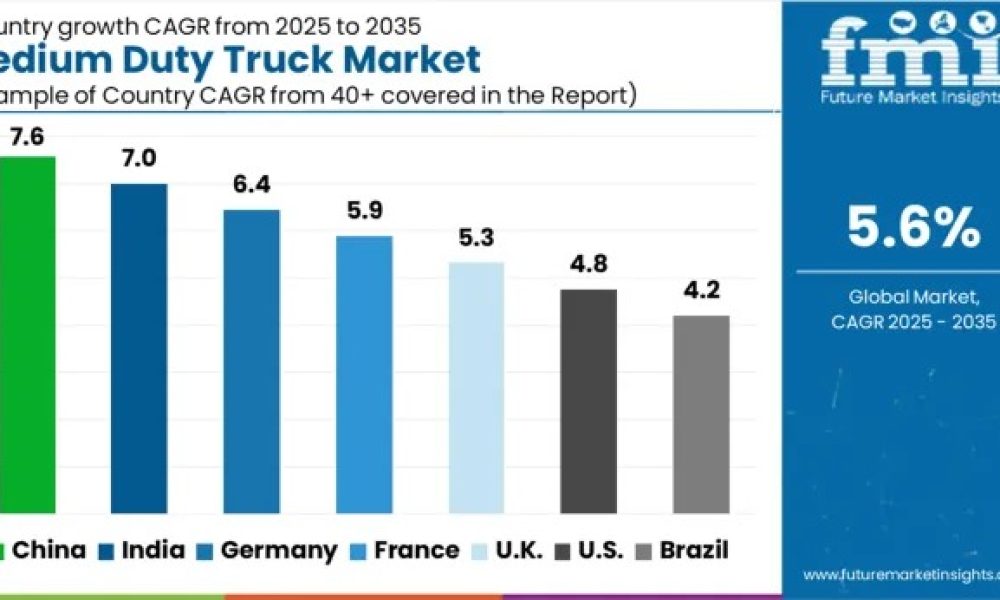
The global medium duty truck market is entering a decade of sustained expansion, underpinned by structural shifts in logistics, urban distribution, and infrastructure development. Valued at USD 57.8 billion in 2025, the market is projected to reach USD 99.6 billion by 2035, registering a compound annual growth rate (CAGR) of 5.6% over the forecast period. This growth trajectory reflects the increasing reliance on medium-duty vehicles as the backbone of regional freight movement and last-mile delivery networks worldwide.
Early market growth is characterized by gradual acceleration as medium duty trucks continue to gain relevance across logistics, construction, food distribution, and municipal services. The expansion of e-commerce and omni-channel retail models has significantly increased demand for flexible vehicles capable of balancing payload capacity with maneuverability, particularly in dense urban environments. Medium duty trucks, positioned between light commercial vehicles and heavy trucks, are increasingly viewed as the optimal solution for mid-range transportation needs.
Between 2026 and 2030, the market is expected to strengthen from USD 57.8 billion to USD 75.9 billion, progressing steadily through USD 61.0 billion, USD 64.4 billion, and USD 68.0 billion. This phase reflects accelerated adoption driven by advancements in vehicle technology, including telematics integration, improved powertrain efficiency, and enhanced safety systems. Regulatory pressure to improve fuel efficiency and reduce emissions is also influencing fleet replacement cycles, further supporting demand during this period.
From 2031 to 2035, the market expands from USD 75.9 billion to USD 99.6 billion, moving through USD 80.1 billion, USD 84.6 billion, USD 89.3 billion, and USD 94.3 billion. Growth during this phase follows a steady deceleration pattern, indicative of a maturing market. However, continued investments in smart logistics infrastructure, electrification initiatives, and fleet digitization are expected to sustain long-term momentum.
Commercial Applications Anchor Market Demand
Medium duty trucks remain integral to the broader commercial vehicle ecosystem, which accounts for approximately 35–40% of total market contribution. Their role in freight transportation, distribution, and service operations makes them indispensable to supply chains across developed and emerging economies. The logistics and supply chain segment follows closely, contributing 25–30%, as regional distribution hubs and last-mile delivery operations expand to meet rising consumer expectations for faster fulfillment.
The construction and building materials segment represents 15–18% of market demand, supported by ongoing infrastructure development and urban expansion projects, particularly in Asia-Pacific and parts of Latin America. Medium duty trucks are widely used to transport materials such as cement, aggregates, and prefabricated components. Meanwhile, waste management contributes 8–10%, driven by urbanization and growing emphasis on efficient municipal services. The food and beverage sector accounts for 10–12%, relying heavily on medium duty trucks for temperature-controlled and regional distribution of perishable goods.
Get access to comprehensive data tables and detailed market insights — request your sample report today!
https://www.futuremarketinsights.com/reports/sample/rep-gb-25868
Segmental Performance Highlights
By vehicle class, Class 4 trucks lead the market with a 28.7% share, reflecting strong adoption in parcel delivery, food distribution, and municipal applications. Their lower total cost of ownership, urban compatibility, and operational flexibility make them particularly attractive to fleet operators seeking right-sized solutions.
Fuel-wise, diesel-powered trucks continue to dominate, accounting for 41.2% of the market. Diesel engines remain preferred for their high torque output, durability, and extensive service infrastructure. While electric and hybrid alternatives are gaining traction—especially in urban operations—diesel remains central to medium-term fleet strategies due to cost-effectiveness and proven reliability.
In terms of horsepower, the below 150 HP segment holds a 33.5% share, favored for city-based operations and light-load applications. These vehicles align well with urban emission zones, traffic constraints, and cost-sensitive fleet requirements, reinforcing their relevance as cities prioritize efficient, low-impact transportation.
Technology and Sustainability Shape Market Evolution
The medium duty truck market is evolving alongside broader trends in fleet electrification, connectivity, and automation. Telematics systems, predictive maintenance tools, and advanced driver assistance features are becoming standard as operators seek greater visibility, uptime optimization, and safety performance. Electrification is progressing gradually, with electric medium duty trucks gaining adoption in controlled urban routes where charging infrastructure and regulatory incentives are supportive.
Autonomous driving technologies, while still emerging in this segment, are expected to play an increasing role over the long term, particularly in hub-to-hub logistics and controlled delivery environments. These innovations are reshaping vehicle design priorities and influencing long-term procurement strategies across the industry.
Drive Your Business Growth Strategy: Checkout the Report for Key Insights
https://www.futuremarketinsights.com/checkout/25868
Regional Growth Dynamics
Regionally, Asia-Pacific remains the fastest-growing market, led by China (7.6% CAGR) and India (7.0% CAGR). Rapid industrialization, expanding logistics networks, and strong infrastructure investment are driving demand in these countries. Europe shows stable growth, with Germany (6.4%), France (5.9%), and the UK (5.3%) benefiting from urban freight optimization and emission-reduction policies. In North America, the United States is projected to grow at 4.8% CAGR, supported by e-commerce expansion and steady infrastructure development.
Competitive Landscape Remains Intense
The global medium duty truck market is highly competitive, with manufacturers differentiating through technology, regional presence, and cost efficiency. Key players include Ashok Leyland Limited, BharatBenz, Eicher Motor Limited, Ford Motor Company, General Motors, Hino Motors, ISUZU MOTORS, Mercedes-Benz Group AG, PACCAR Inc., Tata Motors Limited, and Traton Group. These companies continue to invest in product innovation, alternative powertrains, and connected vehicle solutions to strengthen their market positioning.
Outlook
As logistics networks become more complex and urban delivery requirements intensify, medium duty trucks are set to play an increasingly strategic role in global transportation systems. The combination of steady demand fundamentals, technological advancement, and regulatory transformation positions the market for consistent growth through 2035, reinforcing its importance within the commercial vehicle landscape.
Why Choose FMI: Empowering Decisions that Drive Real-World Outcomes: https://www.futuremarketinsights.com/why-fmi
About Future Market Insights (FMI)
Future Market Insights, Inc. (FMI) is an ESOMAR-certified, ISO 9001:2015 market research and consulting organization, trusted by Fortune 500 clients and global enterprises. With operations in the U.S., UK, India, and Dubai, FMI provides data-backed insights and strategic intelligence across 30+ industries and 1200 markets worldwide.



