
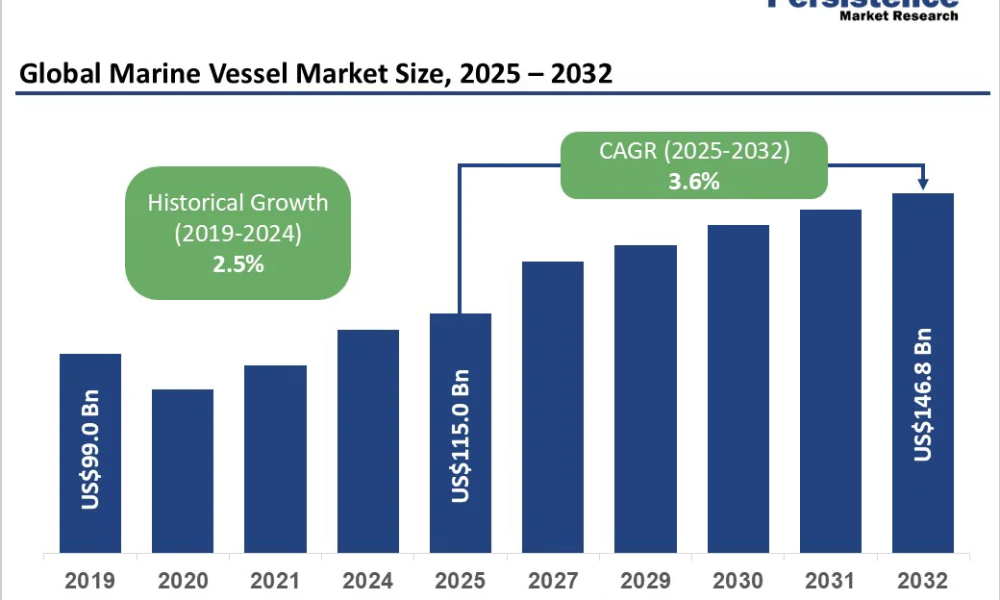
The Marine Vessel Market is undergoing steady transformation as global trade flows, maritime logistics modernization, and sustainability mandates reshape fleet strategies. According to Persistence Market Research, the global marine vessel market size is projected to be valued at US$115 Billion in 2025 and is estimated to reach US$146.8 Billion by 2032, registering a CAGR of 3.6% during the forecast period 2025−2032. Growth is being supported by expanding global trade volumes and the critical role of maritime transport in facilitating cross-border commerce. Rising seaborne trade in crude oil, liquefied natural gas, bulk commodities, and containerized goods continues to strengthen long-term vessel demand.
Accelerating fleet replacement cycles are another vital factor driving the marine vessel industry. Aging fleets across developed and emerging markets are being phased out in favor of fuel-efficient and technologically advanced ships. Increasing investments in sustainable propulsion technologies, including LNG-powered vessels and hybrid systems, are shaping procurement decisions. The leading segment within the Marine Vessel Market is commercial vessels, driven by consistent demand for cargo transportation. Geographically, Asia Pacific dominates the market due to its strong shipbuilding base, expanding port infrastructure, and high concentration of global trade routes.
Get Your FREE Sample Report Instantly Click Now: https://www.persistencemarketresearch.com/samples/35689
Company Insights
Key players operating in the Marine Vessel Market include:
- China State Shipbuilding Corporation (CSSC)
- Hyundai Heavy Industries (HHI)
- Daewoo Shipbuilding & Marine Engineering (DSME)
- Samsung Heavy Industries
- Fincantieri S.p.A.
- Meyer Werft GmbH & Co. KG
- STX Offshore & Shipbuilding
- Wärtsilä Corporation
- MAN Energy Solutions
- Rolls-Royce
- ABB Marine & Ports
- Mitsubishi Heavy Industries
- Kawasaki Heavy Industries
- Hyundai Mipo Dockyard Co., Ltd.
- Vard Marine
Key Highlights from the Report
➤ The global Marine Vessel Market is expected to grow from US$115 Billion in 2025 to US$146.8 Billion by 2032.
➤ The market is projected to register a CAGR of 3.6% during the forecast period 2025−2032.
➤ Expanding global trade volumes are a primary growth driver for vessel demand worldwide.
➤ Accelerating fleet replacement cycles are stimulating investments in new-generation ships.
➤ Sustainable propulsion technologies are reshaping shipbuilding and procurement strategies.
➤ Asia Pacific leads the Marine Vessel Market due to strong shipbuilding capacity and trade dominance.
Market Segmentation
By Vessel Type
- Cargo Vessels
- Passenger Vessels
- Naval Vessels
- Offshore/Service Vessels
- Specialized Vessels
- Fishing Vessels
- Others
By Application
- Commercial Shipping
- Military Operations
- Recreational Boating
- Fishing
- Offshore Energy
- Search & Rescue
- Research & Survey
- Tourism
By Propulsion Type
- Diesel-powered
- LNG-powered
- Hybrid-Electric
- Methanol Hybrid
- Gas Turbine
- Fully Electric
- Nuclear
By Region
- North America
- Europe
- East Asia
- South Asia & Oceania
- Latin America
- Middle East & Africa
Customize This Report for Your Exact Requirements: https://www.persistencemarketresearch.com/request-customization/35689
Regional Insights
Asia Pacific remains the leading regional market, supported by established shipbuilding hubs and strong export-import activity. Countries within the region benefit from cost-competitive manufacturing, skilled labor availability, and government-backed maritime initiatives. The region’s extensive coastline and strategic trade corridors further strengthen its position. Rapid port expansion and investments in logistics infrastructure continue to enhance regional competitiveness.
Europe represents another significant market, driven by technological innovation and sustainability-focused shipbuilding. The region emphasizes environmentally compliant vessels and advanced marine engineering solutions. North America maintains stable growth, supported by offshore energy activities and commercial fleet upgrades. Meanwhile, emerging economies in other regions are witnessing gradual increases in vessel procurement to strengthen maritime trade capabilities.
Market Drivers
The primary driver of the Marine Vessel Market is the steady increase in global trade volumes. Maritime transport remains the backbone of international commerce, handling the majority of goods traded worldwide. As economies expand and consumption patterns evolve, the demand for reliable cargo transportation rises correspondingly. This dynamic supports consistent vessel orders, particularly for container ships and bulk carriers. The growth of e-commerce and global supply chains further intensifies reliance on maritime logistics networks.
Another crucial growth driver is the acceleration of fleet replacement cycles. Many shipping operators are retiring aging vessels to improve fuel efficiency and comply with environmental regulations. Investments in sustainable propulsion technologies are reshaping fleet strategies, encouraging the adoption of LNG-powered and hybrid vessels. These advancements not only reduce emissions but also enhance operational performance. As regulatory pressures increase, shipowners are prioritizing modernization, thereby sustaining long-term demand in the Marine Vessel Market.
Market Restraints
Despite stable growth, the Marine Vessel Market faces certain restraints that could moderate expansion. High capital expenditure requirements remain a significant barrier for new entrants and smaller operators. Vessel construction, maintenance, and retrofitting demand substantial financial resources, often requiring long-term financing arrangements. Fluctuations in raw material prices can further impact shipbuilding costs, affecting profitability margins for manufacturers and operators alike.
Economic volatility and trade disruptions also present challenges to market stability. Geopolitical tensions and policy uncertainties can temporarily slow maritime trade flows. Shipping companies may delay new orders during uncertain economic conditions, affecting short-term revenue streams. Additionally, compliance with evolving environmental regulations requires continuous technological upgrades, increasing operational complexity. These factors collectively pose potential restraints for the Marine Vessel Market.
Market Opportunities
The Marine Vessel Market presents significant opportunities linked to sustainable innovation and digital transformation. Increasing investments in eco-friendly propulsion systems create avenues for shipbuilders specializing in advanced engineering solutions. As environmental compliance becomes central to maritime operations, demand for energy-efficient vessels is expected to grow steadily. This shift supports technological partnerships and research-driven product development.
Digitalization within maritime operations also opens new growth prospects. Smart vessel technologies, predictive maintenance systems, and data-driven navigation solutions enhance efficiency and safety. Shipping companies are increasingly integrating digital platforms to optimize fuel consumption and route planning. These innovations improve cost efficiency while reducing environmental impact. Combined with rising global trade, such advancements create a favorable outlook for the Marine Vessel Market.
Recent Developments:
- March 2024: A leading shipbuilder announced expanded production capacity to meet rising global vessel demand.
- October 2023: A major marine engineering company introduced an advanced fuel-efficient vessel design to support sustainable shipping initiatives.
Ready to Dive Deep? Buy Full Report Today: https://www.persistencemarketresearch.com/checkout/35689
Frequently Asked Questions
➤ What are the main factors influencing the Marine Vessel Market 2025-2032?
➤ Which companies are the major sources in the Marine Vessel Market industry?
➤ What are the opportunities, risks, and overall structure of the Marine Vessel Market?
➤ How do top Marine Vessel Market companies compare in terms of revenue and growth?
➤ How are market types, applications, revenue, and value analyzed in the Marine Vessel Market?
Future Opportunities and Growth Prospects
The Marine Vessel Market is poised for steady growth through 2032, supported by trade expansion and sustainability-driven transformation. Long-term prospects are reinforced by technological advancements and fleet modernization initiatives. As the market progresses from US$115 Billion in 2025 to US$146.8 Billion by 2032 at a CAGR of 3.6%, strategic investments in innovation and green propulsion systems will shape competitive dynamics. Stakeholders focusing on efficiency, environmental compliance, and digital integration are likely to capture significant growth opportunities in the evolving marine vessel industry.




