
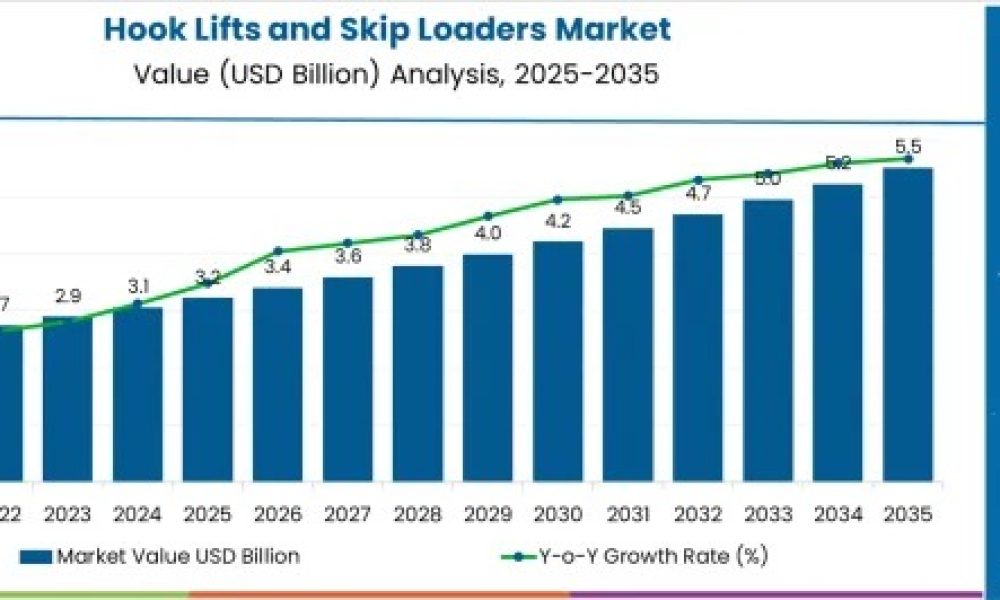
The global Hook Lifts and Skip Loaders Market is poised for a strong decade ahead, expanding from USD 3.2 billion in 2025 to USD 5.5 billion by 2035 at a 5.5% CAGR. This growth is underpinned by rapid urbanization, modern waste management reforms, large-scale construction activities, and widespread adoption of high-efficiency hydraulic lifting solutions across developed and emerging economies.
Subscribe for Year-Round Insights → Stay ahead with quarterly and annual data updates
https://www.futuremarketinsights.com/reports/sample/rep-gb-25886
Rising demand for efficient waste collection, bulk material movement, and flexible container handling is shaping the industry’s trajectory. The growth contribution index highlights that municipal waste systems and commercial construction will dominate early momentum (2025–2028). Meanwhile, emerging economies—driven by infrastructure expansions, industrialization, and smart city programs—will accelerate global adoption between 2029 and 2032. Despite slight maturity-driven moderation post-2033, long-term demand remains resilient due to ongoing modernization of urban waste systems and expanding industrial logistics operations.
Advanced hydraulic technologies, automated control systems, fuel-optimized engines, and modular chassis designs are further boosting market readiness. By 2035, public–private partnerships and investment in smart waste ecosystems will strengthen adoption in both municipal and private sectors.
Market Drivers: Why Adoption is Rising
- Urban waste volumes and sanitation projects
With global cities generating higher volumes of municipal solid waste, hook lifts and skip loaders offer unmatched flexibility for rapid loading, unloading, and multi-container operations. Their ability to reduce labor dependence and optimize fleet efficiency is accelerating procurement across municipalities. - Construction and infrastructure expansion
The construction sector—projected to hold 31.8% of revenue share in 2025—relies heavily on these systems for debris handling, bulk material transport, and site-to-site logistics. Faster turnaround time, container interchangeability, and durability give hook lifts a productivity edge in large and mid-scale construction projects. - Technology-driven evolution
Modern systems integrate telematics, GPS-based route optimization, automated hydraulic functions, corrosion-resistant frames, and safety enhancements. These features improve uptime, reduce maintenance costs, and extend equipment lifecycle, making them increasingly attractive for fleet modernization initiatives. - Regulatory compliance and sustainability
Regions across Europe and North America emphasize low-emission vehicles, safe waste handling procedures, and operator safety. Manufacturers are responding with hybrid/electric options, improved hydraulic efficiency, and emission-compliant powertrains.
Segment Insights: Hook Lifts Lead with 57.8% Share in 2025
The hook lifts segment is projected to dominate with a 57.8% market share in 2025, supported by its modular design, high safety standards, and reduced operational downtime. Its ability to accommodate diverse containers positions it as the preferred choice across construction, waste management, and recycling industries.
Skip loaders complement these systems in applications requiring compact maneuverability and consistent cycle times, especially in urban waste collection frameworks.
Regional Outlook: Strong Growth Across 40+ Countries
- China (CAGR 7.4%) – Driven by municipal modernization, industrial recycling, and construction expansion. Innovations in hydraulics, automation, and telematics fuel adoption.
- India (CAGR 6.9%) – Smart city initiatives, rising waste volumes, and mechanized sanitation are creating sustained demand.
- Germany (CAGR 6.3%) – Emphasis on low-emission fleets, automated hydraulic systems, and lightweight chassis solutions.
- UK (CAGR 5.2%) – Fleet renewal, urban sanitation mandates, and industrial logistics upgrades boosting procurement.
- USA (CAGR 4.7%) – Municipal fleet modernization, industrial waste management, and construction activity drive growth.
Competitive Landscape
Leading players include Ampliroll Hooklift Systems, Hyva Global B.V., Hiab AB, Cargotec Corporation, Marrel SAS, Meiller Group, Palfinger AG, Stellar Industries, Volvo Construction Equipment, and others. Companies are investing in modular platforms, lightweight materials, hydraulic automation, and telematics integration to reduce downtime and align with stricter regulatory standards.
Product portfolios typically detail lifting capacity, container compatibility, hydraulic pressure, safety mechanisms, and maintenance best practices—reflecting a market driven by precision engineering and operational efficiency.
Get data that aligns with your strategic priorities — ask for report customization today:
https://www.futuremarketinsights.com/customization-available/rep-gb-25886
Have a specific Requirements and Need Assistant on Report Pricing or Limited Budget please contact us – [email protected]
About Future Market Insights (FMI)
Future Market Insights, Inc. (FMI) is an ESOMAR-certified, ISO 9001:2015 market research and consulting organization, trusted by Fortune 500 clients and global enterprises. With operations in the U.S., UK, India, and Dubai, FMI provides data-backed insights and strategic intelligence across 30+ industries and 1200 markets worldwide.
Contact Us:
Future Market Insights Inc.
Christiana Corporate, 200 Continental Drive,
Suite 401, Newark, Delaware – 19713, USA
T: +1-347-918-3531



