
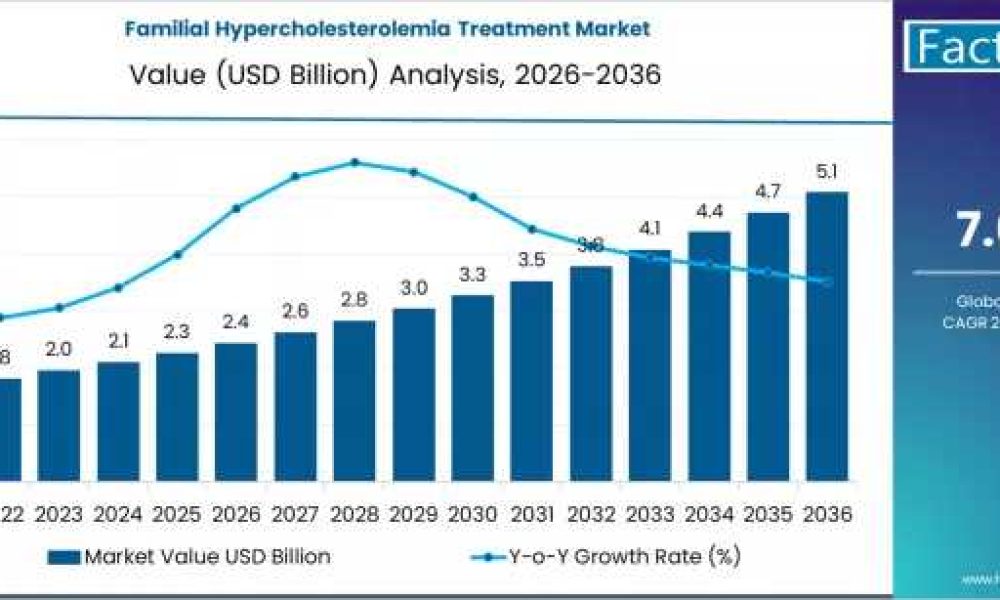
Global Familial Hypercholesterolemia Treatment Market Projected to Reach USD 4,525 Million by 2036, Driven by Genetic Innovation and Personalized Medicine
The global Familial Hypercholesterolemia (FH) treatment market is entering a transformative decade of growth, with new projections estimating a market valuation of USD 2,321.9 million in 2026. According to the latest industry analysis for the 2026–2036 forecast period, the sector is expected to expand at a compound annual growth rate (CAGR) of 6.9%, reaching a total market size of USD 4,525.0 million by 2036.
This surge is primarily attributed to a paradigm shift in how healthcare systems identify and manage genetic lipid disorders. As cardiovascular health takes center stage in global public health initiatives, the integration of advanced genetic sequencing and novel biologics is redefining the standard of care for patients with both Heterozygous (HeFH) and Homozygous (HoFH) variations of the condition.
Request for Sample Report | Customize Report | Purchase Full Report – https://www.factmr.com/connectus/sample?flag=S&rep_id=5643
Strategic Market Overview: Addressing the Underdiagnosis Gap
Familial Hypercholesterolemia remains one of the most common yet underdiagnosed genetic conditions worldwide. By 2026, industry leaders are prioritizing early intervention to combat the high risk of premature cardiovascular disease.
Who: Key pharmaceutical innovators including Amgen, Novartis, Sanofi, Regeneron, and Pfizer are spearheading R&D efforts.
What: A comprehensive ecosystem of diagnostic tools (Genetic Sequencing, PCR-based mutation tests) and therapies (PCSK9 inhibitors, siRNA, and emerging gene-editing technologies).
When: The forecast period spans from 2026 to 2036, marking a decade of expected regulatory breakthroughs and expanded pediatric indications.
Where: While North America remains the largest revenue contributor, the Asia-Pacific region—specifically India (9.9% CAGR) and China (9.7% CAGR)—is emerging as the fastest-growing market.
Why: Increasing prevalence of cardiovascular events and a critical need to move beyond traditional statin therapy for high-risk patients.
Technological Evolution: From Statins to Gene-Silencing
The market landscape is evolving from broad-spectrum lipid management to precision-targeted biologics. Genetic sequencing tests currently lead the product segment with a 34% market share, facilitating the cascade screening of family members—a vital step in capturing the undiagnosed population.
Key Growth Drivers
Rise of Precision Biologics: The adoption of PCSK9 inhibitors (e.g., Repatha, Praluent) and siRNA therapies (e.g., Leqvio) has provided options for patients who are statin-intolerant or fail to reach LDL-C targets.
Pediatric Expansion: Recent FDA approvals for therapies like evinacumab in children as young as one year old are widening the addressable market and enabling treatment at the earliest stages of disease progression.
Bypassing Defective Receptors: For HoFH patients with little to no LDL receptor function, new ANGPTL3 and MTP inhibitors are proving effective, reducing the historical reliance on invasive procedures like apheresis.
Regional Insights and Economic Impact
The United States continues to lead the market with an 8.1% CAGR, supported by robust clinical trial infrastructure and favorable reimbursement for rare disease treatments. However, the global landscape is diversifying:
Europe: Countries like France and Germany are seeing high adoption rates due to established universal screening protocols.
Emerging Markets: Brazil and Saudi Arabia are investing heavily in healthcare infrastructure, focusing on improving the 5% global diagnosis rate for Homozygous FH.
The shift toward targeted, personalized approaches—combined with genetic cascade screening—positions the market to significantly reduce the global burden of FH-related cardiovascular events over the next ten years, says a senior market analyst.
Future Outlook: The Road to 2036
As the industry moves toward 2036, the focus will likely shift toward curative potentials. Research into CRISPR/Cas9 gene editing and AAV-mediated gene therapy represents the next frontier, offering the possibility of a one-and-done treatment that could disrupt the current lifelong medication model.
Despite challenges such as high treatment costs and varying global insurance coverage, the market’s trajectory remains strong. For investors and industry professionals, the 2026–2036 period represents a critical window for the commercialization of next-generation lipid-lowering agents.
Related Reports
Treatment-Resistance Depression Treatment Market https://www.factmr.com/report/3147/treatment-resistance-depression-treatment-market
– Contact Us –
11140 Rockville Pike, Suite 400, Rockville,
MD 20852, United States
Tel: +1 (628) 251-1583 | [email protected]
About Fact.MR
Fact.MR is a global market research and consulting firm, trusted by Fortune 500 companies and emerging businesses for reliable insights and strategic intelligence. With a presence across the U.S., UK, India, and Dubai, we deliver data-driven research and tailored consulting solutions across 30+ industries and 1,000+ markets. Backed by deep expertise and advanced analytics, Fact.MR helps organizations uncover opportunities, reduce risks, and make informed decisions for sustainable growth.



