
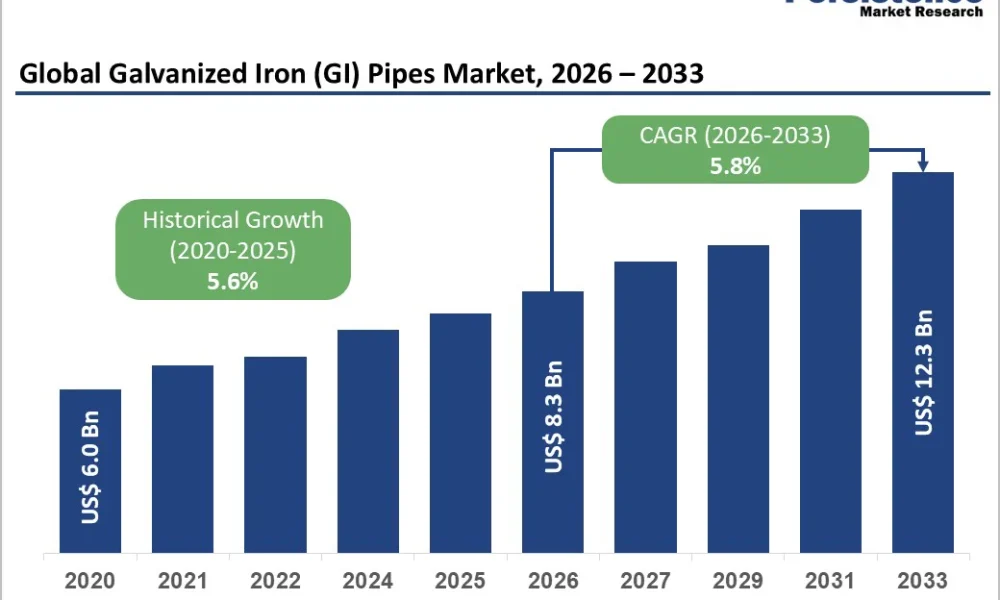
The global Galvanized Iron GI Pipes Market is witnessing steady expansion, supported by rising infrastructure investments and strong construction activity across developing economies. According to Persistence Market Research, the market is likely to be valued at US$8.3 billion in 2026 and is expected to reach US$12.3 billion by 2033, growing at a CAGR of 5.8% during the forecast period from 2026 to 2033. Increasing urbanization and industrialization are accelerating the need for corrosion resistant and durable piping systems in water distribution, structural frameworks, and industrial utilities. GI pipes remain widely preferred due to their strength, cost effectiveness, and long service life in challenging environmental conditions.
Rapid infrastructure development, particularly in Asia Pacific, is a key factor shaping market expansion. Governments are investing heavily in urban housing projects, commercial construction, and public utility upgrades, all of which require reliable piping solutions. The market statistics highlight consistent growth driven by demand from water supply networks, agricultural irrigation, and industrial pipelines. The leading segment continues to be water supply and plumbing applications due to increasing demand for safe and efficient water transportation systems. Asia Pacific leads the geographical landscape, supported by construction growth, population expansion, and expanding manufacturing sectors that require durable galvanized iron pipes.
One Click to Access Your Free Sample Report : https://www.persistencemarketresearch.com/samples/15235
Key Highlights from the Report
➤ The global Galvanized Iron GI Pipes Market is projected to grow at a CAGR of 5.8% between 2026 and 2033
➤ Market valuation is expected to rise from US$8.3 billion in 2026 to US$12.3 billion by 2033
➤ Rapid infrastructure development and construction boom are primary growth catalysts
➤ Water supply and plumbing applications represent the leading demand segment
➤ Asia Pacific dominates the market due to urbanization and industrial growth
➤ Increasing preference for corrosion resistant and durable piping systems boosts adoption
Market Segmentation
The Galvanized Iron GI Pipes Market is segmented based on product type, diameter range, application, and end user industries. By product type, standard GI pipes and lightweight GI pipes cater to varied structural and plumbing needs. Different diameter categories address residential, commercial, and heavy industrial requirements. Smaller diameter pipes are commonly used in household plumbing and water supply lines, while larger diameters are utilized in industrial installations and infrastructure projects. The diversity in product specifications enables manufacturers to address a broad customer base across multiple sectors.
By application, the market is segmented into water supply, structural support, industrial pipelines, agricultural irrigation, and others. Water supply and plumbing remain the dominant segment due to expanding urban infrastructure and sanitation projects. Industrial end users include manufacturing plants, oil and gas facilities, and processing units that require corrosion resistant pipelines for fluid transport. Agricultural irrigation is also contributing to steady demand, particularly in developing regions investing in rural development and water management systems. The wide applicability of GI pipes across sectors supports sustained market expansion.
Get a Customized Market View in One Click : https://www.persistencemarketresearch.com/request-customization/15235
Regional Insights
Asia Pacific holds the largest share of the Galvanized Iron GI Pipes Market, driven by rapid urbanization and infrastructure development. Countries in the region are witnessing strong residential and commercial construction activities. Expanding manufacturing hubs and government backed infrastructure initiatives are fueling demand for durable and cost effective piping solutions. The construction boom in urban centers and industrial corridors continues to reinforce regional dominance.
Other regions are also experiencing stable growth supported by infrastructure modernization and industrial activities. Investments in water management systems and replacement of aging pipeline networks are sustaining demand. The focus on improving public utilities and expanding industrial production capacity contributes to consistent adoption of galvanized iron pipes across global markets.
Market Drivers
Rapid infrastructure development remains the primary driver of the Galvanized Iron GI Pipes Market. Governments across emerging economies are prioritizing housing, transportation, and water distribution projects to support growing populations. Such initiatives require extensive piping networks for water supply, drainage, and structural reinforcement. GI pipes offer durability and resistance to corrosion, making them suitable for long term infrastructure use.
Urbanization is further accelerating construction activities, particularly in Asia Pacific. Growing urban populations increase the need for residential complexes, commercial buildings, and industrial facilities. The construction boom directly translates into higher demand for galvanized iron pipes. Additionally, the emphasis on reliable and long lasting piping materials enhances the adoption of GI pipes in both public and private sector projects.
Market Restraints
Despite steady growth, the Galvanized Iron GI Pipes Market faces certain restraints. Fluctuations in raw material prices can impact production costs and profit margins for manufacturers. Steel price volatility may affect pricing strategies and procurement planning. This can create challenges for smaller manufacturers operating with limited financial flexibility.
Another restraint is the availability of alternative piping materials. Materials offering lighter weight or specialized performance characteristics may compete in certain applications. End users may evaluate multiple material options based on project specifications, cost considerations, and long term maintenance requirements. Such competition can influence purchasing decisions and moderate growth in specific segments.
Market Opportunities
The ongoing expansion of urban infrastructure presents significant opportunities for the Galvanized Iron GI Pipes Market. Smart city initiatives and modernization of water distribution systems create sustained demand for corrosion resistant pipelines. Replacement of aging infrastructure in established cities also opens avenues for manufacturers to supply upgraded GI pipe solutions.
Industrial expansion in developing economies offers additional growth prospects. New manufacturing facilities, processing plants, and industrial parks require reliable piping systems. As governments focus on economic development and industrial output, demand for durable galvanized iron pipes is expected to strengthen. Continuous investment in construction and public utilities supports long term market potential.
Confirm Your Purchase & Access Full Insights : https://www.persistencemarketresearch.com/checkout/15235
Company Insights
Key players operating in the Galvanized Iron GI Pipes Market include:
- JSW
- Arcelor Mittal
- Bhushan Steel
- Essar Steel
- APL Apollo
- Hunan Great Steel Pipe
- GI Pipes India
Recent Developments
January 2024
A leading manufacturer expanded its galvanized iron pipe production capacity to meet growing infrastructure demand.
September 2023
A major player introduced enhanced corrosion resistant GI pipe variants for water supply applications.
Future Opportunities and Growth Prospects
The future of the Galvanized Iron GI Pipes Market remains promising as infrastructure development and urban expansion continue worldwide. Sustained investments in construction, water supply systems, and industrial facilities are expected to maintain steady demand. With projected growth to US$12.3 billion by 2033 at a CAGR of 5.8%, the market demonstrates resilience and long term potential. Manufacturers focusing on product quality, durability, and capacity expansion are likely to benefit from evolving infrastructure needs and industrial development trends.




