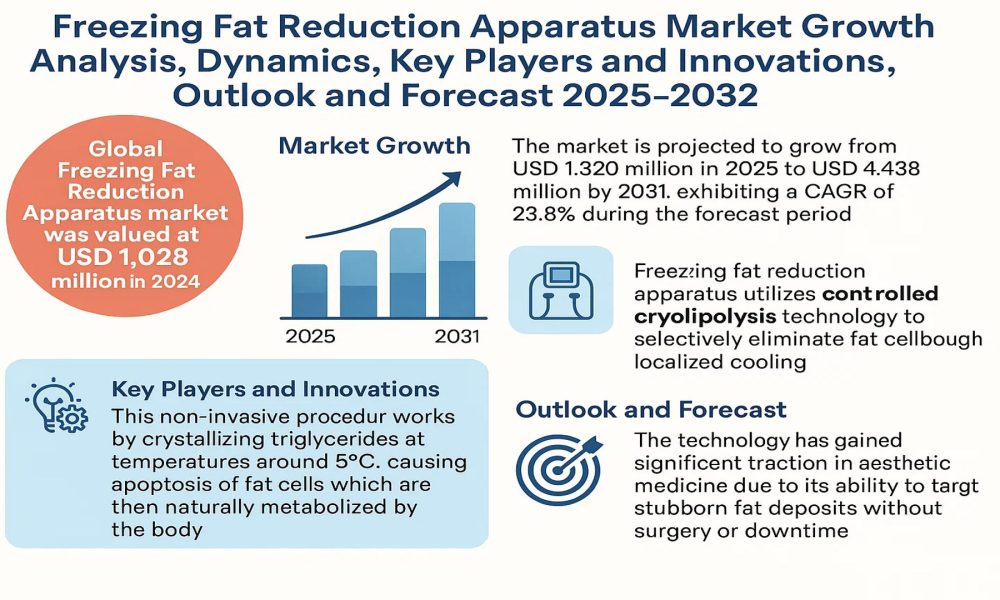
Freezing Fat Reduction Apparatus Market was valued at USD 1,028 million in 2024. The market is projected to grow from USD 1,320 million in 2025 to USD 4,438 million by 2031, exhibiting a CAGR of 23.8% during the forecast period.
Freezing fat reduction apparatus utilizes controlled cryolipolysis technology to selectively eliminate fat cells through localized cooling. This non-invasive procedure works by crystallizing triglycerides at temperatures around 5°C, causing apoptosis of fat cells which are then naturally metabolized by the body. The technology has gained significant traction in aesthetic medicine due to its ability to target stubborn fat deposits without surgery or downtime.
The market expansion is driven by several key factors including increasing demand for non-invasive body contouring procedures, growing obesity rates worldwide, and technological advancements in aesthetic devices. According to industry data, non-surgical fat reduction procedures grew by 19.9% globally in 2021, significantly outpacing surgical alternatives. North America currently dominates the market, accounting for over 40% of global revenue, followed by Europe and Asia-Pacific regions with rapidly growing adoption rates.
Download Your Free Copy of the Sample Report- https://www.intelmarketresearch.com/download-free-sample/9029/freezing-fat-reduction-apparatus-market
MARKET DYNAMICS
MARKET DRIVERS
Rising Demand for Non-Invasive Fat Reduction Solutions to Accelerate Market Growth
The global freezing fat reduction apparatus market is witnessing robust growth, primarily driven by increasing consumer preference for non-surgical body contouring solutions. Unlike traditional liposuction, cryolipolysis offers a pain-free alternative with minimal downtime, appealing to time-constrained individuals. The market has seen remarkable adoption, particularly in developed regions like North America and Europe, where over 65% of procedures are performed in clinic settings. This shift reflects a broader consumer trend favoring minimally invasive cosmetic treatments, with the total addressable market expanding as awareness grows among younger demographics seeking preventative aesthetic solutions.
Technological Advancements in Cryolipolysis Devices to Enhance Market Expansion
Recent innovations in temperature control and applicator designs are revolutionizing treatment precision and patient outcomes. Next-generation devices now incorporate real-time temperature monitoring and adjustable cooling intensities, allowing practitioners to customize treatments for different body areas and fat densities. The introduction of high-capacity multi-applicator systems has increased clinic throughput by up to 40%, making the technology more accessible. Furthermore, portable models are gaining traction in home-use segments, though professional-grade equipment still dominates nearly 80% of the market revenue due to superior efficacy and safety profiles.
Growing Medical Tourism for Aesthetic Procedures to Stimulate Market Demand
The globalization of beauty standards and more affordable treatment packages are fueling medical tourism for fat reduction procedures. Countries with advanced healthcare infrastructure and competitive pricing, including Brazil, Thailand, and South Korea, are experiencing a surge in international patients combining vacation with aesthetic treatments. This trend is particularly prominent in the 30-55 age demographic, which accounts for nearly 75% of all cryolipolysis procedures globally. The convenience of combined travel and treatment packages, often priced 30-50% below Western markets, is making freezing fat reduction more accessible to middle-income consumers worldwide.
MARKET OPPORTUNITIES
Emerging Markets and Male Demographic Expansion to Offer Growth Potential
Developing economies in Asia Pacific and Latin America present substantial growth opportunities, with their expanding middle-class populations showing increasing interest in aesthetic procedures. While currently representing only 25% of the global market, these regions are projected to grow at a compound annual rate exceeding 30% through 2031. Simultaneously, the male demographic, traditionally accounting for less than 15% of procedures, is becoming a significant growth segment. Manufacturers are responding by developing specialized applicators for male-specific fat distribution patterns and marketing campaigns that resonate with male aesthetic concerns.
Integration with Complementary Technologies to Create New Treatment Paradigms
The convergence of cryolipolysis with other aesthetic technologies is opening new therapeutic possibilities. Combination treatments pairing fat freezing with lymphatic massage, radiofrequency skin tightening, or injectable fat reducers are showing enhanced outcomes in clinical settings. This multimodal approach is particularly effective for comprehensive body contouring, with combination therapies demonstrating up to 35% better patient satisfaction rates than standalone treatments. The development of integrated systems capable of delivering synchronized therapies presents a significant opportunity for manufacturers to create differentiated, high-value solutions in an increasingly competitive market.
Advancements in Home-Use Devices to Expand Consumer Accessibility
The consumer-grade segment is poised for growth as technological improvements bridge the efficacy gap with professional devices. Recent FDA clearances for next-generation home cryolipolysis devices incorporating advanced temperature regulation and safety features are gaining consumer confidence. These developments, coupled with more affordable price points in the $300-$500 range, are making fat reduction technology accessible beyond clinical settings. While professional treatments remain the gold standard, the home-use market is projected to grow at nearly 40% annually, particularly among tech-savvy consumers prioritizing convenience and privacy in their aesthetic routines.
Segment Analysis:
By Type
- Cart Type
- Portable
Cart Type devices dominate the market due to their advanced cooling technology, clinical-grade precision, and suitability for professional settings.
By Application
- Beauty Agency
- Household
Beauty Agency applications lead market adoption, driven by rising demand for non-invasive body contouring procedures in professional settings.
By Technology
- Cryolipolysis
- Vacuum-Assisted
- Multi-Applicator
Cryolipolysis remains the most preferred technology due to its FDA-approved safety profile and clinically proven fat reduction results.
By Price Range
- Premium
- Mid-Range
- Economy
Premium segment shows strongest growth potential as healthcare providers invest in advanced, multi-functional systems to enhance service offerings.
List of Leading Freezing Fat Reduction Apparatus Manufacturers
- Zeltiq Aesthetics (U.S.) [Allergan Aesthetics]
- ITS Medical (Italy)
- Ibramed (Brazil)
- AAMS (France)
- Biotec Italia (Italy)
- Beijing ADSS Development (China)
- Hunan Fude Technology (China)
- ASTILAND Medical Aesthetics Technology (South Korea)
- CLASSYS (South Korea)
FREEZING FAT REDUCTION APPARATUS MARKET TRENDS
Non-Invasive Body Contouring Driving Market Expansion
The growing preference for non-surgical fat reduction procedures is accelerating the adoption of freezing fat reduction apparatus globally. As a safe and effective alternative to liposuction, cryolipolysis technology has gained traction due to its minimal downtime and reduced risk of complications. The global market was valued at $1,028 million in 2024 and is projected to reach $4,438 million by 2031, exhibiting a compound annual growth rate (CAGR) of 23.8%. This surge is primarily attributed to the increasing demand for aesthetic treatments, particularly in North America and Asia-Pacific, where non-invasive procedures account for nearly 35% of the total cosmetic treatments.
Other Trends
Technological Advancements Enhancing Treatment Precision
Recent innovations in freezing fat reduction devices have significantly improved treatment efficacy through advanced temperature control and targeted cooling mechanisms. Next-generation systems now incorporate real-time monitoring and AI-driven energy delivery to maximize fat cell necrosis while protecting surrounding tissues. Portable and home-use devices are also emerging as a disruptive trend, expanding the market beyond traditional clinical settings. Leading manufacturers, such as Zeltiq Aesthetics and ITS Medical, have introduced compact models with customizable applicators for precise body sculpting.
Download Your Free Copy of the Sample Report- https://www.intelmarketresearch.com/download-free-sample/9029/freezing-fat-reduction-apparatus-market
Recent Developments
- Launch of Advanced Cryolipolysis Devices
- Leading manufacturers such as Zeltiq Aesthetics (Allergan) and Lumenis have introduced next-generation cryolipolysis devices.
- These devices feature multi-applicator systems capable of treating multiple body areas simultaneously, reducing treatment time and improving patient comfort.
- Some models now incorporate AI-driven temperature control, optimizing fat freezing while minimizing risks of skin damage.
- Integration of Non-invasive Technologies
- Companies are combining cryolipolysis with radiofrequency (RF) and ultrasound therapies to enhance fat reduction results.
- For instance, devices that merge cooling and RF technology have shown improved skin tightening alongside fat reduction, making them more appealing to aesthetic clinics.
- FDA and CE Approvals
- Several manufacturers have recently received FDA clearance for newer devices designed for specific body areas like arms, thighs, and submental fat (double chin).
- CE certification in Europe is also on the rise, indicating expanded market accessibility for innovative models.
- Portable and Home-use Devices
- There is a growing trend toward compact, home-use fat freezing devices targeting price-sensitive consumers.
- Brands like CoolTech and SlimCryo are launching user-friendly models that allow safe at-home treatments, expanding the consumer base beyond professional clinics.
- Strategic Partnerships and Collaborations
- Companies are forming alliances with esthetic clinics, wellness centers, and dermatology chains to promote device adoption.
- Some players are collaborating with research institutes to validate efficacy and enhance device features through clinical studies.
- Expansion into Emerging Markets
- Manufacturers are targeting Asia-Pacific and Latin America, where rising disposable income and growing awareness of non-invasive aesthetic treatments are driving demand.
- Local partnerships in countries like India, Brazil, and South Korea are helping brands establish distribution networks and training programs for practitioners.
- Focus on Patient Comfort and Safety
- Modern devices now emphasize painless procedures, reduced treatment times, and ergonomic applicator design.
- Features like real-time monitoring of skin temperature and suction pressure are being incorporated to enhance safety and improve results.
About Intel Market Research
Intel Market Research delivers actionable insights in technology and infrastructure markets. Our data-driven analysis leverages:
- Real-time infrastructure monitoring
- Techno-economic feasibility studies
Competitive intelligence across 100+ countries
Trusted by Fortune 500 firms, we empower strategic decisions with precision.
International: +1(332) 2424 294 | Asia: +91 9169164321
Website: https://www.intelmarketresearch.com
Follow us on LinkedIn: https://www.linkedin.com/company/intel-market-research




