
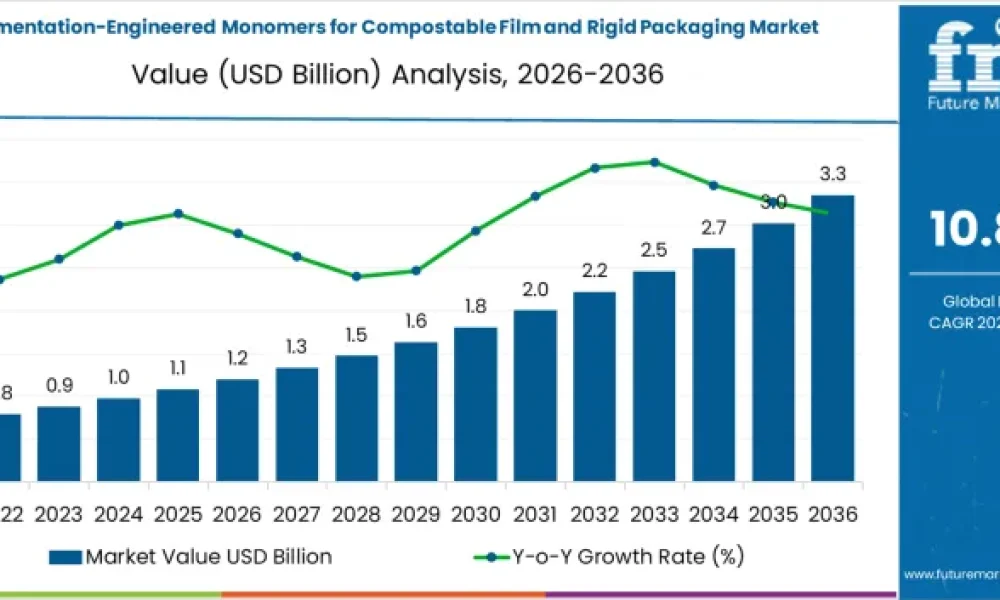
The global fermentation-engineered monomers for compostable film and rigid packaging market is on a robust growth trajectory, projected to expand from approximately USD 1.2 billion in 2026 to USD 3.3 billion by 2036, representing a compound annual growth rate (CAGR) of 10.8 percent over the forecast period. This rapid expansion is driven by increasing environmental regulations, heightened consumer demand for sustainable packaging alternatives, and innovation in fermentation technology that enhances both performance and scalability. Compostable films and rigid containers derived from bio-based monomers are becoming integral to corporate sustainability strategies and regulatory compliance across food & beverage, consumer goods, and personal care sectors. The shift from fossil-based plastics toward renewable, compostable materials underscores a broader industry transformation toward circular economy models.
Key Market Insights at a Glance
The fermentation-engineered monomers segment is expanding as industries prioritize eco-friendly materials with lifecycle advantages over conventional plastics. Bio-derived monomers such as lactic acid and polyhydroxyalkanoates (PHAs) produced via microbial fermentation are key feedstocks, enabling compostable polymer solutions with mechanical and barrier properties suitable for packaging applications. Compostable films and flexible packaging dominate the market with roughly 50 percent share, leveraging their versatility and growing adoption in high-volume applications. In parallel, the food & beverage packaging segment accounts for about 46 percent of total demand, where consumer preference for sustainable packaging and regulatory restrictions on single-use plastics are strongest.
Regional dynamics reveal North America—especially the United States—as a leading growth region, propelled by supportive regulatory frameworks and elevated sustainability commitments among manufacturers and brands. Europe also exhibits strong demand, supported by stringent waste reduction policies and circular economy mandates. Emerging markets across Asia, including China and South Korea, are accelerating adoption as environmental awareness and policy interventions encourage deployment of compostable solutions in packaging supply chains.
Segment Overview
The market’s segmentation by packaging type highlights compostable films and flexible formats as the leading category, favored for their lightweight characteristics and broad applicability across consumer goods and food packaging. These materials are increasingly replacing traditional plastics in retail and e-commerce packaging applications. Rigid compostable containers, while growing at a slightly slower pace, are gaining traction in segments such as ready-to-eat meals, cosmetics, and specialty packaging where structural integrity and sustainability converge. Technological advancements in fermentation pathways and metabolic engineering are broadening the range of achievable monomer properties, enabling performance optimization across diverse packaging formats.
From an end-use perspective, the dominance of food and beverage packaging is clear, reflecting both the sector’s volume and the rising imperative for sustainable packaging solutions. Consumer awareness of plastic pollution and legislative measures targeting single-use packaging have accelerated demand for materials that can fulfill functional performance while aligning with environmental targets. Beyond food & beverage, applications in personal care, consumer goods, and industrial packaging continue to contribute to market expansion.
To access the complete data tables and in-depth insights — Request Your Sample Report Now
Regional Overview
North America leads with aggressive implementation of sustainability standards and corporate commitments to reduce plastic waste, positioning the U.S. as a major growth hub. Europe’s stringent regulatory environment fosters broad adoption of compostable materials, with several countries advancing policies that encourage bio-based packaging solutions. In the Asia-Pacific region, markets like China and South Korea are witnessing increased investment in green technologies, aligning domestic manufacturing with global sustainability trends. These regions are expected to post steady compound growth as regulatory frameworks evolve and consumer preferences shift toward eco-responsible packaging.
Competitive Landscape
The fermentation-engineered monomers market is characterized by a competitive landscape featuring established innovators and emerging specialists focused on sustainable materials. Leading participants include NatureWorks LLC, Danimer Scientific, TotalEnergies Corbion, Novamont S.p.A., BASF SE, Arkema (Bio-Based Chemicals), Biomer (PHA producers), CJ Biomaterials, Futamura Chemical Co., Ltd., and Trellis Earth Products. These companies are investing in research and development to enhance monomer yields, diversify feedstock inputs, and improve polymer performance to meet evolving industry needs. Strategic partnerships and collaboration across biotechnology and packaging sectors are also shaping competitive dynamics.
Market Outlook: Powering the Next Decade
Over the next decade, the fermentation-engineered monomers market is expected to transition from early adoption to mainstream integration, catalyzed by ongoing improvements in cost efficiency, production scale, and material performance. As sustainability imperatives intensify, compostable films and rigid packaging solutions will become entrenched across global supply chains. Continued innovation in fermentation processes and regulatory momentum toward plastic waste reduction will underpin this transition, supporting market growth well beyond the current forecast horizon.
Key Players of Sustainable Label Industry
Industry leaders are accelerating efforts to embed sustainability into packaging ecosystems, leveraging fermentation-derived monomers to deliver compostable alternatives without compromising on quality or functionality. These efforts are complemented by advancements in compostability standards and certification frameworks that enhance market transparency and build consumer trust.
Recent Strategic Developments
Recent strategic initiatives among key players include capacity expansion, technology partnerships, and product portfolio diversification aimed at strengthening market positioning. Investment in next-generation fermentation technology and collaboration with end-use industries are enabling tailored solutions for high-growth applications. These developments reflect an industry increasingly aligned with long-term environmental goals and circular economy principles.
This press release captures a comprehensive snapshot of the fermentation-engineered monomers market, highlighting its growth potential, competitive landscape, and strategic drivers shaping the evolution of sustainable packaging solutions over the next decade.
Have a specific Requirements and Need Assistant on Report Pricing or Limited Budget please contact us – [email protected]
About Future Market Insights (FMI)
Future Market Insights, Inc. (FMI) is an ESOMAR-certified, ISO 9001:2015 market research and consulting organization, trusted by Fortune 500 clients and global enterprises. With operations in the U.S., UK, India, and Dubai, FMI provides data-backed insights and strategic intelligence across 30+ industries and 1200 markets worldwide.
Why Choose FMI: https://www.futuremarketinsights.com/why-fmi



