
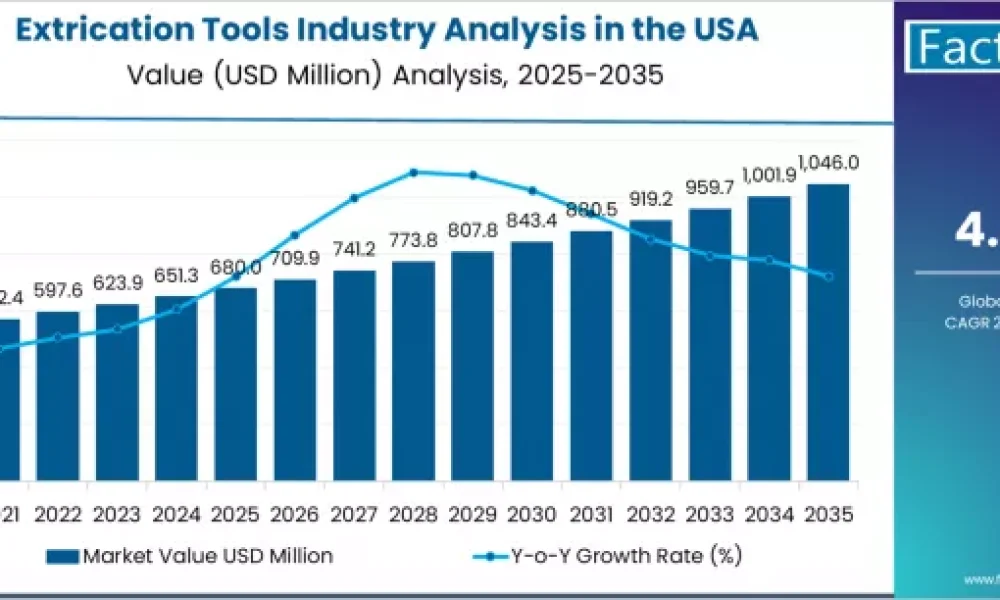
The United States extrication tools market is set for steady expansion over the next decade, driven by increasing focus on emergency response modernization, rising vehicle complexity, and sustained investments in firefighting and rescue infrastructure. The demand for extrication tools in the USA is projected to grow from USD 680.0 million in 2025 to approximately USD 1,050.0 million by 2035, rising at a CAGR of 4.4%, and recording an absolute increase of USD 370.0 million over the forecast period.
As road traffic incidents remain a major emergency category and disaster response readiness becomes a national priority, adoption of high-performance hydraulic, battery-powered, and smart rescue tool systems continues to gain momentum across fire departments, federal agencies, EMS units, and homeland response teams.
To access the complete data tables and in-depth insights, request a Discount On The Report here: https://www.factmr.com/connectus/sample?flag=S&rep_id=11961
Strategic Market Drivers Fueling Demand
Modern Fire & Rescue Fleet Upgrades
Continuous equipment modernization across U.S. fire departments is accelerating adoption of tools that deliver:
- Faster cutting and spreading capability
- Lightweight portability for rapid deployment
- Improved ergonomics for operator safety
- Low-maintenance and durable design
Rising Vehicle Complexity Increases Tool Requirements
The growing use of ultra-high-strength steel, reinforced frames, and electric powertrains in modern vehicles demands more powerful and precise rescue systems. Advanced cutters, spreaders, rams, and combination tools are now essential to safely extract passengers without compromising control.
Battery-Powered Tools Enable Rapid Setup
Cordless rescue systems are witnessing high adoption due to:
- Faster on-scene setup
- Easy access in confined or remote locations
- Safer operation around hybrid and electric vehicle accident sites
Government-Led Safety and Disaster Preparedness Investments
Federal and state road safety funding and emergency modernization programs are increasing deployment of extrication tools across:
- National highways, tunnels, and bridges
- Disaster-response units and safety hubs
- Public safety training institutes
- Industrial and community rescue teams
Market Penetration Across Emergency and Safety Sectors
Extrication tool adoption is rising in key response areas:
| Sector | Primary Use Case |
| Fire Departments | Vehicle and structural rescue |
| EMS & Trauma Teams | Road accident victim extraction |
| Homeland Security | Disaster and emergency readiness kits |
| Training Institutes | Rescue tool simulation and skill development |
| Industrial Safety Units | Emergency containment and plant rescue |
Product Category and Technology Insights
By Power Source
- Hydraulic Systems – Preferred for maximum force output
- Battery-Powered Systems – Fastest-growing due to mobility
- Pneumatic Tools – Used in industrial rescue environments
- Manual Kits – Critical backup tools
By Tool Type
- Cutters & Spreaders – Most widely deployed
- Rams – High use in heavy vehicle rescue
- Combination Tools – Growing adoption for multi-function rescue
- Rescue Accessory Kits – Carrying units, chains, support systems
Challenges Affecting Market Growth
- High Initial Procurement Costs for advanced rescue systems
- Regular maintenance and technical training requirements
- Supply chain exposure for high-strength industrial components
Competitive Landscape
The U.S. extrication tools market is moderately consolidated, with manufacturers focusing on:
- High-force rescue innovation
- Lightweight modular tool design
- Multi-functionality and fast deployment
- Extended battery and reliability improvements
- Integration of smart emergency support systems
Key Companies Profiled
- Holmatro USA
- HURST Jaws of Life
- Milwaukee Tool
- DeWalt Rescue Systems
- Genesis Rescue Systems
- Stanley Black & Decker
- Super Vac (SVI)
- Weber Rescue Systems
Recent Industry Trends
- 2024: Introduction of sensor-enabled rescue kits improving tool efficiency and response timing
- 2023: High adoption of cordless micro-mobility rescue systems
- 2022: Emergency training programs expand tool simulation infrastructure
Future Outlook
The next decade will continue to witness strong and sustained demand, supported by:
- Increasing complexity of vehicle design
- Continued modernization of fire and EMS rescue fleets
- Expanded disaster-response preparedness budgets
- Transition toward cleaner, cordless, and efficient rescue system operation
As national safety agencies emphasize speed, force, reliability, and operator protection, the U.S. extrication tools industry is positioned for steady long-term growth through 2035.
Have a specific Requirements and Need Assistant on Report Pricing or Limited Budget please contact us – [email protected]
About Fact.MR
Fact.MR is a global market research and consulting firm, trusted by Fortune 500 companies and emerging businesses for reliable insights and strategic intelligence. With a presence across the U.S., UK, India, and Dubai, we deliver data-driven research and tailored consulting solutions across 30+ industries and 1,000+ markets. Backed by deep expertise and advanced analytics, Fact.MR helps organizations uncover opportunities, reduce risks, and make informed decisions for sustainable growth.



