
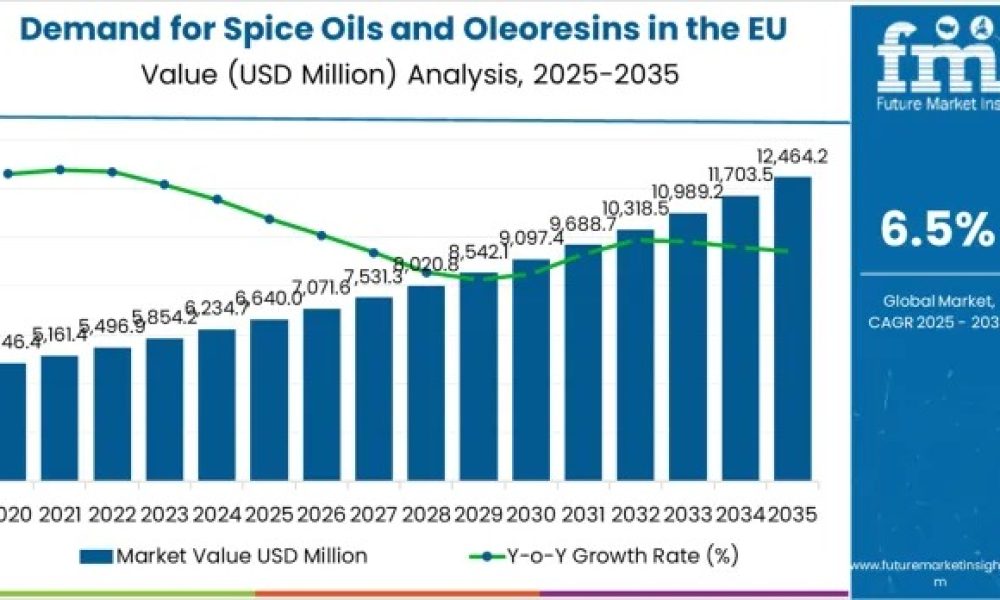
The European Union spice oils and oleoresins industry is entering a decisive growth phase, underpinned by accelerating clean-label adoption, rising preference for natural flavoring agents, and expanding applications across food, pharmaceuticals, cosmetics, and dietary supplements. According to the latest industry analysis, EU spice oils and oleoresins sales are projected to increase from USD 6,640.0 million in 2025 to USD 12,464.2 million by 2035, registering a CAGR of 6.5% over the forecast period.
This expansion represents an absolute value addition of USD 6,060.0 million and a total growth of 91.3%, with the overall industry expected to grow by nearly 1.9X between 2025 and 2035. Growth momentum reflects structural shifts in European food manufacturing toward natural, standardized, and functionally reliable spice-derived ingredients that can effectively replace synthetic flavorings and colorants.
Get Exclusive Access To Data Tables, Market Sizing Dashboards, And Analyst Insights. Request Sample Report!
Market Growth Accelerates Across the Decade
Between 2025 and 2030, EU demand is forecast to rise from USD 6,640.0 million to USD 9,200.0 million, generating USD 2,560.0 million in incremental value. This phase accounts for 42.2% of total decade growth, driven by increased availability of spice oils and oleoresins across food processing, pharmaceuticals, and cosmetics, along with growing consumer trust in natural ingredient solutions.
From 2030 to 2035, the market is expected to add another USD 3,500.0 million, representing 57.8% of total expansion. Growth during this period will be shaped by nutraceutical and pharmaceutical uptake, premium organic extract launches, and broader adoption of advanced extraction technologies that deliver higher purity, potency, and flavor consistency.
Oleoresins Dominate Product Demand
By product type, oleoresins are projected to command 57.0% of total EU sales in 2025, reinforcing their position as the leading format. Their dominance is supported by concentrated flavor intensity, inclusion of both volatile and non-volatile spice components, superior heat stability, and standardized composition that ensures batch-to-batch consistency for food manufacturers.
Key advantages driving oleoresin adoption include:
- Reduced dosage and transportation costs due to high concentration
- Extended shelf stability with minimal flavor degradation
- Reliable performance in processed food and beverage applications
Oleoresins are expected to further strengthen their share to 60.0% by 2035, as manufacturers increasingly prioritize efficiency and quality control.
Food & Beverages Lead Applications, While Supplements Gain Traction
The food and beverages segment accounts for 28.0% of total demand in 2025, making it the largest application category. Usage is concentrated in meat products, snacks, sauces, ready meals, and beverages, where spice oils and oleoresins deliver clean-label flavor solutions with high processing stability. Within this segment, bakery and confectionery represent 12.0% share, beverages 9.0%, and dressings and condiments 8.0%.
At the same time, dietary supplements hold a 14.0% share, reflecting rising interest in spice-derived bioactives linked to wellness, immunity, and digestive health. Pharmaceutical and nutraceutical expansion is expected to outpace traditional food growth beyond 2030.
Conventional Products Maintain Scale Amid Organic Shift
By nature, conventional spice oils and oleoresins represent 55.0% of EU sales in 2025, supported by cost competitiveness, volume scalability, and established supply chains. While this share is projected to decline to 50.0% by 2035, conventional products will continue serving mainstream food processors and large-scale industrial users, even as organic and sustainably sourced extracts gain share.
Technology, Traceability, and Sustainability Reshape the Industry
Advanced supercritical CO₂ extraction is transforming production by enabling solvent-free processing, improved bioactive retention, and premium quality differentiation. These green technologies are particularly critical for pharmaceutical-grade and organic extracts.
Simultaneously, producers are integrating blockchain-enabled traceability systems to ensure origin verification, regulatory compliance, and transparency from farm to finished product. Sustainability initiatives, including fair-trade sourcing and direct farmer partnerships, are becoming essential for premium positioning in Europe’s ethically conscious markets.
Germany and France Anchor Regional Growth
Germany leads EU sales with a 32.1% share in 2025 and the fastest growth rate at 7.8% CAGR, supported by advanced food processing infrastructure and a strong pharmaceutical base. France follows with a 7.3% CAGR, driven by premium culinary positioning and rising clean-label requirements. Italy, Spain, and the Netherlands show steady growth, reflecting traditional food culture, tourism-driven demand, and innovation-led ingredient development.
Subscribe for Year-Round Insights → Stay ahead with quarterly and annual data updates.
Competitive Landscape Remains Moderately Fragmented
The EU market features competition among multinational flavor houses and specialized extract producers. Key players include Symrise AG, Givaudan AG, McCormick & Company, Synthite Industries, Firmenich SA, IFF, Sensient Technologies, Kancor Ingredients, and Plant Lipids, alongside numerous regional processors. Differentiation increasingly centers on extraction technology, sustainability credentials, and application-specific technical support.
About Future Market Insights (FMI)
Future Market Insights, Inc. (FMI) is an ESOMAR-certified, ISO 9001:2015 market research and consulting organization, trusted by Fortune 500 clients and global enterprises. With operations across the U.S., UK, India, and Dubai, FMI delivers data-backed insights and strategic intelligence spanning 30+ industries and over 1,200 global markets, empowering decision-makers with actionable, forward-looking analysis.



