
Market Overview
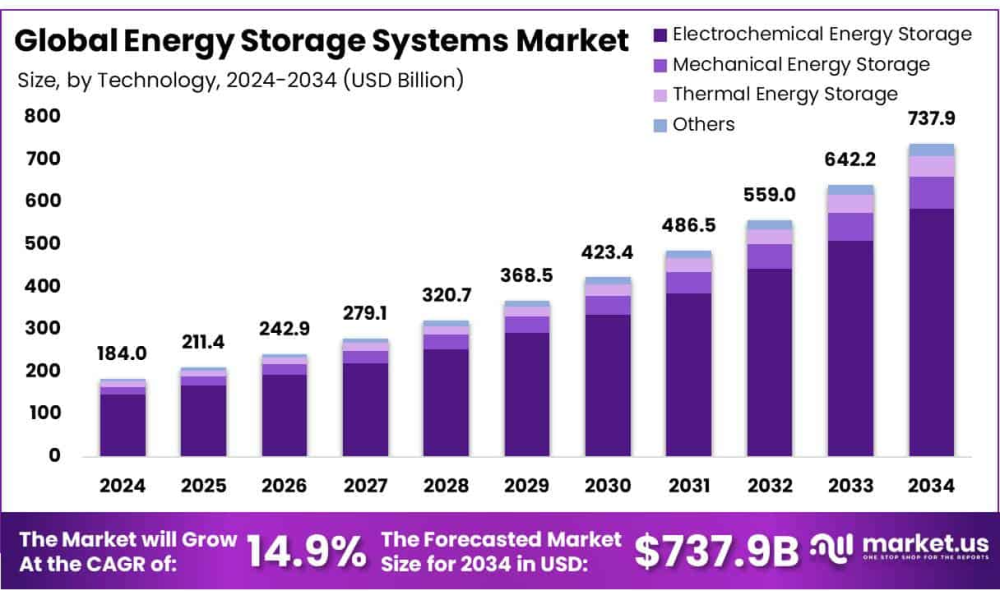
The global energy storage systems market is projected to reach approximately USD 738 billion by 2034, rising from an estimated USD 184 billion in 2024. This growth reflects a compound annual growth rate (CAGR) of 14.9% over the forecast period from 2025 to 2034.
The systems, encompassing everything from electrochemical batteries to thermal and mechanical storage, are increasingly vital in balancing supply and demand, stabilizing energy grids, and seamlessly integrating intermittent renewables like solar and wind. As costs continue to fall and adoption rises across utilities, industries, and homes, energy storage is shifting from a niche technology to a central component in modern power systems.
According to a 2023 international energy report, the global supply of renewable energy—derived from solar, wind, hydro, geothermal, and ocean sources—increased by over 5%, highlighting continued momentum toward sustainable power generation. As per the 2017 International Renewable Energy Agency (IRENA) report, the global energy storage capacity must rise significantly from 4.67 terawatt-hours (TWh) in 2017 to a projected 11.89–15.72 TWh by 2030 to support the growing share of renewables and ensure grid reliability. In December 2022, the Australian Renewable Energy Agency (ARENA) committed support for 2 GW / 4.2 GWh of grid-scale battery storage equipped with grid-forming inverters, replacing functions traditionally performed by thermal power.
The European Union has invested nearly €1.25 billion through the Connecting Europe Facility to fund 41 cross-border infrastructure projects, focusing on electricity grids and storage to advance energy market integration and decarbonization. Meanwhile, the U.S. and Canada are jointly progressing toward a 50% clean energy target by 2025, backed by collaborative efforts from companies such as Canadian Solar and Solar Bank, and initiatives like the Supercharging Battery Storage Initiative, reinforcing cross-border clean energy and storage infrastructure.
Important Revelation
- The global energy storage systems market was valued at USD 184 billion in 2024.
- The market is projected to grow at a CAGR of 14.9% from 2025 to 2034.
- It is estimated to reach USD 738 billion by 2034.
- Electrochemical energy storage accounted for the largest technology segment with a 79.3% market share.
- Utility applications dominated the market with a 48.1% share.
- Asia Pacific emerged as the largest regional market, holding a 48.3% share of the global energy storage systems market.
Download Exclusive Sample Of This Premium Report (Including Full TOC, Table & Figures):
https://market.us/report/energy-storage-systems-market/free-sample/
Factors Affecting the Growth of the Energy Storage Systems Market
- Growing Integration of Renewable Energy: As solar and wind power continue to expand globally, energy storage systems are essential for managing their variability. These systems store excess energy and release it when needed, ensuring a stable and continuous power supply.
- Supportive Government Policies and Incentives: Many countries are introducing favorable policies, funding programs, and mandates to encourage the deployment of energy storage systems. These regulations help accelerate adoption across residential, commercial, and utility sectors.
- Technological Advancements in Storage Solutions: Ongoing improvements in battery technologies such as increased energy density, faster charging, and longer lifespans are making energy storage systems more efficient and cost-effective, driving broader market acceptance.
- Rising Demand for Grid Stability and Energy Security: The increasing strain on power grids from growing energy consumption is pushing the need for reliable energy storage. These systems help stabilize the grid, manage peak loads, and prevent outages, especially during high demand.
- Decreasing Costs of Energy Storage Technologies: As manufacturing scales up and innovation continues, the cost of key storage technologies, particularly lithium-ion batteries, is declining. This makes storage systems more accessible to a wider range of users and industries.
Report Segmentation
Technology Analysis: Electrochemical energy storage has emerged as the leading technology segment in the energy storage systems market, driven by strong adoption and continuous innovation. In 2024, this segment accounted for a substantial 79.3% share of total market revenue. The widespread use of lithium-ion batteries known for their high energy density, operational efficiency, and decreasing costs has significantly boosted the popularity of electrochemical systems.
Application Analysis: The utility segment held the dominant position in the energy storage systems market, capturing a significant 48.1% share in 2024. This leadership is largely attributed to the growing integration of renewable energy sources, heightened demand for grid stability, and increased investment in large-scale storage projects by both public and private utilities. Utility-scale energy storage plays a critical role in balancing the variability of solar and wind power, enhancing the reliability of the energy supply, and supporting efficient peak load management. These factors have firmly positioned the utility sector at the forefront of the market’s growth.
To Purchase this Premium Report@ https://market.us/purchase-report/?report_id=48512
Market Key Segmentation
By Technology
- Electrochemical Energy Storage
- Lithium-ion
- Lead-acid
- Nickel based
- Flow Batteries
- Others
- Mechanical Energy Storage
- Pumped Hydro Storage
- Compressed Air Energy Storage (CAES)
- Flywheels
- Thermal Energy Storage
- Others
By Application
- Utility
- Commercial & Industrial
- Transportation
- Critical Infrastructure
- Infrastructure & Commercial Buildings
- Others
- Residential
Geopolitical Impact Analysis
The ongoing trade disputes between the United States, China, and the European Union have had a considerable impact on the global energy storage systems market, primarily by disrupting supply chains and hindering production. Tariffs imposed during the Trump administration significantly increased the cost of importing batteries and essential raw materials many of which are sourced from China. Given that China supplies over 90% of the lithium-ion battery cells used in U.S. energy storage projects, the market remains highly sensitive to such geopolitical shifts.
China’s dominant position in global battery manufacturing makes it a critical player in the clean energy supply chain, particularly for lithium-ion technologies. In response to U.S. trade actions, China introduced its own export controls and licensing requirements on key raw materials vital for battery and storage technologies. By April 2025, these measures intensified with the restriction of exports on seven rare earth elements and specialized magnets. These components are crucial not only for energy storage systems and electric vehicles but also for renewable energy infrastructure and high-tech defense applications, highlighting the broad-reaching implications of these geopolitical tensions.
Regional Analysis
The Asia-Pacific region emerged as the leading force in the global energy storage systems market in 2024, capturing 48.3% of the total market share. This dominance is fueled by a combination of rapid renewable energy deployment, growing electricity demand, and significant investments in grid modernization. Countries such as China, Japan, South Korea, India, and Australia are actively advancing energy storage initiatives to improve grid reliability, manage peak demand, and better integrate intermittent renewable sources like wind and solar into their energy mix.
China remains at the forefront of this regional growth, supported by government-backed large-scale projects and a robust battery manufacturing industry. Meanwhile, Japan and South Korea are making substantial investments in cutting-edge battery technologies and smart grid systems. In developing economies such as India and parts of Southeast Asia, favorable government policies, goals for rural electrification, and declining battery costs are accelerating the adoption of storage solutions. As regulatory support strengthens and technological advancements continue, the Asia-Pacific region is expected to solidify its position as a global center for energy storage innovation and expansion.
Competitive Landscape
- General Electric
- Siemens AG
- Mitsubishi Heavy Industries, Ltd.
- BYD Co. Ltd.
- Panasonic Corporation
- LG Energy Solution Ltd
- Andritz AG
- Samsung SDI Co., Ltd.
- Ecoult
- Langley Holdings plc
- Saft
- BrightSource Energy Inc
- Abengoa SA
- Baltimore Aircoil Company
- Voith GmbH & Co. KGaA
- Other Key Players
Recent Development
In March 2025, BYD Energy Storage introduced its new Battery-Box LV5.0+ and Power-Box hybrid inverters at Solar & Storage Live Africa 2025. These solutions feature enhanced performance, higher power output, and advanced safety features, specifically designed to support residential energy storage and accelerate Africa’s green energy transition.
In May 2024, Mitsubishi Electric and Musashi Energy Solutions signed a co-development agreement to design energy storage modules and battery management systems for railway applications. The partnership focuses on hybrid super capacitor technology to promote carbon neutrality, targeting both domestic and international railway markets with regenerative energy and eco-friendly train operations.
Get in Touch with Us:
Market.us (Powered By Prudour Pvt. Ltd.)
Address: 420 Lexington Avenue, Suite 300 New York City, NY 10170, United States
Send Email: [email protected]



