
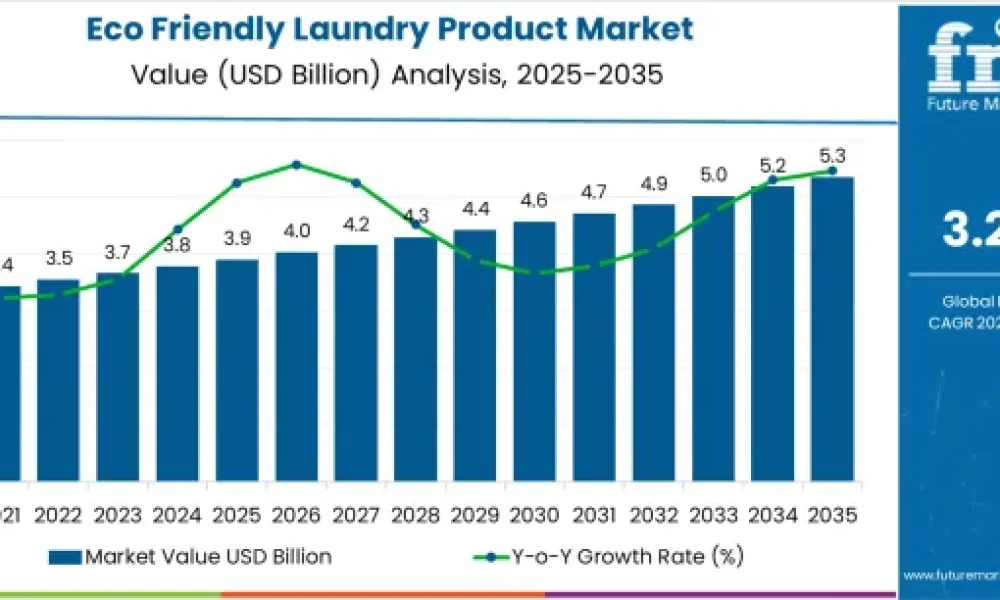
The market for eco‑friendly laundry products is poised for sustained expansion over the next decade, according to the latest analysis from FutureMarketInsights. The global market — currently valued at around USD 3,901 million in 2025 — is projected to grow to USD 5,345.3 million by 2035, representing a compound annual growth rate (CAGR) of 3.2%.
Subscribe for Year-Round Insights → Stay ahead with quarterly and annual data updates : https://www.futuremarketinsights.com/reports/sample/rep-gb-27632
📈 Market Growth & Forecast: A Decade of Steady Expansion
The forecast period from 2025 to 2035 marks a pivotal transformation in laundry-care preferences, underpinned by growing environmental consciousness, urbanization, and a shift toward sustainable consumption.
- Phase 1 (2025–2030): The market is expected to climb from US$ 3.90 B to approximately US$ 4.86 B, adding about US$ 962.3 million — roughly 67% of total growth over the decade. This phase will see accelerated adoption of concentrated detergent formats, enzyme‑based biodegradable formulations, and plastic‑free or refillable packaging.
- Phase 2 (2030–2035): Growth will continue to US$ 5.35 B — a further increase of around US$ 482 million (≈ 33% of total expansion). This reflects mainstream penetration of eco‑friendly laundry technologies, broader acceptance of sustainability certifications, and integration into existing washing infrastructure.
Key product types driving growth include traditional laundry powders, concentrated liquid detergents, eco‑friendly beads, and ultra‑compact laundry sheets.
Market Composition: Products, Applications & Regional Dynamics
Product Types & Consumer Preferences
- Laundry Powder: Leading segment with ~42% market share in 2025. Attributes such as superior cleaning performance, biodegradability, plastic‑free packaging, and compatibility with traditional washing habits continue to favor powders.
- Liquid Detergents: Holding roughly 28% share. Growth here is driven by convenience, dosing precision, cold‑water efficacy, and appeal among urban households embracing washing machines.
- Laundry Beads & Sheets: Emerging segments — beads at ~18%, sheets at ~12%. These formats cater to convenience, pre-measured dosing, compact storage, zero-waste packaging, and lifestyle-driven adoption by millennials and environmentally conscious consumers.
Application Segments
- Household: Dominates with ~78% share. This reflects strong demand from residential users seeking sustainable, safe, and effective laundry solutions that align with rising awareness about health, environmental impact, and sustainability trends.
- Non-residential (Hotels, Laundries, Commercial): Growing, though smaller — hospitality accounts for ~12%, professional laundry services around ~8%. As sustainability norms and eco-certification standards rise across industries, these segments are expected to adopt green laundry solutions more broadly.
Regional Growth & Emerging Markets
The fastest acceleration is expected in the Asia-Pacific region, with China (CAGR ~4.3%) and India (CAGR ~4.0%) leading the growth curve.
Key drivers of growth in emerging economies:
- Rising middle-class income and urbanization.
- Increasing environmental awareness and sustainability initiatives.
- Modern retail expansion, enabling access to global eco-friendly brands.
In developed markets (Europe, North America), growth remains steady as eco-conscious consumers continue trading up for certified, environmentally responsible laundry solutions.
Key Market Drivers — Sustainability, Health & Convenience
Several shifting consumer dynamics underpin the growth:
- Environmental responsibility: Concern about plastic pollution and water contamination drives demand for biodegradable detergents, refillable systems, and zero‑waste packaging.
- Health awareness: Growing aversion to harsh chemicals — especially among families with children or sensitive skin — is boosting demand for hypoallergenic, plant-based laundry formulations.
- Convenience & modern lifestyles: Urban households are increasingly favoring concentrated liquids, laundry sheets, and refill subscription services for ease of use, compact storage, and reduced environmental footprint.
- Regulatory & certification momentum: Stricter environmental regulations and growing prominence of eco‑certification help legitimize eco-friendly detergents, making them an attractive, credible alternative to conventional products.
Challenges & Market Headwinds
Despite robust growth prospects, certain constraints continue to limit adoption:
- Price sensitivity: Eco‑friendly products often carry a premium over conventional detergents. In cost-sensitive regions or lower‑income households, price differential may hinder widespread adoption.
- Perception of performance trade‑off: Some consumers remain skeptical about the cleaning power or stain‑removal efficacy of eco‑friendly detergents, especially in demanding washing conditions — which may slow repeat purchases or acceptance.
- Market fragmentation in certifications: Varied and sometimes inconsistent eco‑certification standards across regions can create consumer confusion and slow down trust and adoption rates.
Strategic Opportunity Windows & Innovation Pathways
The market analysis identifies several high-potential “pathways” for industry stakeholders to maximize value and growth:
- Powder formulation optimization & sustainable packaging innovations: Focusing on enzyme-based formulations, biodegradable surfactants, packaging transition to cardboard or refillable containers.
- Concentrated liquids & cold-water detergents: Catering to urban consumers and machine-washing households, emphasizing convenience and environmental benefits.
- Emerging formats — sheets, beads, subscription/refill models: Appeal to eco-conscious, space-constrained, and convenience-seeking demographics.
- Regional expansion strategies, especially in Asia-Pacific: Local manufacturing, strategic retail partnerships, and awareness campaigns tailored to emerging economies like India and China.
- Certification & transparency-driven marketing: Investing in credible eco-labels and educating consumers to build trust, especially in regions new to sustainable products.
Conclusion
The global eco‑friendly laundry product market is entering a definitive growth era, shifting from niche specialty segment to mainstream household and institutional adoption. With a projected rise to US$ 5.35 billion by 2035, the market stands to benefit significantly from evolving consumer values, regulatory momentum, and sustainable lifestyle trends. Growing environmental consciousness, health awareness, modern lifestyles, and expanding retail reach — especially in Asia-Pacific — collectively set the stage for a sustainable laundry-care revolution.
The current landscape offers a strategic vantage point for stakeholders to accelerate market share, extend product portfolios, and drive innovation in sustainable detergents across multiple formats and geographies.
Have a specific Requirements and Need Assistant on Report Pricing or Limited Budget please contact us – [email protected]
About Future Market Insights (FMI)
Future Market Insights, Inc. (FMI) is an ESOMAR-certified, ISO 9001:2015 market research and consulting organization, trusted by Fortune 500 clients and global enterprises. With operations in the U.S., UK, India, and Dubai, FMI provides data-backed insights and strategic intelligence across 30+ industries and 1200 markets worldwide.



