
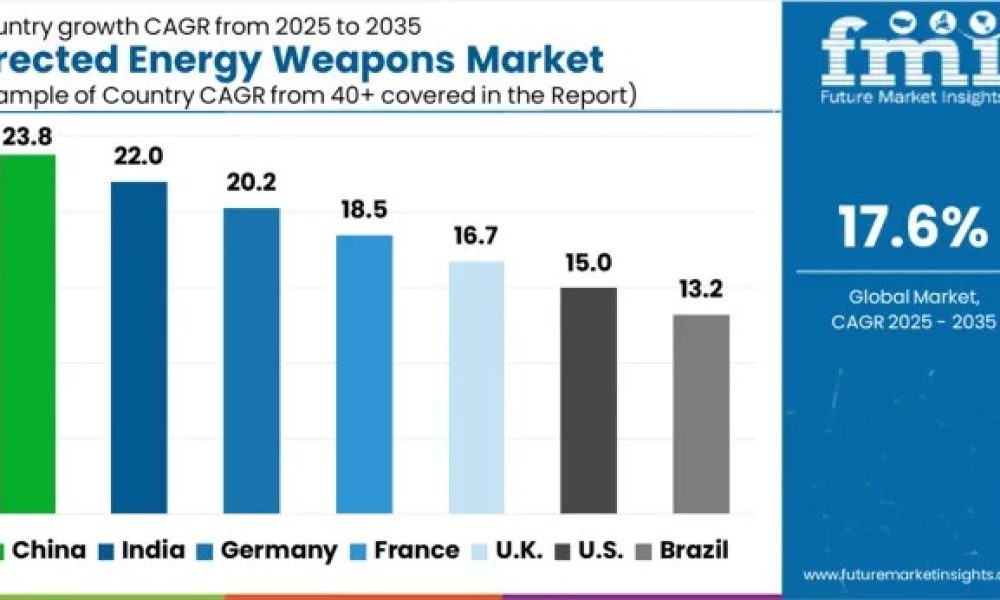
The global directed energy weapons (DEW) market is entering a period of accelerated growth, underpinned by rising defense budgets, intensifying geopolitical dynamics, and the urgent need for advanced counter-drone and missile defense capabilities. According to the latest industry assessment, the market is projected to expand at a robust CAGR of 17.6% between 2025 and 2035, growing from an estimated USD 7.9 billion in 2025 to USD 39.9 billion by 2035. This rapid expansion highlights the increasing strategic importance of directed energy systems within next-generation military arsenals.
Directed energy weapons, which include high-energy lasers, high-power microwave systems, electromagnetic weapons, and particle beam technologies, are gaining traction as militaries worldwide seek precision-based, non-kinetic solutions that reduce collateral damage while enhancing operational efficiency. Unlike conventional munitions, DEWs offer advantages such as a low cost per engagement, deep magazines constrained primarily by power availability, and the ability to engage multiple targets rapidly. These attributes are reshaping procurement priorities across air, land, and maritime defense domains.
Defense Modernization and Platform Integration Drive Demand
The market’s growth trajectory is strongly linked to global defense modernization initiatives, which currently represent the largest contributing parent market with an estimated 35% share of overall demand. Armed forces are upgrading legacy systems to counter emerging threats such as unmanned aerial systems (UAS), hypersonic missiles, and asymmetric attacks. Directed energy weapons are increasingly viewed as a critical layer within integrated air and missile defense architectures.
Get access to comprehensive data tables and detailed market insights — request your sample report today!
https://www.futuremarketinsights.com/reports/sample/rep-gb-25170
The aerospace and naval defense segment, accounting for approximately 25% of market demand, is another major growth pillar. Fighter aircraft, naval vessels, and surveillance platforms are progressively incorporating DEW systems for point defense, long-range interception, and fleet protection. Meanwhile, homeland security and border protection applications contribute around 15%, driven by rising investments in counter-drone operations and critical infrastructure security. Research and development programs, also representing roughly 15% of demand, are accelerating technological maturity through government-funded initiatives and public–private collaborations.
Collectively, military modernization, aerospace and naval defense, and R&D activities account for nearly three-quarters of total market demand, underscoring the sector’s focus on operational superiority, precision targeting, and rapid threat neutralization.
Lethal Systems and High-Energy Lasers Lead Market Segments
By product type, lethal directed energy weapons dominate the market, holding an estimated 57.4% share in 2025. Their leadership reflects defense priorities centered on systems capable of neutralizing or destroying threats such as drones, missiles, and artillery with high accuracy and minimal logistical burden. Advances in beam control, targeting software, and power management have significantly enhanced the effectiveness and reliability of lethal DEWs, reinforcing their role in modern combat strategies.
From a technology perspective, high-energy laser systems are expected to capture approximately 44.6% of total market revenue in 2025, making them the leading technology segment. Continuous improvements in laser power scalability, thermal management, and efficiency have enabled operational deployment across multiple platforms. High-energy lasers offer the ability to engage targets at the speed of light, deliver precise effects, and maintain a relatively low cost per shot, making them particularly attractive for counter-UAS and missile defense missions.
Land Platforms Anchor Deployment, While Multi-Platform Use Expands
In terms of platform segmentation, land-based systems are projected to account for nearly 39.8% of market revenue in 2025, the largest share among all platforms. Land platforms provide flexibility for deploying directed energy weapons on mobile vehicles, fixed installations, and forward operating bases, enabling rapid response and adaptable mission profiles. These systems are increasingly deployed to protect critical ground assets and counter threats such as rocket, artillery, and drone attacks.
At the same time, integration across airborne, naval, and emerging space platforms is gaining momentum. Modular system architectures, adaptable power solutions, and software-defined targeting capabilities are allowing DEWs to be retrofitted onto existing platforms, reducing deployment costs and accelerating adoption timelines.
Regional Growth Led by Asia-Pacific, Supported by Europe and North America
Regionally, the DEW market is expanding across North America, Asia-Pacific, and Europe, with particularly strong growth in emerging defense powers. China leads with a projected CAGR of 23.8% from 2025 to 2035, driven by large-scale defense modernization programs, domestic R&D investment, and integration of DEWs across naval, air, and land forces. India follows closely at 22.0% CAGR, supported by indigenous defense initiatives, counter-drone requirements, and government-backed R&D through national defense agencies.
European markets such as Germany (20.2% CAGR) and the UK (16.7%) are benefiting from NATO-aligned modernization programs, a strong emphasis on precision systems, and collaborative defense research across the region. The United States, growing at 15.0% CAGR, continues to play a central role through extensive military R&D, prototype testing, and multi-platform deployment programs focused on counter-UAV and missile defense applications.
Drive Your Business Growth Strategy: Checkout the Report for Key Insights
https://www.futuremarketinsights.com/checkout/25170
Competitive Landscape Focused on Precision, Reliability, and Integration
Competition in the directed energy weapons market is defined by precision, energy output, platform compatibility, and defense-grade reliability. Leading companies including Lockheed Martin, BAE Systems, Northrop Grumman, Raytheon Technologies, Rheinmetall, Thales, Boeing, Elbit Systems, and L3Harris Technologies are investing heavily in advanced R&D, system integration, and collaborative defense programs. Strategic priorities across the industry include component miniaturization, improved energy efficiency, ruggedization for extreme environments, and software-enabled targeting and control systems.
Partnerships with armed forces, participation in multinational defense consortia, and joint development programs are accelerating deployment while ensuring compliance with stringent military standards and export regulations.
Outlook: Directed Energy Weapons Move Toward Operational Mainstream
As technological barriers continue to fall and unit economics improve, directed energy weapons are transitioning from experimental systems to operationally deployed assets across multiple defense domains. Their ability to deliver precision effects, reduce collateral damage, and counter emerging threats positions DEWs as a cornerstone of future defense strategies.
With sustained investment, expanding platform integration, and growing international collaboration, the directed energy weapons market is set to remain one of the fastest-growing segments in the global defense industry over the next decade, offering substantial opportunities for stakeholders across the value chain.
Why Choose FMI: Empowering Decisions that Drive Real-World Outcomes: https://www.futuremarketinsights.com/why-fmi
About Future Market Insights (FMI)
Future Market Insights, Inc. (FMI) is an ESOMAR-certified, ISO 9001:2015 market research and consulting organization, trusted by Fortune 500 clients and global enterprises. With operations in the U.S., UK, India, and Dubai, FMI provides data-backed insights and strategic intelligence across 30+ industries and 1200 markets worldwide.



