
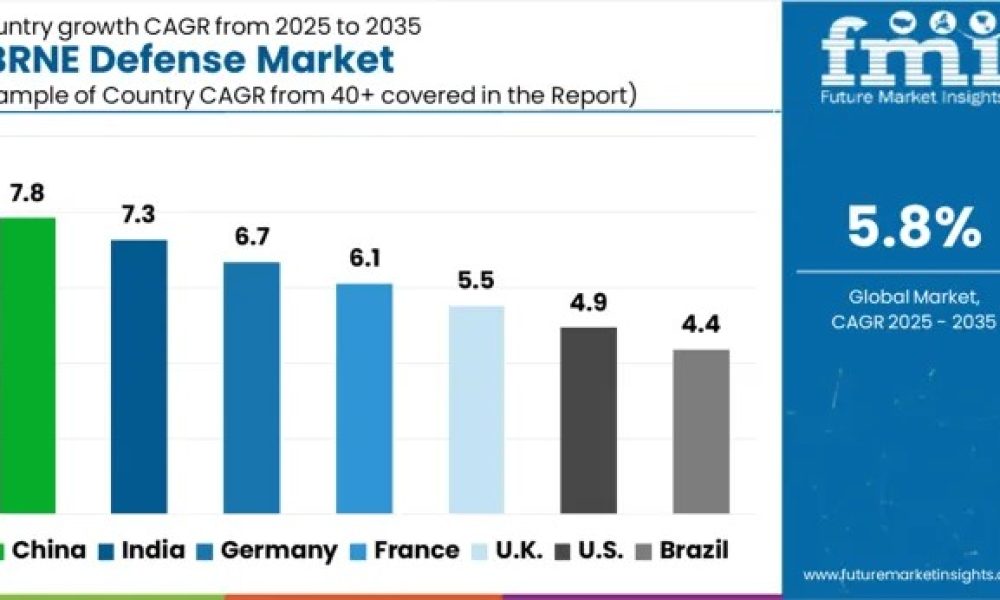
The global CBRNE (Chemical, Biological, Radiological, Nuclear, and Explosives) defense market is undergoing steady and structurally supported expansion, underpinned by regulatory mandates, national security priorities, and rising geopolitical risk. Valued at USD 18.4 billion in 2025, the market is forecast to reach USD 32.4 billion by 2035, expanding at a compound annual growth rate (CAGR) of 5.8% over the forecast period.
CBRNE defense has emerged as a mission-critical segment within the broader defense and homeland security ecosystem, accounting for approximately 4.7% of global defense technology spending and over 5% of homeland security and emergency response investments. Growth is being shaped not only by threat evolution but by a regulatory and compliance-driven environment that enforces readiness, interoperability, and adherence to international non-proliferation frameworks.
Regulatory Frameworks as a Structural Growth Driver
International treaties such as the Chemical Weapons Convention (CWC), Biological Weapons Convention (BWC), and the Nuclear Non-Proliferation Treaty (NPT) form the regulatory backbone of the CBRNE defense market. These agreements mandate standardized detection, protection, and response capabilities, driving sustained public-sector investment across military, civil defense, and emergency preparedness programs.
Get access to comprehensive data tables and detailed market insights — request your sample report today!
https://www.futuremarketinsights.com/reports/sample/rep-gb-25126
In North America and Europe, stringent procurement standards govern the acquisition of detection systems, protective equipment, and decontamination solutions. These frameworks prioritize validated performance, traceability, and lifecycle reliability—factors that directly influence supplier selection and long-term contracting. Export control regimes further shape market dynamics, particularly in the cross-border transfer of advanced sensing, filtration, and radiological detection technologies.
Regulatory influence extends beyond military use into civil preparedness, where national mandates increasingly require readiness against radiological and nuclear incidents. As funding allocations continue to align with these obligations, regulatory enforcement remains a central force sustaining long-term market momentum.
Technology Innovation and Integrated Defense Systems Gain Priority
Recent developments within the CBRNE defense market highlight a shift toward integrated, interoperable, and rapidly deployable systems. Innovations include portable biosensors, AI-enabled chemical detection platforms, and next-generation protective suits offering enhanced resistance while improving mobility and wearer comfort.
Unmanned aerial vehicles (UAVs) and robotic systems are gaining traction for remote detection, reconnaissance, and decontamination, reducing human exposure in hazardous environments. These technologies are increasingly incorporated into national response frameworks, particularly for urban infrastructure protection, border security, and disaster response scenarios.
Collaboration between defense contractors, research institutions, and government agencies is accelerating development timelines and improving system interoperability, particularly within NATO-aligned and allied defense networks.
Chemical Threat Mitigation Anchors Segmental Demand
By threat type, the chemical segment accounts for an estimated 32.8% of market revenue in 2025, maintaining its position as the largest category. Chemical agents continue to pose immediate and large-scale health risks in both military and asymmetric threat scenarios, necessitating rapid detection, containment, and neutralization capabilities.
Compliance with the Chemical Weapons Convention has driven widespread adoption of advanced chemical detection systems, personal protective equipment, and decontamination technologies. Continued innovation in portable detection devices and high-efficiency filtration materials reinforces this segment’s strategic importance.
Protective Wearables Remain Central to Operational Readiness
By equipment type, protective wearables represent approximately 27.4% of total market demand, reflecting their indispensable role in safeguarding personnel during CBRNE operations. Demand is increasingly concentrated around lightweight, ergonomically optimized suits, respirators, and gloves that enable extended operational endurance without compromising safety.
Advanced materials offering multi-threat resistance, combined with integrated physiological and environmental sensors, are redefining protective gear functionality. Long-term government supply contracts and modernization programs continue to underpin stable demand for this segment.
Defense and Government End Use Dominates Market Structure
The defense and government sector accounts for nearly 58.6% of total market revenue, reinforcing its role as the primary demand driver. Defense ministries and homeland security agencies are expanding budgets for detection networks, mobile response units, training simulators, and rapid deployment infrastructure.
Joint military exercises and multinational security alliances are promoting equipment standardization and interoperability, further strengthening procurement volumes across allied nations.
Regional Growth Patterns Reflect Security Priorities
Regionally, North America, Europe, and Asia-Pacific remain the most significant contributors to market growth. China leads with a projected 7.8% CAGR, driven by military modernization, domestic manufacturing expansion, and integration of AI-driven monitoring systems. India follows at 7.3%, supported by rising defense expenditure, counter-terrorism initiatives, and indigenous production programs.
Germany (6.7% CAGR) and the United Kingdom (5.5%) benefit from NATO commitments, advanced research capabilities, and strong public safety preparedness frameworks. The United States, growing at 4.9%, continues to invest heavily in biodefense, autonomous detection platforms, and inter-agency response coordination.
Drive Your Business Growth Strategy: Checkout the Report for Key Insights
https://www.futuremarketinsights.com/checkout/25126
Competitive Landscape Defined by Integration and Compliance
The competitive environment is shaped by the ability to deliver certified, interoperable, and technologically advanced systems rather than by scale alone. Leading participants including Thales, Rheinmetall, Saab, Teledyne FLIR, Bruker, Avon Protection, Smiths Group, Battelle, Chemring Group, Leidos, INDRA, KNDS, and Karcher Futuretech continue to invest in R&D, system integration, and government partnerships.
Differentiation increasingly depends on compliance with international standards, proven field performance, and the capacity to support long-term defense programs across multiple jurisdictions.
Outlook
As global security challenges evolve, the CBRNE defense market is positioned as a strategic, regulation-driven growth sector within the defense and homeland security landscape. Continued emphasis on preparedness, interoperability, and advanced threat mitigation is expected to sustain market expansion toward USD 32.4 billion by 2035, reinforcing its role as a cornerstone of modern security infrastructure.
Why Choose FMI: Empowering Decisions that Drive Real-World Outcomes: https://www.futuremarketinsights.com/why-fmi
About Future Market Insights (FMI)
Future Market Insights, Inc. (FMI) is an ESOMAR-certified, ISO 9001:2015 market research and consulting organization, trusted by Fortune 500 clients and global enterprises. With operations in the U.S., UK, India, and Dubai, FMI provides data-backed insights and strategic intelligence across 30+ industries and 1200 markets worldwide.



