
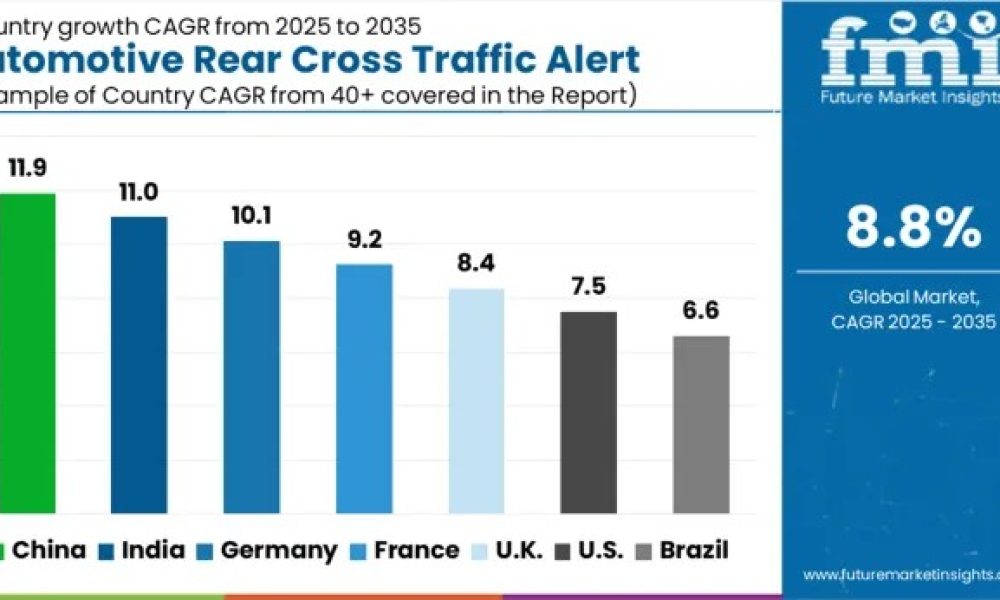
The global automotive rear cross traffic alert (RCTA) market is entering a phase of accelerated growth as vehicle safety technologies evolve from optional enhancements into core system requirements. Valued at USD 4.5 billion in 2025, the market is projected to reach USD 10.5 billion by 2035, expanding at a robust compound annual growth rate (CAGR) of 8.8% over the forecast period. This sustained expansion underscores the growing strategic importance of rear cross traffic alert systems within the broader advanced driver assistance systems (ADAS) ecosystem.
Rear cross traffic alert has emerged as a critical safety function designed to mitigate collision risks during reversing maneuvers, particularly in congested urban environments and parking scenarios with limited visibility. As vehicle architectures become increasingly sensor-driven and software-defined, RCTA systems are gaining traction as essential components that enhance driver awareness, reduce accident rates, and support the transition toward higher levels of driving automation.
Radar-Based Systems Anchor Market Leadership
Technology contribution analysis highlights radar-based systems as the dominant segment, accounting for the largest share of the market in 2025. Radar technology has established itself as the backbone of rear cross traffic alert solutions due to its reliability in detecting moving objects across wide angles, even under challenging conditions such as low visibility, poor lighting, or adverse weather. These performance advantages have ensured strong adoption across both premium and mid-range vehicle segments.
Get access to comprehensive data tables and detailed market insights — request your sample report today!
https://www.futuremarketinsights.com/reports/sample/rep-gb-24911
Ultrasonic sensor-based systems continue to play a role in entry-level and compact vehicles, where affordability and short-range detection are primary considerations. However, their limited detection range constrains their application in higher-end systems. In contrast, camera-based solutions are gaining momentum, supported by advances in image recognition, artificial intelligence, and real-time processing. Improved threat classification and reduced false alerts are positioning camera technologies as an increasingly valuable complement to radar.
The most rapid growth is anticipated in sensor fusion systems, which integrate radar, camera, and ultrasonic technologies into multi-layered detection architectures. This approach delivers higher accuracy and system redundancy, aligning closely with the automotive industry’s shift toward semi-autonomous and autonomous driving platforms. Sensor fusion is expected to significantly reshape the technology mix over the next decade.
Sensors and Passenger Vehicles Drive Revenue Concentration
By component, sensors represent the leading segment, accounting for 36.4% of total market revenue in 2025. Their central role in detecting obstacles and transmitting real-time data to vehicle control units has made them indispensable to RCTA performance. Continuous innovation in radar and ultrasonic sensors—focused on enhanced accuracy, lower power consumption, and miniaturization—has strengthened their adoption across diverse vehicle architectures.
From a vehicle perspective, passenger vehicles dominate demand, contributing 54.7% of market revenue in 2025. Rising consumer expectations for safety, combined with increasing urban traffic congestion and parking complexity, have driven OEMs to integrate rear cross traffic alert systems as standard or high-value features. SUVs and crossovers, in particular, have emerged as strong adopters due to inherent rear visibility limitations.
Integration Within ADAS Accelerates Adoption
Rear cross traffic alert systems now represent nearly 3.7% of the overall ADAS market, highlighting their growing relevance within collision avoidance and parking assistance technologies. They also account for approximately 3.1% of passenger vehicle safety systems, 2.8% of the automotive radar and sensor components sector, and 2.4% of electronic parking assist technologies. Within the broader smart mobility and connected vehicle safety ecosystem, RCTA contributes around 2.2%, reflecting its expanding role in driver awareness and accident prevention.
Recent developments emphasize tighter integration of rear cross traffic alert with blind spot monitoring, automatic emergency braking, and unified safety suites. Advances in short-range radar and ultrasonic sensors have improved detection accuracy in crowded environments, while adaptive alert algorithms are reducing false warnings. Semiconductor manufacturers are supporting this evolution through miniaturized radar modules and advanced signal processing, enabling cost-effective deployment across compact and mid-range vehicles.
Regulatory Momentum and Urban Safety Needs Support Growth
Market growth is being reinforced by increasing regulatory focus on vehicle safety and collision prevention, particularly in North America, Europe, and parts of Asia-Pacific. Safety assessment programs and government initiatives promoting advanced driver assistance technologies are influencing OEM strategies and accelerating adoption. At the same time, rising urbanization, traffic density, and constrained parking infrastructure are intensifying demand for systems that enhance reversing safety.
Declining component costs and scalable sensor architectures are further broadening accessibility, enabling rear cross traffic alert systems to move beyond luxury models into mass-market vehicles. This trend is expected to continue as manufacturers seek to differentiate offerings while meeting evolving safety expectations.
Drive Your Business Growth Strategy: Checkout the Report for Key Insights
https://www.futuremarketinsights.com/checkout/24911
Asia-Pacific and Europe Lead Regional Expansion
Regionally, North America, Asia-Pacific, and Europe represent the key growth engines. China is projected to expand at a CAGR of 11.9%, driven by rapid ADAS adoption, strong domestic production capabilities, and government emphasis on road safety. India follows with an estimated CAGR of 11.0%, supported by rising passenger vehicle and SUV sales and gradual penetration beyond premium segments.
In Europe, Germany is forecast to grow at 10.1%, reflecting its strong automotive manufacturing base and leadership in safety innovation. The United Kingdom is expected to register a CAGR of 8.4%, supported by regulatory alignment and growing adoption in SUVs and crossovers. The United States, with a projected CAGR of 7.5%, continues to see strong demand driven by safety-focused consumers and widespread adoption in SUVs, pickup trucks, and premium vehicles.
Competitive Landscape Defined by Technology Leadership
The automotive rear cross traffic alert market is characterized by the presence of leading global technology providers and semiconductor specialists, including Bosch, Aptiv, Continental, Denso, Infineon, NXP Semiconductors, Sensata, Valeo, and ZF Friedrichshafen. These companies are shaping a highly competitive, innovation-driven environment through continuous advancements in radar, sensors, and AI-enabled algorithms.
Outlook
As vehicles become more intelligent, connected, and automated, rear cross traffic alert systems are evolving from standalone safety features into foundational elements of integrated ADAS platforms. The market’s strong growth trajectory reflects its dual role in addressing immediate safety challenges and supporting the automotive industry’s long-term transition toward automated driving. Detailed insights into technology trends, regional opportunities, and competitive strategies are explored further in the full market report.
Why Choose FMI: Empowering Decisions that Drive Real-World Outcomes: https://www.futuremarketinsights.com/why-fmi
About Future Market Insights (FMI)
Future Market Insights, Inc. (FMI) is an ESOMAR-certified, ISO 9001:2015 market research and consulting organization, trusted by Fortune 500 clients and global enterprises. With operations in the U.S., UK, India, and Dubai, FMI provides data-backed insights and strategic intelligence across 30+ industries and 1200 markets worldwide.



