
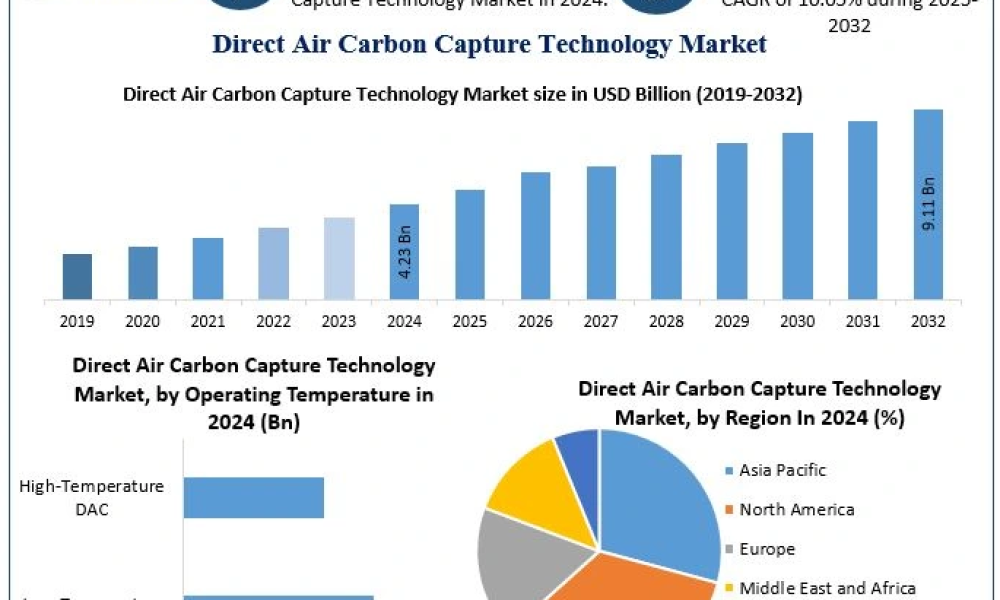
As per a recent study released by Maximize Market Research, titled, “Direct Air Carbon Capture Technology Market,” The Direct Air Carbon Capture Technology Market, valued at USD 4.23 billion in 2024, and is projected to reach nearly USD 9.11 billion by 2032. This anticipated growth corresponds to a Compound Annual Growth Rate (CAGR) of 10.05% over the forecast period 2025-2032.
Direct Air Carbon Capture Technology Market Overview:
DAC technologies involve extracting carbon dioxide (CO₂) directly from ambient air, rather than capturing emissions at point sources such as power plants or industrial facilities, and then storing or utilizing the CO₂ through various applications. Simultaneously, the technology faces significant challenges: the energy intensity due to low CO₂ concentration in the atmosphere, high capital and operational costs, and infrastructure demands for CO₂ storage and transportation.
Increasingly, governments, corporations, and financial institutions are recognizing DAC as a key component in the global strategy to mitigate climate change, especially under more ambitious climate targets and net-zero commitments. Research and development efforts are intensifying, focusing on improving capture efficiency, lowering energy consumption, and innovating new materials for adsorption and absorption processes.
Download a Free Sample Report Today : https://www.maximizemarketresearch.com/request-sample/80672/
Direct Air Carbon Capture Technology Market Dynamics
A principal driver behind the DAC market’s growth is the mounting urgency of climate change mitigation. As global emissions continue to rise and the impacts of atmospheric greenhouse gases grow more severe, DAC offers a unique pathway to actively remove CO₂ already in the air, complementing emissions reductions. Supportive policy frameworks—including carbon pricing, grants, tax incentives—and corporate sustainability goals are steadily aligning to provide financial and regulatory backing for DAC projects. Public awareness and pressure from consumers for climate action are further pushing governments and industries to adopt carbon removal measures as part of broader environmental responsibility strategies.
On the flip side, the market is constrained by its inherent energy demands and high cost structure. Because CO₂ is much more dilute in air compared to emissions directly from industrial sources, more energy is required per unit of CO₂ captured. Establishing DAC plants involves large upfront capital expenditure; operational costs—particularly for heat and electricity—are substantial. Moreover, regulatory frameworks in many regions are still evolving, creating permitting uncertainties. The logistics of transporting captured CO₂ and finding or developing safe, permanent storage sites also add complexity and cost, especially in regions lacking existing infrastructure or geological capacity.
Direct Air Carbon Capture Technology Market Outlook and Future Trends :
Over the forecast period, the DAC market is expected to benefit from continued innovation in materials science and process engineering, including development of new adsorbents/absorbents, electrochemical and passive capture methods, and more efficient thermal systems. These technological advancements will seek to reduce energy consumption and lower lifecycle costs. Increased investment in pilot and demonstration plants will validate scale, build confidence, and help drive standardization of processes and equipment.
Furthermore, the role of policy instruments will become increasingly critical. Enhanced tax credits, carbon pricing mechanisms, public funding, and subsidies for carbon removal technologies will likely become more common in jurisdictions committed to the Paris Agreement and net-zero goals. Collaboration between private sector, governments, and research institutions is expected to deepen, particularly in the development of DAC infrastructure—storage, transport, monitoring—and in ensuring regulatory and permitting pathways are streamlined.
Direct Air Carbon Capture Technology Market Regional Insights:
North America currently leads the DAC market, driven by strong government incentives, clear regulatory frameworks, and ambitious emissions reduction targets. For example, tax credit policies in the United States (like enhancements to 45Q) make DAC projects more financially tenable. Europe is also pushing forward aggressively: the European Commission’s goals for CO₂ storage, and increasing investment in carbon capture, utilization, and storage (CCUS) including DAC, are significant. Asia-Pacific, especially in nations with rapidly growing energy demand, is expected to become an increasingly important market, though adoption may be uneven due to variations in regulatory environments, financial capacity, and availability of storage/infrastructure.
Direct Air Carbon Capture Technology Market Segmentation
by Operating Temperature
Low-Temperature DAC
High-Temperature DAC
by End User Industry
Energy Industry
Industrial Sector
Transportation
Others
Some of the current players in the Direct Air Carbon Capture Technology Market are:
1. Carbon Clean Solutions
2. Climeworks
3. Carbon Engineering (Canada)
4. Global Thermostat (United States)
5. Climeworks (United States)
6. Carbon Cure Technologies (Canada)
7. Carbon Clean Solutions (United States)
8. Skytree (United States)
9. Global Thermostat (United States)
10. Carbon Clean Solutions (United Kingdom)
About Maximize Market Research:
Maximize Market Research is one of the fastest-growing market research and business consulting firms serving clients globally. Our revenue impact and focused growth-driven research initiatives make us a proud partner of majority of the Fortune 500 companies. We have a diversified portfolio and serve a variety of industries such as IT & telecom, chemical, food & beverage, aerospace & defense, healthcare and others.
Contact Maximize Market Research:
MAXIMIZE MARKET RESEARCH PVT. LTD.
⮝ 3rd Floor, Navale IT park Phase 2,
Pune Banglore Highway, Narhe
Pune, Maharashtra 411041, India.
✆ +91 9607365656
🖂 [email protected]




