
Definition
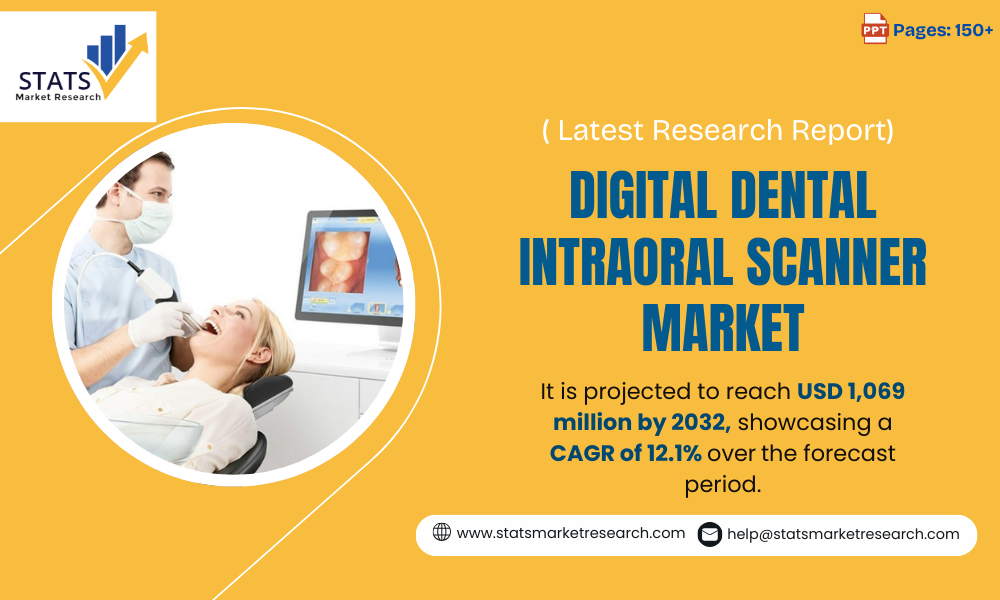
Digital dental intraoral scanners are advanced diagnostic devices that utilize optical scanning technology to capture highly accurate 3D digital impressions of a patient’s teeth and oral structures. Unlike traditional putty-based methods, these scanners enable precise, fast, and comfortable dental imaging.
Key Features and Functions:
- 3D Digital Capture: Creates accurate models for restorative and cosmetic procedures.
- Integration with CAD/CAM Systems: Enables design and fabrication of crowns, bridges, orthodontic aligners, and implants.
- Enhanced Patient Experience: Eliminates discomfort from conventional molds.
- Real-Time Visualization: AI-assisted guidance improves accuracy and reduces errors during scanning.
Applications:
- Restorative dentistry (crowns, bridges)
- Orthodontics (aligners, braces)
- Implantology
- Prosthodontics
Digital intraoral scanners improve clinical workflows, reduce chair time, and allow dentists to provide same-day restorations, which enhances practice efficiency and patient satisfaction.
Market Size
Global digital dental intraoral scanner market was valued at USD 485 million in 2023 and is projected to reach USD 1,069 million by 2030, exhibiting a CAGR of 12.1% during the forecast period.
Market Insights:
- North America and Europe together account for ~65% of global revenue, with strong adoption in the U.S., Germany, and the UK.
- Align Technologies and Dentsply Sirona dominate the market, holding a combined 55% market share.
- Increasing demand for cosmetic and restorative dental procedures, along with advancements like AI-powered scanning, are key growth drivers.
Historical Trend:
- Traditional molds dominated until the 2010s, but increasing adoption of digital dentistry and CAD/CAM integration has transformed the market.
- Efficiency gains, improved accuracy (up to 99%), and patient comfort are contributing to faster adoption rates.
Download FREE Sample of this Report @ https://www.statsmarketresearch.com/download-free-sample/8059873/global-digital-dental-intraoral-scanner-forecast-market
Recent Developments
The digital dental intraoral scanner market is experiencing a rapid evolution, moving beyond basic impression-taking to become a central hub for digital dentistry. A major development is the widespread integration of artificial intelligence (AI) and machine learning (ML) into scanner software. AI-powered algorithms are now used to guide the scanning process, ensure complete data capture, and even assist in real-time diagnostics, such as identifying early signs of caries or gum disease. The market is also seeing a significant shift from wired to wireless devices, which enhances user mobility and patient comfort. Furthermore, manufacturers are focusing on creating “open” systems that can seamlessly integrate with a variety of other dental technologies, including CAD/CAM milling machines and 3D printers, which is a key driver for broader adoption in dental practices.
Major Distribution Channels
The distribution of digital dental intraoral scanners is primarily a direct, business-to-business model. Manufacturers like Align Technology (iTero), Dentsply Sirona (Primescan), and 3Shape (TRIOS) sell their high-value equipment and associated software directly to end-users. The largest customer segments are private dental clinics, large group practices, and dental schools. These companies leverage a global network of sales representatives, technical support teams, and regional offices to provide demonstrations, training, and ongoing service. While some third-party distributors may exist, the high cost and technical complexity of the devices necessitate a close relationship between the manufacturer and the customer. The market is highly concentrated, with a few major players dominating a significant portion of the global share.
Market Dynamics
Drivers
Rapid Adoption of Digital Dentistry:
- Digital workflows replace messy putty impressions in over 45% of restorative dentistry cases.
- Accuracy improves by up to 70%, and procedural time is reduced by 30–50%, mitigating shortages in dental professionals globally.
Technological Advancements:
- AI-assisted scanning for real-time guidance, automatic margin detection, and trueness levels below 10μm.
- Cloud-based integration allows same-day restorations, now adopted by 62% of progressive practices.
- Major companies invest 15–20% of revenue in R&D for advanced scanners.
Cost Efficiency Over Time:
- Practices recover investment within 12–18 months, especially with reimbursement support and younger dentists trained in digital workflows.
Restraints
High Capital Investment:
- Initial system costs range from $20,000 to $60,000, excluding software, staff training, and IT infrastructure, adding 40–60% to the total investment.
Integration Challenges:
- Compatibility with legacy systems affects 28% of first-time adopters, requiring additional software or equipment.
Reimbursement Policy Variability:
- Inconsistent insurance coverage for digital impressions slows adoption in certain regions.
Opportunities
Emerging Markets:
- Asia-Pacific projected CAGR of 18.3% through 2030 due to rising disposable incomes and dental tourism.
- Budget-friendly portable scanners are emerging in India and China for small and mid-sized clinics.
Teledentistry Integration:
- Cloud-connected scanners enable remote evaluation and consultations.
- Synergy with telehealth services and aligner companies reduces turnaround times by up to 60%.
Challenges
Workflow Disruption:
- Digital transition requires 40–60 hours of retraining per staff member, causing 15–20% productivity decline initially.
Data Security Concerns:
- Sensitive patient data requires enhanced cybersecurity; 60% of practices implement new IT measures.
Ongoing Maintenance Requirements:
- Annual technical disruptions affect 25% of users, necessitating reliable support networks.
Regional Analysis
North America:
- Dominates adoption due to strong infrastructure and high disposable income.
- U.S. dental clinics lead the digital transition with early adoption of AI-enabled scanners.
Europe:
- Germany, UK, and France show robust adoption, driven by precision engineering and regulatory support.
Asia-Pacific:
- Fastest-growing region with government-backed digital dentistry initiatives in China, Japan, and India.
South America:
- Brazil and Argentina adopting scanners for both clinics and dental tourism sectors.
Middle East & Africa:
- Adoption led by UAE and Saudi Arabia, mainly in urban centers with modern dental facilities.
Competitor Analysis
- Align Technologies: Leader with iTero Element series, AI-assisted scanning.
- Dentsply Sirona: Primescan AC with 50% faster processing.
- 3Shape: Open-architecture scanners compatible with multiple CAD/CAM systems.
- Planmeca: Integrated chairside solutions combining scanning and milling units.
- Other Notable Players: Carestream Dental, 3M ESPE, Dental Wings, Densys, Condor, Launca, Shining 3D, Meyer, FREQTY, FUSSEN, Vatech.
Strategy Insights:
- Heavy R&D investments in AI and cloud integration.
- Regional expansions by Asian manufacturers to provide cost-effective alternatives.
- Strategic partnerships with aligner and telehealth companies to expand market reach.
Get the Complete Report & TOC @ https://www.statsmarketresearch.com/global-digital-dental-intraoral-scanner-forecast-market-8059873
Global Digital Dental Intraoral Scanner: Market Segmentation Analysis
This report provides a deep insight into the global Digital Dental Intraoral Scanner market covering all its essential aspects. This ranges from a macro overview of the market to micro details of the market size, competitive landscape, development trend, niche market, key market drivers and challenges, SWOT analysis, value chain analysis, etc.
The analysis helps the reader to shape the competition within the industries and strategies for the competitive environment to enhance the potential profit. Furthermore, it provides a simple framework for evaluating and assessing the position of the business organization. The report structure also focuses on the competitive landscape of the Global Digital Dental Intraoral Scanner Market, this report introduces in detail the market share, market performance, product situation, operation situation, etc., of the main players, which helps the readers in the industry to identify the main competitors and deeply understand the competition pattern of the market.
In a word, this report is a must-read for industry players, investors, researchers, consultants, business strategists, and all those who have any kind of stake or are planning to foray into the Digital Dental Intraoral Scanner market in any manner.
Market Segmentation (by Application)
- Restorative Dentistry
- Orthodontics
- Implantology
- Prosthodontics
- Others
Market Segmentation (by Type)
- Powder-free Intraoral Scanners
- Powder-based Intraoral Scanners
Key Company
- Align Technologies (U.S.)
- Dentsply Sirona (U.S./Germany)
- 3Shape (Denmark)
- Carestream Dental (U.S.)
- Planmeca (Finland)
- 3M ESPE (U.S.)
- Dental Wings (Canada)
- Densys (South Korea)
- Condor (Italy)
- Launca (China)
- Shining 3D (China)
- Meyer (U.S.)
- FREQTY (China)
- FUSSEN (China)
- Vatech (South Korea)
Geographic Segmentation
- North America: USA, Canada, Mexico
- Europe: Germany, UK, France, Russia, Italy, Rest of Europe
- Asia-Pacific: China, Japan, South Korea, India, Southeast Asia, Rest of Asia-Pacific
- South America: Brazil, Argentina, Columbia, Rest of South America
- Middle East & Africa: Saudi Arabia, UAE, Egypt, Nigeria, South Africa, Rest of MEA
FAQ
Q1: What is the current market size of the Global Digital Dental Intraoral Scanner market?
A1: The market was valued at USD 485 million in 2023 and is projected to reach USD 1,069 million by 2030, growing at a CAGR of 12.1%.
Q2: Which are the key companies operating in the Global Digital Dental Intraoral Scanner market?
A2: Key players include Align Technologies, Dentsply Sirona, 3Shape, Carestream Dental, Planmeca, 3M ESPE, Dental Wings, Densys, Condor, Launca, Shining 3D, Meyer, FREQTY, FUSSEN, Vatech.
Q3: What are the key growth drivers in this market?
A3: Growth is driven by digital dentistry adoption, AI-enabled scanning, increased demand for cosmetic procedures, efficiency gains, and integration with CAD/CAM systems.
Q4: Which regions dominate the Global Digital Dental Intraoral Scanner market?
A4: North America and Europe dominate due to high disposable incomes, early adoption of digital dentistry, and robust dental infrastructure.
Q5: What are the emerging trends in the market?
A5: Trends include AI-assisted scanning, cloud-based CAD/CAM integration, teledentistry applications, portable scanners for emerging markets, and open-architecture systems for multi-CAD compatibility.
About Us
☎️ International: +1 (332) 2424 294
📄 Website: www.statsmarketresearch.com
Join us on LinkedIn:- https://www.linkedin.com/company/statsmarketresearch




