
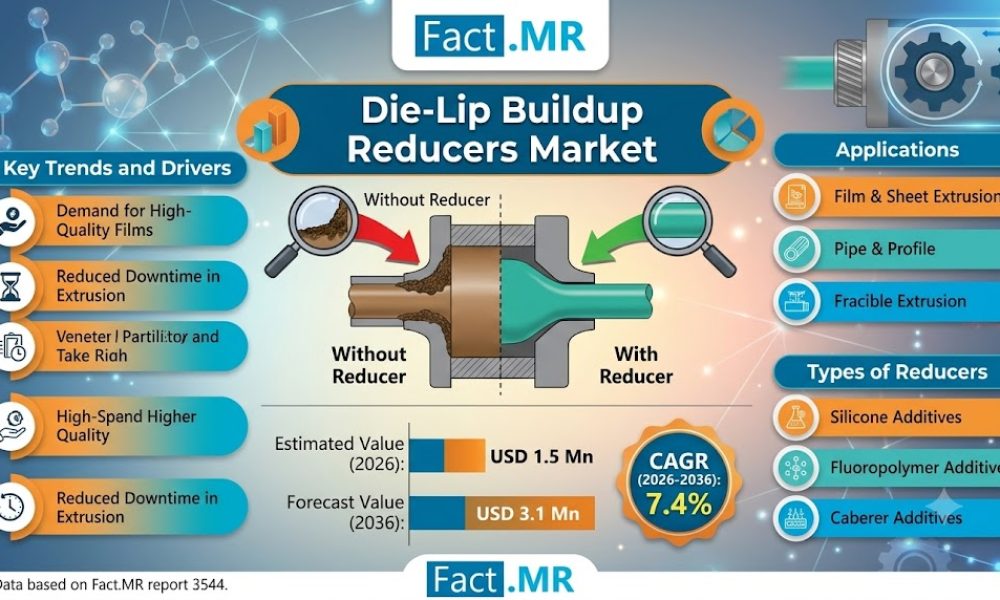
The global die-lip buildup reducers market is projected to increase from USD 1.5 billion in 2026 to USD 3.1 billion by 2036, registering a 7.4% CAGR over the forecast period. The market reached USD 1.4 billion in 2025, creating an absolute opportunity of approximately USD 1.6 billion between 2026 and 2036. Demand is being supported by film plants and compounders seeking longer extrusion runs with fewer die-cleaning interruptions.
Film plants use these processing aids to limit deposits at the die lip, helping reduce surface marks and manual cleaning during production. Polyethylene processors are also seeking steadier melt flow at high line speeds, while compounders require even additive dispersion so treatment levels remain consistent across resin and output lots.
Get Detailed Market Forecasts, Competitive Benchmarking, and Pricing Trends: https://www.factmr.com/connectus/sample?flag=S&rep_id=16547
Regulatory changes are also shaping formulation choices. On August 11, 2026, the European Commission stated that the Packaging and Packaging Waste Regulation (PPWR) applies from August 12, 2026, including restrictions concerning PFAS in food-contact packaging. This is supporting interest in fluoropolymer-free processing-aid alternatives.
Global Segment Leaders
- Silicone masterbatch — 34.0% share in 2026: Silicone masterbatch leads the processing-aid chemistry segment because it can be metered through common blending equipment. Pelletized formats also support controlled dosing in polyethylene lines.
- Melt-fracture reduction — 31.0% share in 2026: This processing function leads as unstable die-exit flow can produce roughness and distortion on film surfaces. Plants can evaluate melt-fracture control alongside buildup reduction during high-shear extrusion.
- Polyethylene — 36.0% share in 2026: Polyethylene leads the polymer substrate segment because of its broad use in flexible packaging and film production. Long extrusion runs also make die-deposit control easier to measure against cleaning frequency.
- Blown film — 29.0% share in 2026: Blown film represents the leading application because long production runs can make die deposits more visible through surface marks and increased cleaning requirements.
Country-Level Performance
- China — 8.6% CAGR: China records the highest stated country growth through 2036, supported by its large polyolefin base and extrusion activity. The National Bureau of Statistics reported in February 2026 that China’s ethylene output reached 41.508 million tonnes in 2025, up 6.4% from 2024.
- Japan — 7.5% CAGR: Japan’s market is shaped by demand for stable film finish and repeatable processing. METI reported in February 2026 that Japan’s December 2025 industrial production index was 101.8 on a seasonally adjusted basis, while the original index stood at 106.8, up 2.6% from December 2024.
- USA — 7.1% CAGR: U.S. demand is supported by plastics manufacturing investment and the need to improve extrusion efficiency. The U.S. Bureau of Economic Analysis reported in June 2026 that new foreign direct investment expenditures in U.S. plastics and rubber products manufacturing totaled USD 19.0 billion in 2025.
- France — 7.1% CAGR: France is projected to expand at the same stated rate as the USA, with packaging conversion and polymer-processing activity influencing demand. INSEE reported in July 2026 that production in rubber and plastics products and other non-metallic mineral products was 1.5% higher over the latest three-month period than a year earlier.
- Germany — 6.9% CAGR: Germany records the lowest CAGR among the five profiled countries. Recycling requirements and extrusion efficiency remain relevant to processing-aid selection. Germany’s Environment Agency and Central Agency Packaging Register reported in January 2026 that around 5.5 million tonnes of packaging waste collected through Germany’s dual systems were recovered in 2024.
Regional Context
The report covers North America, Latin America, Western Europe, Eastern Europe, East Asia, South Asia & Pacific, and the Middle East & Africa, with detailed country analysis for China, Japan, the USA, France, and Germany.
The country CAGR range spans 1.7 percentage points. China’s larger polyolefin production base supports its higher projected growth, while Japan’s outlook centers on stable film finish and process control. The USA and France each record 7.1% CAGR but are influenced by different market conditions, including plastics manufacturing investment and packaging conversion. Germany’s growth reflects the interaction between recycling requirements, resin compatibility, and extrusion efficiency.
Competitive Landscape
Key companies profiled in the die-lip buildup reducers market include Dow, Wacker Chemie, Momentive, Evonik, and Mitsubishi Chemical Group. Competition centers on resin compatibility, additive dosage, extrusion performance, and regulatory documentation.
Dow has a direct presence in die-lip buildup control through DOWSIL™ 5-1050 Polymer Processing Aid. In September 2025, Dow introduced a polyethylene-based masterbatch for blown and stretch film applications, stating that it mitigates melt fracture and suppresses die-lip buildup in linear low-density polyethylene grades.
Wacker Chemie offers GENIOPLAST® silicone processing aids, including PE50S08 for polyethylene extrusion and profile-related applications. Momentive supplies PEarlene™ silicone masterbatches for plastics processing, while Evonik offers organo-modified siloxane polymer processing aids such as TEGO® PPA 51-1 and 51-7. Mitsubishi Chemical Group supplies METABLEN™ processing aids and modifiers for thermoplastics, including grades designed to reduce or prevent die deposits.
Analyst Opinion
Shambhu Nath Jha, Principal Consultant at Fact.MR, stated:
“Die-lip buildup raises line cost. Demand is forecast to favor products that keep film surfaces clean and fit common resin recipes. Suppliers that pair steady dispersion with food-contact records have a clear path into approved lines.”
Market Considerations
For manufacturers and compounders, several operating factors are shaping product qualification:
- Plants are comparing buildup control with melt-fracture performance because both issues can appear within the same high-shear process window.
- Compounders need consistent masterbatch dispersion so treatment rates remain stable across film and profile runs.
- Carrier compatibility and pellet form need to be evaluated before an aid is approved across multiple resin systems.
- Food-contact documentation and chemical-compliance records are becoming part of product approval.
- Recycled polyolefin streams can create wider process variability because feedstock changes may affect viscosity and deposit formation.
- Suppliers are also developing low-dose solutions for profile, pipe, and cable extrusion applications.
Research Methodology
Fact.MR’s analysis draws on 120+ sources, 35+ company portfolios, 25+ countries, and more than 20 industry interviews. Primary research covers manufacturers, service providers, technology developers, distributors, end users, and subject-matter experts. Desk research includes government statistics, regulatory publications, company filings, trade data, technical studies, industry associations, standards, and public policy.
Explore More Related Studies Published by Fact.MR Research:
Biodegradable Sulfate-Free Thickeners Market
Bio-Based Electronics Assembly Adhesives Market
About Fact.MR
Fact.MR is a leading provider of market research and consulting services, offering syndicated and customized research across industries including Consumer Goods, Healthcare, and Chemicals & Materials.



