
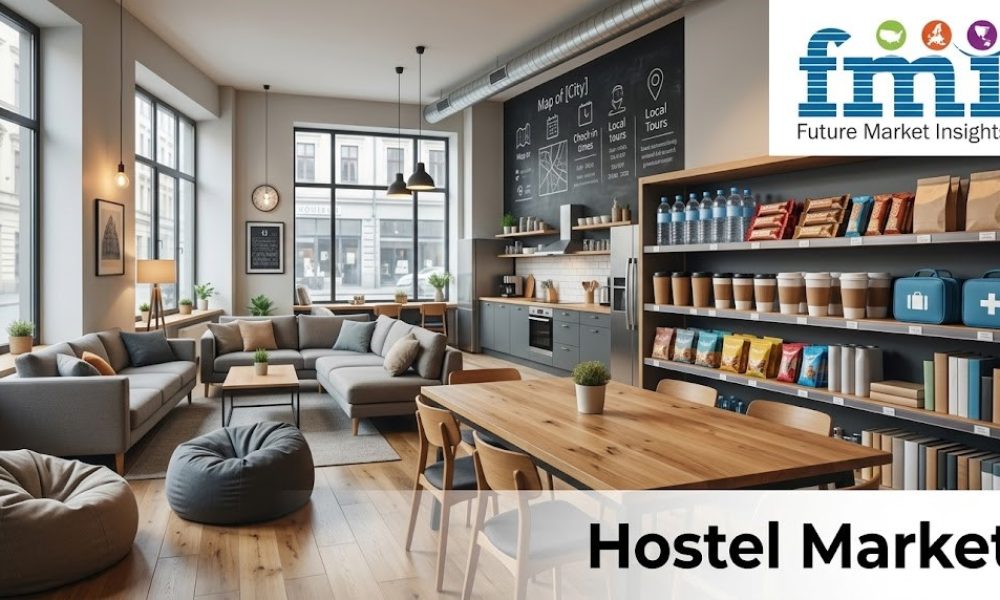
The global hostel market is projected to grow from USD 5.6 billion in 2025 to USD 15.5 billion by 2036, registering a 9.8% CAGR from 2026 to 2036. The market is expected to create an incremental opportunity of USD 9.4 billion over the forecast period. Online booking is estimated to account for 55% of distribution channel demand in 2026, highlighting the growing role of digital platforms in hostel reservations.
Hostel demand is being supported by affordable travel, youth mobility, backpacking circuits, and short domestic trips. Students, young travelers, solo tourists, and budget-conscious guests continue to use hostels to manage accommodation costs while maintaining access to city centers and leisure destinations. Shared kitchens, social lounges, and coworking areas are also helping hostels compete with budget hotels and alternative accommodation formats.
Private Rooms Broaden Hostel Demand
Private rooms are expected to hold 33.1% of the hostel market in 2026, as travelers increasingly seek greater privacy and comfort without moving into higher-cost accommodation. Operators are adding upgraded bedding and en-suite options while retaining shared social facilities, allowing hostels to serve a broader range of travelers.
The shift toward private accommodation is taking place alongside continued demand for traditional hostel experiences. Independent travelers are estimated to account for 41.0% of demand in 2026, supported by flexible solo trip planning and the appeal of common spaces and local destination information. The 26 to 35 years age group is projected to represent 38.0% share, reflecting mobile-first travel behavior and demand for flexible, budget-oriented stays.
Get detailed market forecasts, competitive benchmarking, and pricing trends: https://www.futuremarketinsights.com/reports/sample/rep-gb-3214
Digital Booking Supports Occupancy Management
Online booking is becoming a central part of hostel operations. Travelers use digital platforms to compare prices, ratings, room availability, and location before making reservations. Operators are also using automated check-ins, online payments, and guest messaging to reduce routine service workloads and manage room inventory more efficiently.
Digital visibility is particularly relevant in competitive urban lodging markets, where hostels compete with budget hotels and short-term accommodation. Review performance, cleanliness, safety, and location remain important factors in the booking decision. Properties with reliable digital systems can also adjust rates during local events and peak weekends.
India and Thailand Show Strong Country-Level Growth
Country-level growth varies according to tourism corridors, student mobility, accommodation supply, and budget travel demand. India is projected to expand at a 7.6% CAGR through 2036, supported by domestic travel, youth mobility, and backpacking corridors. Rajasthan and Goa are identified as important backpacker destinations, while education trips and regional transport access add to hostel demand.
Thailand is forecast to grow at a 7.2% CAGR, supported by backpacker networks, inbound tourism, and budget accommodation demand. Bangkok and Chiang Mai attract travelers seeking central locations and social accommodation, while coastal destinations support leisure demand. Digital nomads also contribute to longer hostel stays where coworking and shared spaces are available.
The United Kingdom is projected to grow at 5.4% CAGR, with London and Edinburgh supporting demand amid high urban hotel prices. Spain is forecast to expand at 5.9% CAGR, supported by cultural and coastal tourism, while the United States is expected to grow at 4.8% CAGR under more mature lodging conditions.
Competitive Landscape
The hostel market remains fragmented across branded chains, independent properties, and booking platforms. Major companies profiled include Hostelworld, Generator Hostels, A&O Hotels and Hostels, Selina, Safestay, YHA Hostels, and Meininger Hotels. Regional and independent operators include Stayokay, St Christopher’s Inn, Khaosan Hostels, and Green Tortoise Hostel.
Competition centers on booking visibility, room affordability, property networks, guest experience, and operational consistency. Branded operators use standardized formats and network scale, while independent hostels compete through local identity and social atmosphere. Digital engagement, review management, mobile messaging, and online payments are increasingly important across hostel operations.
Recent industry developments include a strategic development partnership between Generator and Freehand Hotels with Dusit Hotels and Resorts in August 2024, aimed at expanding hybrid hostel and lifestyle accommodation models across several regions. In October 2024, a&o Hostels announced its first expansion into Belgium with a&o Antwerpen Centraal, a 516-bed property.
Analyst View
Ronak Shah, Principal Consultant at Future Market Insights (FMI), says: “Hostel demand is moving toward a mixed lodging model as private rooms add comfort and online booking improves visibility. Operators with strong digital access and consistent guest service can manage price-sensitive demand better. Safety upgrades and practical room improvements support stronger conversion across young travelers.”
Access the Complete Report in PDF Format: https://www.futuremarketinsights.com/reports/brochure/rep-gb-3214
Market Outlook
The hostel market is increasingly positioned between traditional dormitory accommodation and budget hotels, with private rooms, digital services, and social facilities expanding the range of guests that hostel operators can serve. Budget travel, domestic mobility, backpacking, and digital booking remain key demand factors through 2036.
At the same time, operators face higher upgrade costs and licensing requirements, particularly in dense urban markets. The report identifies digital booking tools, automated guest services, private-room offerings, and reliable service as areas supporting future market opportunities.
Business Impact
FMI helps organizations transform market complexity into strategic clarity, enabling leadership teams to identify growth opportunities faster, optimize resource allocation, strengthen competitive positioning, and make high-stakes business decisions with confidence.
To explore how FMI Custom Research can support your strategic priorities, please connect with our team at – [email protected]
About Future Market Insights (FMI)
Future Market Insights, Inc. (FMI) is an ESOMAR-certified, ISO 9001:2015 market research and consulting organization, trusted by Fortune 500 clients and global enterprises. With operations in the U.S., UK, India, and Dubai, FMI provides data-backed insights and strategic intelligence across 30+ industries and 1200 markets worldwide.



