
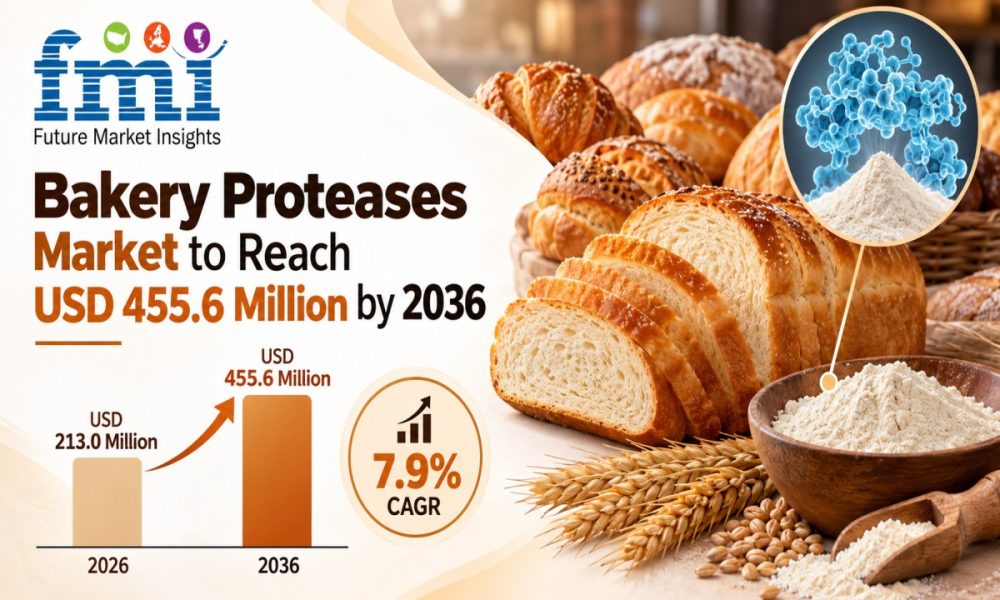
Global bakery proteases market projected to grow from USD 213.0 million in 2026 to USD 455.6 million by 2036 at a 7.9% CAGR, according to Future Market Insights
The global Bakery Proteases Market is projected to reach USD 455.6 million by 2036, up from approximately USD 213.0 million in 2026, expanding at a 7.9% CAGR during the forecast period, according to the latest analysis by Future Market Insights (FMI).
Demand is being supported by industrial bakeries seeking controlled gluten relaxation, shorter dough rest times, consistent dough handling and improved processing stability across changing flour lots. Bakery proteases are increasingly being evaluated as part of broader enzyme and dough-improvement programs designed to improve manufacturing consistency.
Bakery proteases are enzymes used to modify dough and flour performance during commercial bakery production. Their application spans bread and rolls, cakes and muffins, biscuits and cookies, viennoiserie and pastry, and other bakery and snack products.
Get Detailed Market Forecasts, Competitive Benchmarking, and Pricing Trends:
https://www.futuremarketinsights.com/reports/sample/rep-gb-34889
Standard Grade Continues to Anchor Product Demand
Standard grade bakery proteases are expected to account for 45.0% of product type demand in 2026, making them the largest product category.
The segment benefits from broad compatibility with conventional bakery formulations and established processing programs. Industrial bakery technologists generally evaluate proteases against specific dough-rheology requirements before considering specialty claims or certification requirements.
Powder – Dry Leads the Form Category
Powder – dry bakery proteases are projected to account for 43.0% of the form segment in 2026.
Dry enzyme formats fit established flour-side dosing and premix workflows, allowing bakery operators to incorporate enzyme activity alongside other flour conditioners and bread improvers.
Flour Standardization and Dough Relaxation Support Market Growth
Industrial bakery production is increasingly focused on reducing variability in dough processing while maintaining finished-product quality.
Proteases can help bakeries address flour-strength variations and controlled gluten relaxation requirements. Where shorter rest periods or more consistent machining create measurable production benefits, bakeries can justify the qualification costs associated with introducing a new enzyme system.
Dose Sensitivity Remains a Key Market Consideration
Although bakery proteases offer processing benefits, enzyme selection remains highly dose-sensitive.
An unsuitable dose can weaken gluten beyond the required production target and negatively affect dough structure or finished-product characteristics. As a result, bakery manufacturers generally require application trials before incorporating a new protease into an established production specification.
Saudi Arabia Shows the Fastest Growth Among Highlighted Countries
FMI’s country-level analysis identifies Saudi Arabia as the fastest-growing market among the highlighted countries, with a projected 9.0% CAGR through 2036.
The United Kingdom follows at 8.4%, while the United States is projected to grow at 8.1%. France and Germany are expected to record CAGRs of 7.8% and 7.4%, respectively.
The country-level growth profile reflects differences in bakery manufacturing structures, flour-processing requirements, qualification practices and technical support needs.
Country-Level Market Analysis
Saudi Arabia
Saudi Arabia is projected to record a 9.0% CAGR through 2036.
Bakery processors are increasingly focused on controlled production processes and consistent product quality. Supplier qualification can require complete technical specifications, handling information and responsive application support.
United Kingdom
The UK bakery proteases market is projected to grow at an 8.4% CAGR through 2036.
Industrial and private-label bakeries evaluate enzyme solutions based on reformulation economics, production efficiency, traceability and line performance.
United States
The United States is projected to expand at an 8.1% CAGR through 2036.
Large bakery groups often require standardized technical documentation and plant-scale evidence before implementing enzyme changes across multiple facilities.
France
France is expected to register a 7.8% CAGR through 2036.
Bakery processors place emphasis on formulation consistency, controlled production changes and technical validation when assessing enzyme suppliers.
Competitive Landscape
The Bakery Proteases Market includes global enzyme companies, bakery ingredient suppliers and specialized baking solution providers.
Key companies profiled by FMI include Novonesis, IFF, Kerry Group, AB Enzymes, Puratos, Corbion, dsm-firmenich and Lallemand.
Competitive positioning is influenced by enzyme portfolio breadth, bakery application expertise, plant-scale technical support, geographic coverage, reformulation capabilities and the ability to demonstrate consistent performance under customer-specific flour and production conditions.
Companies with broader bakery enzyme portfolios can support customers across multiple applications, while specialized baking companies can differentiate through formulation expertise and direct application support.
Key Industry Developments
The bakery enzyme industry continues to develop through expanded application support, baking laboratories, acquisitions and innovation centers.
In June 2026, AB Enzymes opened a new office and baking laboratory in Curitiba, Brazil, strengthening application support for customers in South America.
In June 2025, Lallemand completed the acquisition of AIT Ingredients, expanding its baking solutions portfolio and application capabilities.
In June 2026, Puratos opened a Flour Competence Center in Belgium designed to connect flour analysis with bakery application guidance and address flour variability.
Analyst Perspective
“Bakery proteases earn their place only after a plant proves the usable dose window against its actual flour and line speed. Commercial value comes from reducing rest time or machining variability without weakening loaf structure or forcing repeated recipe qualification.” — Nandini Roy Choudhury, Principal Consultant, Future Market Insights
Exclusive Discounts on Full Report:
Bakery Proteases Market – https://www.futuremarketinsights.com/reports/bakery-proteases-market
Report Scope
The FMI study covers the Bakery Proteases Market by product type, form, application, claim, sales channel and region.
Product types include standard grade, premium/specialty grade, organic certified and clean label grade.
Forms covered include powder – dry, liquid, paste/semi-solid and granules/pieces.
Applications include bread & rolls, cakes & muffins, biscuits & cookies, viennoiserie & pastry and other bakery & snacks.
Claims include conventional, clean label, organic and non-GMO/identity preserved.
Sales channels include direct to industrial bakeries, ingredient distributors, foodservice & artisan supply and online B2B.
The research covers North America, Latin America, Europe, East Asia, South Asia and Pacific, and the Middle East and Africa.
The forecast period extends from 2026 to 2036.
FMI’s methodology combines primary and secondary research with market triangulation. Analysts assess manufacturer activity, distributor networks, bakery procurement requirements, regulatory developments, technical qualification processes and country-level demand conditions to establish market estimates and forecasts.
Key Executive Benefits
Decision-Ready Insights
Reduced Strategic Risk
Market Entry Confidence
Competitive Advantage
Faster Growth Decisions
Primary Market Validation
To explore how FMI Custom Research can support your strategic priorities, connect with our team at [email protected].
About Future Market Insights (FMI)
Future Market Insights, Inc. is an ESOMAR-certified, ISO 9001:2015 market research and consulting organization trusted by Fortune 500 companies. With a global presence across the U.S., UK, India and Dubai, FMI delivers data-driven insights across 30+ industries and 1,200 markets worldwide.



