
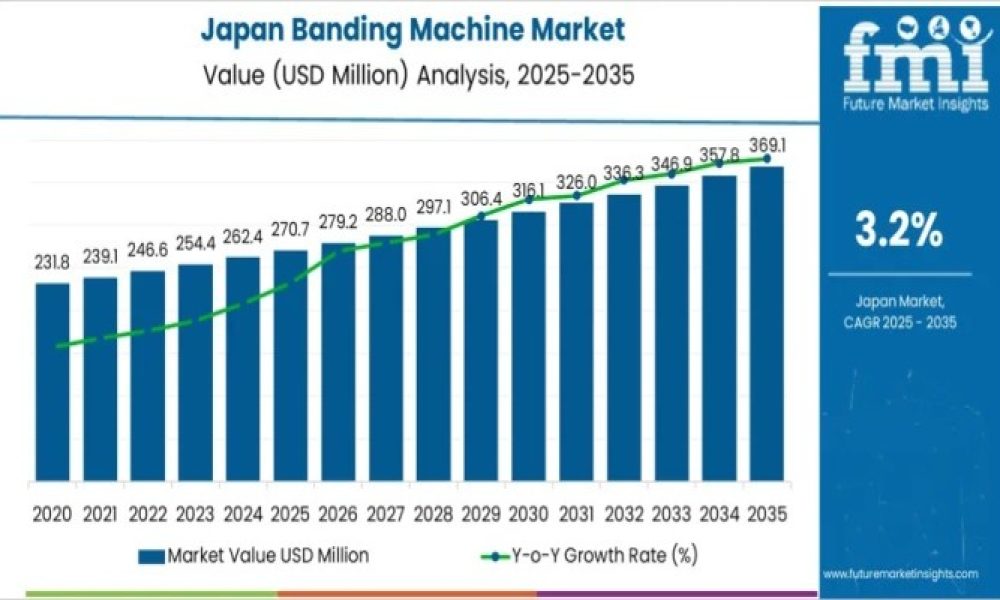
Demand for banding machines in Japan is projected to grow steadily over the next decade as packaging, logistics, food processing, and print-finishing operations continue to modernize. Valued at USD 270.7 million in 2025, the Japan banding machine demand is expected to reach USD 369.1 million by 2035, expanding at a compound annual growth rate (CAGR) of 3.2%.
This measured yet resilient growth reflects Japan’s disciplined approach to capital investment, where automation upgrades are carefully aligned with efficiency gains, labor optimization, and material reduction goals. Banding machines are increasingly favored for their ability to maintain bundle integrity, reduce packaging waste, and deliver cost-efficient unitization across high-volume processing environments.
Discover Market Opportunities – Get Your Sample of Our Industry Overview Today!
Quick Stats: Japan Banding Machine Demand Outlook
- Sales Value (2025): USD 270.7 million
- Forecast Value (2035): USD 369.1 million
- Forecast CAGR (2025–2035): 3.2%
- Leading Operation Type: Automatic banding machines
- Key Growth Regions: Kyushu & Okinawa, Kanto, Kansai
- Major Players: StraPack, Inc., Signode, Transpak, Dynaric, Fromm
Automation Investments Sustain Market Momentum
Demand acceleration is closely tied to automation investment cycles across logistics centers, food packaging plants, and printing facilities. As e-commerce fulfillment volumes rise and just-in-time manufacturing expands, operators are prioritizing equipment that improves throughput while minimizing manual handling.
Banding machines support these objectives by applying controlled tension bands around cartons, trays, printed stacks, and bundled consumer goods—improving handling efficiency without compromising product visibility or labeling accuracy.
Key demand drivers include:
- Rising automation upgrades in distribution and fulfillment centers
- Increased e-commerce parcel movement and unit consolidation
- Material-efficient bundling aligned with sustainability targets
- Integration with conveyors, barcode tracking, and automated labeling
While growth remains steady, periods of deceleration occur when capital spending slows or when existing equipment continues to meet operational requirements. This cyclical pattern reflects Japan’s mature industrial environment rather than structural weakness.
Automatic Banding Machines Dominate by Operation
Automatic banding machines account for 63.0% of total demand, reflecting their alignment with Japan’s productivity standards and labor-optimization strategies. These systems deliver faster cycle times, consistent sealing quality, and reduced operator involvement—key advantages in a high-wage, precision-driven manufacturing landscape.
Operation-wise demand highlights:
- Automatic systems (63.0%)
- Preferred in logistics hubs, food packaging lines, and electronics assembly
- Support lean manufacturing and smart factory integration
- Semi-automatic systems (37.0%)
- Used by SMEs and facilities with varied or low-volume workflows
- Favored where flexibility outweighs maximum throughput
System integration with conveyors, robotics, and inspection platforms remains a decisive purchasing factor.
Optimal Speed Segments Balance Precision and Throughput
Machines operating at 1.0–1.5 seconds per strap hold the largest share at 44.0%, offering a balance between speed, accuracy, and cost. These systems are widely deployed across consumer goods packaging, food products, and parcel handling.
Strapping speed preferences reflect:
- Mid-range speeds supporting mainstream logistics throughput
- Precision prioritized over ultra-high speed for delicate products
- Slower systems retained for specialty or variable packaging
Consistency and reliability remain more critical than maximum speed in Japan’s packaging environment.
E-Commerce Leads End-Use Adoption
By end use, e-commerce represents the largest share at 31.0%, driven by high parcel volumes requiring secure bundling, tamper control, and efficient labeling.
End-use demand distribution:
- E-commerce: 31.0%
- Food & Beverage: 26.0%
- Pharmaceuticals: 18.0%
- Electrical & Electronics: 15.0%
- Household & Small Business: 10.0%
Food manufacturers rely on banding for hygienic, non-damaging bundling of boxed perishables, while pharmaceutical packers value label visibility and traceability support.
Regional Demand Anchored in Industrial Clusters
Regional deployment mirrors Japan’s industrial geography, with Kyushu & Okinawa, Kanto, and Kansai leading due to dense logistics networks and packaging service providers.
Regional CAGR highlights (2025–2035):
- Kyushu & Okinawa: 3.9%
- Kanto: 3.6%
- Kansai: 3.2%
- Chubu: 2.8%
- Tohoku: 2.5%
- Rest of Japan: 2.3%
Kyushu & Okinawa benefit from food processing and coastal logistics, Kanto from e-commerce and print distribution, and Kansai from ready-to-eat food packaging and industrial supply networks.
Sustainability and Smart Integration Shape Market Trends
Sustainability considerations are increasingly influencing equipment selection. Paper banding materials are gaining traction as they align with recycling guidelines and reduce plastic usage without compromising barcode visibility.
Key market trends include:
- Shift toward recyclable paper banding materials
- Integration with vision inspection and quality-control systems
- Compact designs suited for space-constrained facilities
- Reduced maintenance requirements and energy-efficient sealing
Mobile and tabletop banding machines are also expanding adoption among bakeries and prepared-food operators seeking flexibility.
Competitive Landscape Focused on Reliability and Service
The competitive landscape is led by established suppliers emphasizing durability, tension accuracy, and responsive after-sales service.
Key players include:
- StraPack, Inc. – Estimated 28% share, strong regional service networks
- Signode – High-durability automated systems for large facilities
- Transpak – Semi-automatic solutions for SMEs
- Dynaric – Reliable systems for logistics workflows
- Fromm – Industrial bundling and tool compatibility
Competition centers on machine reliability, consumable compatibility, and seamless integration into automated lines.
Why FMI: https://www.futuremarketinsights.com/why-fmi
About Future Market Insights (FMI)
Future Market Insights, Inc. (FMI) is an ESOMAR-certified, ISO 9001:2015 market research and consulting organization, trusted by Fortune 500 clients and global enterprises. With operations in the U.S., UK, India, and Dubai, FMI provides data-backed insights and strategic intelligence across 30+ industries and 1200 markets worldwide.



