
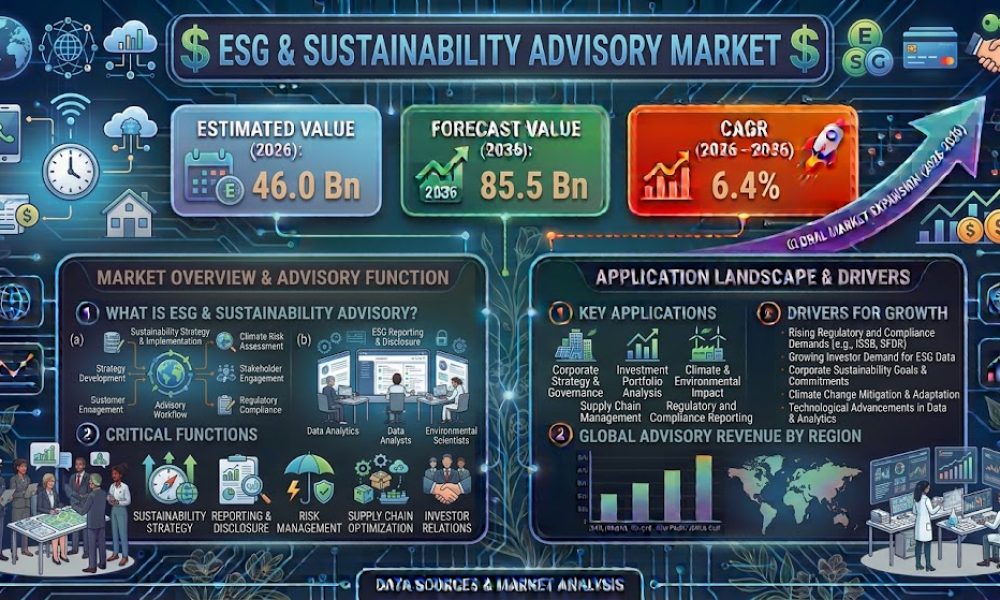
The global ESG & sustainability advisory market is estimated at USD 46.0 billion in 2026 and is projected to reach USD 85.5 billion by 2036, expanding at a 6.4% CAGR from 2026 to 2036. The market crossed USD 43.2 billion in 2025. Companies are increasingly seeking advisory support as sustainability reporting moves toward auditable data, climate-risk assessment, and transition planning.
ESG advisory is becoming more closely connected with finance and operating decisions. Boards need better visibility into climate exposure, while finance and legal teams require consistent information for disclosures and investor questions. Operating teams also need reliable sustainability data to support planning and implementation.
Get Detailed Market Forecasts, Competitive Benchmarking, and Pricing Trends: https://www.factmr.com/connectus/sample?flag=S&rep_id=8061
Global Segment Leaders
- Climate Change & Energy Advisory is projected to hold 38.0% share in 2026. Companies need emissions baselines, transition plans, and climate-related analysis.
- BFSI is expected to account for 31.0% share. Banks and asset managers increasingly use ESG data when assessing lending, investment, and portfolio risks.
- Reporting & Disclosure Support is projected to capture 35.0% share. Companies need help preparing sustainability information for formal reporting and assurance review.
- Climate Risk is anticipated to hold 33.0% share. Boards require clearer evidence of physical and transition exposure when making capital and operating decisions.
- Large Enterprises are expected to account for 48.0% share. Multinational companies face broader reporting obligations and need stronger systems for collecting ESG information.
Country-Level Performance
- United States: The market is projected to expand at a 12.3% CAGR through 2036. Investor scrutiny and state-level climate rules are supporting demand for climate-risk analysis, ESG data governance, and board-level reporting support.
- United Kingdom: Growth is forecast at 10.3% CAGR. Sustainability reporting and transition planning are increasing demand, while the country’s sustainability reporting framework is adding to advisory requirements.
- Germany: The market is expected to register an 8.4% CAGR. CSRD-linked reporting and supply-chain responsibilities are increasing the need for stronger ESG data and industrial sustainability expertise.
- China: Growth is projected at 6.2% CAGR. Export-oriented manufacturers need emissions and supplier data to meet global customer and supply-chain requirements.
- India: The market is forecast to expand at 5.6% CAGR. BRSR-related reporting is strengthening demand for disclosure support, supplier data collection, and climate-risk advisory.
Disclosure Requirements Strengthen Advisory Demand
Disclosure regulation is a major driver for ESG and sustainability advisory services. Companies need support in understanding reporting requirements, building data systems, and preparing sustainability statements for external review.
The European Commission states that the first companies subject to the Corporate Sustainability Reporting Directive (CSRD) apply the rules for the 2024 financial year, with reports published in 2025. This has increased the need for reporting preparation and assurance-readiness support among affected businesses.
Advisory work is also moving beyond reporting. Companies need to connect sustainability targets with capital expenditure, operating changes, and risk management.
Climate Risk Becomes a Board-Level Issue
Climate risk is projected to account for 33.0% of advisory demand in 2026. Companies increasingly need evidence on both physical climate exposure and transition risks linked to policy, technology, and market changes.
Banks and insurers also require scenario analysis and portfolio reviews. For industrial companies, transition planning can connect emissions targets with capital programs and operational decisions.
ESG data governance is another growing requirement. Inconsistent information across business units and suppliers can delay analysis and increase project costs. Advisory firms can help organizations establish clearer data controls and reporting processes.
Supply Chain Reporting Creates New Opportunities
Supply-chain sustainability is becoming an important area for advisory firms. Manufacturers and large enterprises need supplier-level information for value-chain disclosures and purchasing decisions.
Advisors can support data collection across suppliers, identify gaps, and help clients establish processes for sustainability information. This is particularly relevant for companies operating across multiple markets with different reporting requirements.
Transition planning also provides an opportunity. Industrial clients need practical roadmaps that connect emissions-reduction goals with capital spending and operating changes.
Data Quality Remains a Key Challenge
ESG data inconsistency can slow advisory projects. Companies may store information across spreadsheets, local systems, and supplier files, making it difficult to establish a consistent reporting base.
Advisory firms may therefore need to spend significant project time cleaning and validating information before deeper analysis begins. This can increase project costs and extend delivery timelines.
The market also requires sector-specific expertise because ESG risks vary across financial services, energy, manufacturing, transportation, healthcare, and public services.
Competitive Landscape
The ESG and sustainability advisory market includes large consulting organizations, environmental specialists, engineering consultancies, and sustainability-focused firms.
Key companies profiled by Fact.MR include:
- Antea Group
- Arcadis N.V.
- Boston Consulting Group
- ERM
- EY
- Inogen Alliance
Competition is shaped by regulatory knowledge, sector expertise, ESG data capabilities, and implementation support. Large consultancies can pursue board-level strategy mandates, while specialist firms can focus on areas such as climate risk, environmental due diligence, and operational decarbonization.
Analyst Perspective
Shambhu Nath Jha, Senior Analyst at Fact.MR, states:
“ESG advisory demand is shifting from statement writing to operational proof. Companies need advisors that can connect disclosure and transition planning. Firms that combine climate expertise and reporting controls will gain stronger client access.”
About the ESG & Sustainability Advisory Market Report
Fact.MR’s ESG & Sustainability Advisory Market report covers professional services that help organizations assess environmental and governance risks, strengthen ESG reporting, develop climate strategies, manage sustainability data, and plan transitions.
The study analyzes the market by service, end-use industry, delivery model, advisory focus, client type, and region. Services include climate change and energy advisory, environmental impact assessment and sustainable development, environmental management and due diligence, contaminated land, and water and waste management.
The report also covers strategy advisory, reporting and disclosure support, assurance readiness, and implementation support, along with climate risk, ESG data governance, transition planning, and supply-chain sustainability.
The forecast covers 2026 to 2036, with country-level analysis for the United States, United Kingdom, Germany, China, and India.
Explore More Related Studies Published by Fact.MR Research:
Contract Dry Extrusion Services Market
High-Soda Laundry Formulas Market
About Fact.MR
Fact.MR is a global market research and consulting firm, trusted by Fortune 500 companies and emerging businesses for reliable insights and strategic intelligence. With a presence across the U.S., UK, India, and Dubai, we deliver data-driven research and tailored consulting solutions across 30+ industries and 1,000+ markets. Backed by deep expertise and advanced analytics, Fact.MR helps organizations uncover opportunities, reduce risks, and make informed decisions for sustainable growth.



