
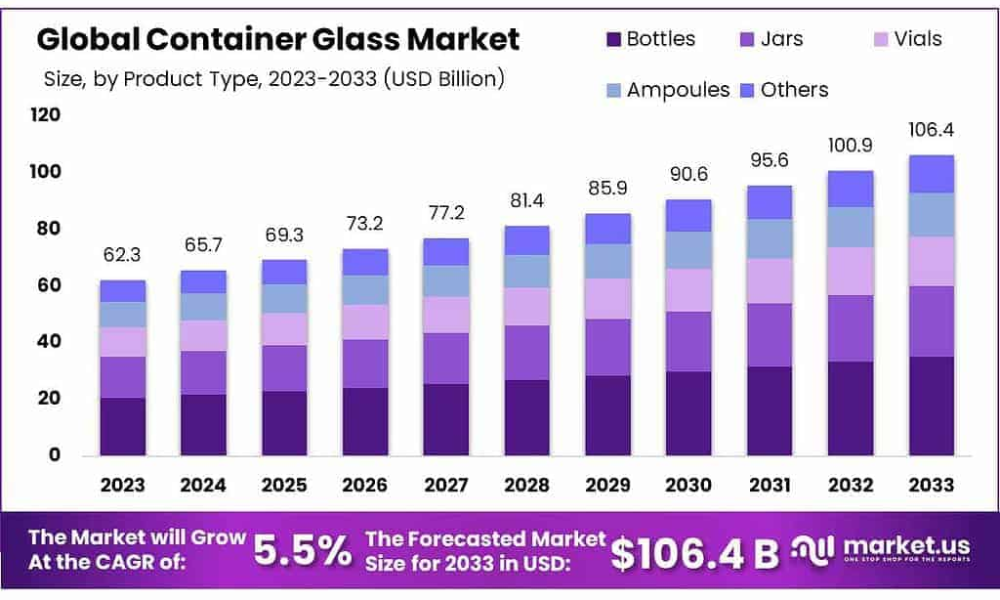
New York, NY – July 03, 2025 – The Container Glass Market is projected to experience substantial expansion in the coming decade, with global demand expected to increase significantly. The Global Container Glass Market size is expected to be worth around USD 106.4 billion by 2033, up from USD 62.3 billion in 2023, growing at a CAGR of 5.5 % during the forecast period from 2024 to 2033.
This rise reflects growing consumer preference for sustainable, reusable, and recyclable packaging solutions, particularly in the beverage, food, cosmetics, and pharmaceutical industries. Driven by heightened environmental awareness, manufacturers and brands are increasingly embracing glass containers to meet regulatory requirements and consumer demand for eco‑friendly options. The market’s popularity is further reinforced by advances in lightweight glass production, enhanced barrier properties, and cost efficiencies achieved through production optimization.
These factors collectively support expanding applications and deeper market penetration across emerging and developed regions. Opportunities for innovation are abundant: the introduction of smart glass packaging, decorative designs, and personalization is anticipated to attract premium segments and foster brand differentiation. Expansion is expected across all key regions, especially in Asia‑Pacific and Latin America, where growing population, rising disposable incomes, and evolving consumption patterns are fueling demand. The combined effect of sustainability trends, technological improvements, and global consumption shifts underpins robust market demand and positions the container glass market for significant long‑term growth.
Important Revelation
- Market Growth: The container glass market is set to hit approximately USD 106.4 billion by 2033, experiencing a notable CAGR of 5.5% from USD 62.3 billion in 2023. This growth is primarily fueled by increased beverage consumption and the surging demand for ampoules, vials, and pharmaceutical products.
- Product Insights: Bottles are the predominant product, claiming over 27% of the market share. Their versatility makes them highly adaptable across industries like beverages, pharmaceuticals, cosmetics, and various liquid-based goods. Glass bottles, due to their eco-friendliness and recyclability, maintain popularity among consumers.
- End-User Analysis: The food and beverage industry stands out as the primary user of container glass, capturing over 28% market share. Glass packaging ensures freshness, flavor, and safety for products, reinforcing consumer trust due to its non-reactive nature, particularly crucial for preserving taste and quality.
- Market Drivers: The surge in sustainable packaging preferences, increased beverage consumption, and the trust placed in glass for preserving product quality act as major drivers. Glass, being highly recyclable and preserving taste, attracts industries seeking reliable packaging solutions.
- Market Restraints: Despite growth, glass faces competition from cheaper alternative materials like plastics and metals. Handling and transportation challenges due to fragility increase logistics costs. Additionally, the energy-intensive manufacturing process raises production expenses.
- Regional Growth: Asia-Pacific leads with a projected 7.3% annual growth, driven by increased online shopping. North America, Europe, South & Central America, and the Middle East & Africa each show varying growth rates attributed to distinct industry demands.
➤ Download Exclusive Sample Of This Premium Report (Including Full TOC, Table & Figures): https://market.us/report/container-glass-market/request-sample/
Report Segmentation
Product Analysis
- In 2023, bottles emerged as the leading product type in the container glass market, accounting for a substantial share of over 27%. Their dominance can be attributed to their widespread use across diverse industries such as beverages, pharmaceuticals, cosmetics, and other liquid-based goods. The inherent versatility and adaptability of glass bottles make them a preferred packaging choice, offering design flexibility in terms of shape, size, and closure options to meet various industry requirements.
- The preference for glass bottles is strongly influenced by their environmental advantages, including high recyclability, which aligns with global sustainability efforts. Their durability and ability to preserve the quality and purity of contents further enhance their appeal, especially in segments like alcoholic drinks, carbonated beverages, and pharmaceutical solutions, where product integrity is essential. Consumer inclination towards glass packaging, often associated with premium quality, has further reinforced the continued demand for bottles in the container glass industry.
End-Use Analysis
- In the same year, the Food & Beverage industry represented the dominant end-use sector in the container glass market, capturing a market share exceeding 28%. This sector extensively utilizes glass containers for packaging a wide array of consumables, including sauces, juices, alcoholic beverages, and preserved foods. The primary reason for this dominance lies in the ability of glass to maintain product freshness, flavor, and safety without interacting chemically with its contents.
- The inert nature of glass ensures that food and beverages retain their original taste and quality throughout the shelf life, which is especially crucial in premium and sensitive product categories. Its transparency also enhances product visibility, contributing to consumer trust and appeal. Furthermore, growing environmental awareness among consumers has amplified the preference for recyclable and non-toxic packaging materials like glass.
- The leading position of the Food & Beverage industry underscores the critical role of the container glass market in maintaining product integrity and aligning with sustainability-driven market dynamics. Its ongoing demand is expected to remain strong, as both manufacturers and consumers continue to favor glass for its safety, environmental benefits, and product-preserving capabilities.
Market Key Segmentation
By Product
- Bottles
- Vials & Ampoules
- Jars
- Other Products
By End-user
- Chemical
- Food & Beverage
- Cosmetics & Personal Care
- Pharmaceutical
- Other End-Users
Regional Analysis
Asia-Pacific: This area is set to grow by 7.3% each year, mainly because more people are shopping online and need more glass packaging. North America: In North America, the glass packaging market will grow by 4.2% every year. This is because food and drink companies there want better glass bottles. Europe’s glass packaging market will grow by 2.8% annually. It’s happening because more companies in healthcare and beauty want glass packages. South and Central America: In these areas, the glass packaging market will grow by 5.6% every year.
That’s because more food and drink companies there need glass bottles. The U.S. has a high beer consumption, which is a key factor in the growth of the container glass market. China is the next largest consumer of beer in the world, with the U.S. being the second. Nearly 14.3% of all global beer consumption is made in the United States. Market growth can also be influenced by a large number of beverage and pharmaceutical companies based in the United States.
Factors Affecting the Growth of the Container Glass Market
1. Rising Beverage Consumption: The growing global consumption of alcoholic drinks, soft beverages, and bottled water is driving demand for glass containers. Glass is valued for its taste preservation and premium image, which supports higher growth in the beverage segment and increases overall demand within the container glass market.
2. Pharmaceutical Packaging Needs: The pharmaceutical industry relies on glass for vials, ampoules, and bottles due to its chemical inertness and ability to preserve sensitive medications, such as vaccines. As global health needs expand, this increased reliance supports consistent market growth.
3. Sustainability and Eco‑Conscious Consumers: Consumers and brands are increasingly rejecting single‑use plastics in favor of fully recyclable and reusable glass packaging. Environmental regulations and rising awareness of sustainability are reinforcing the shift toward glass, thus boosting demand.
4. Advances in Manufacturing Technology: Technological improvements in glass forming, such as lightweight designs and pressure-based molding techniques, are reducing material use and energy consumption. This enhances efficiency, reduces cost, and makes glass more competitive versus alternative packaging.
5. Fragility and Higher Production Cost: Glass is fragile and heavy, increasing costs in production, handling, and shipping. Breakage during transport can lead to inventory losses. Additionally, energy‑intensive molten glass operations increase manufacturing expenses and carbon footprint, impacting market margins.
Competitive Landscape
- Ardagh Group
- Gerresheimar AG
- Borosil
- Schott AG
- Stevanato Group
- Piramal Glass Private Limited
- Corning Incorporated
- Unitrade FZE
- Saverglass SAS
- O-I Glass, Inc.
- Vitro
- Frigoglass SAIC
- Amcor plc
- SGD SA
- Owens-Illinois
- Other Key Players
Get in Touch with Us:
Market.us (Powered By Prudour Pvt. Ltd.)
Address: 420 Lexington Avenue, Suite 300, New York City, NY 10170, United States
Send Email: [email protected]
Refer More Related Reports:
Plant-Based Collagen Market
Offshore Wind Turbine Installation Vessel Market
Cold Brew Coffee Market



